
Presentation
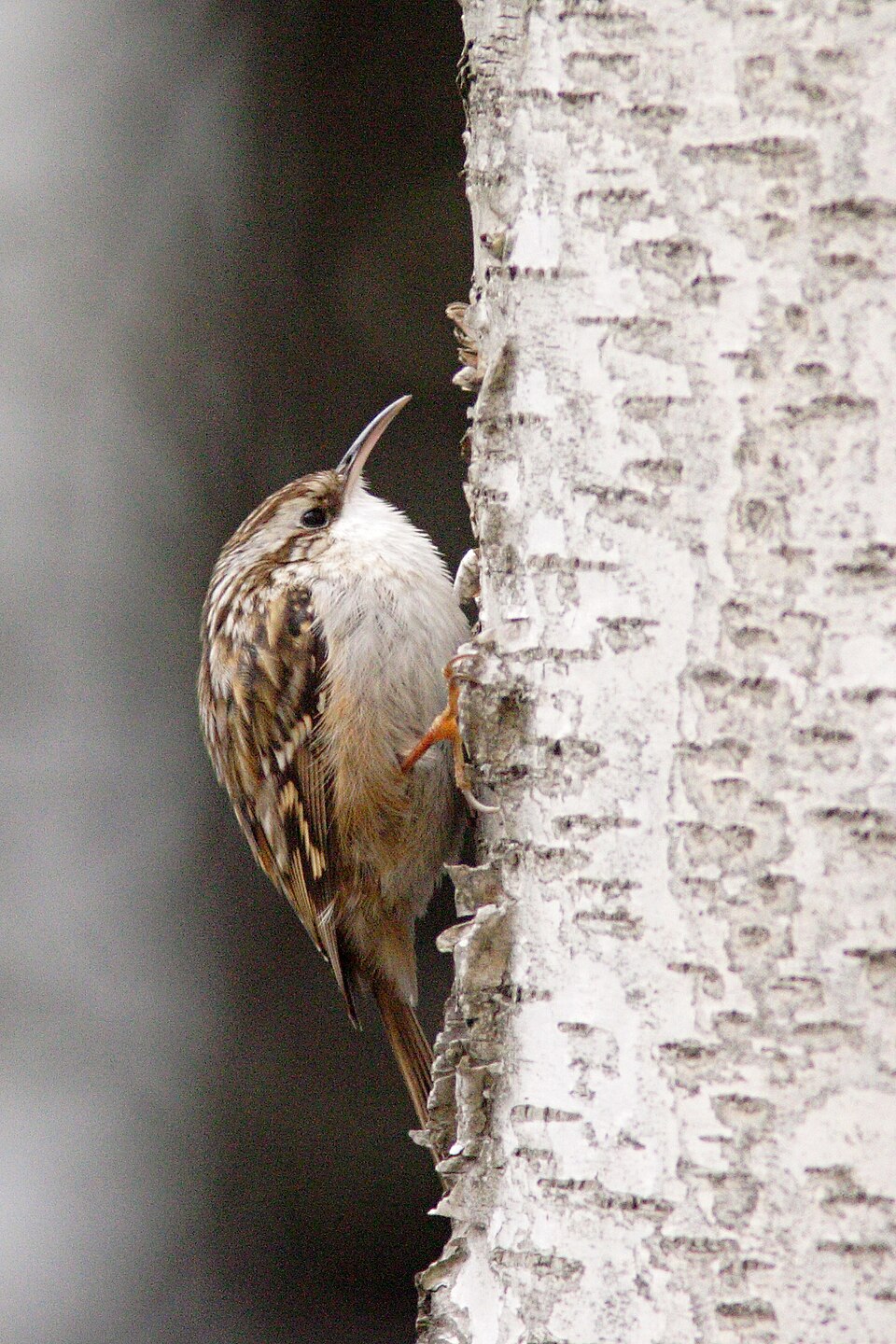
The short-toed treecreeper (Certhia brachydactyla) is a small insectivorous songbird recognised by its fine, curved bill and brown spotted plumage on the back, white underneath. It moves in a spiral pattern along tree trunks, climbing from base to crown, searching for insects hidden beneath the bark. Discreet and well camouflaged, it often goes unnoticed despite being fairly common across Europe and North Africa. Its high-pitched song and slender silhouette help distinguish it from other similar small forest birds.
The treecreeper measures approximately 12 to 13 cm long and is very lightweight. Its fine, curved bill is adapted for capturing insects lodged in bark crevices. Short legs and sharp claws allow it to grip firmly to vertical trunks, while its stiff tail serves as support, like in woodpeckers.
Characteristics
Indicative values: they vary by subspecies, sex and region.
Habitat and distribution
The treecreeper frequents deciduous forests, mixed woodlands, and parks and gardens with mature trees. It particularly favours old trees with rough, fissured bark, which are suitable for feeding and nesting. It is found in lowland areas as well as in wooded mountain regions.
CURRENT RANGE
The species is widespread in western and central Europe and in North Africa, particularly in the Maghreb. In Tunisia, it is present in a localized fashion in the wooded regions of the country's north. Its range remains linked to the presence of mature forest blocks.
Behaviour
This bird is discreet and solitary outside the breeding season. It climbs along trunks in a spiral pattern, moving upwards, then flies to the base of a neighbouring tree to repeat its ascent. Its flight is brief and undulating, rarely sustained over long distances. It is active throughout the day and remains relatively tame but difficult to spot due to its cryptic plumage.
Reproduction
The female builds a discrete nest behind a piece of loose bark or in a trunk crevice, often lined with moss and twigs. She typically lays 5 to 6 eggs per clutch, one or two times a year depending on the region. Incubation lasts about two weeks, and the young leave the nest after fifteen to sixteen days of parental care.
Peculiarities
Its spiral climbing technique around tree trunks is a unique adaptation among small European songbirds. Its vibrant song and slender silhouette make it difficult to mistake for another species once identified, despite its camouflage. It shares ecological convergence with woodpeckers, although it belongs to a different order.
Threats and conservation
The species is not globally threatened, benefiting from a stable population across Europe. The loss of old trees and intensive forest management can locally reduce available nesting sites. In Tunisia, the fragmentation of natural forests in the north represents a potential pressure on its local populations.
Numbers and trends vary across sources and regions. See the IUCN assessment for the latest reference data.
Gallery
1 documented photographs.
References
Profile updated 05 September 2026 · Reviewed by the TunisieVet editorial team.
Comments (0)
No comments yet.
CONSERVATION STATUS
Least concern (LC)
IUCN source, latest published assessment.
Species health
Documented diseases for this species.
This information is provided for educational purposes only and is not a substitute for a veterinary consultation. If you have any concerns about your animal's health, consult a veterinarian.
Similar animals
Other species documented in Animalpedia.

TunisieVet in your pocket 📱🐾 Access your veterinary services wherever you are. [ Download the app ]
Learn more