Presentation
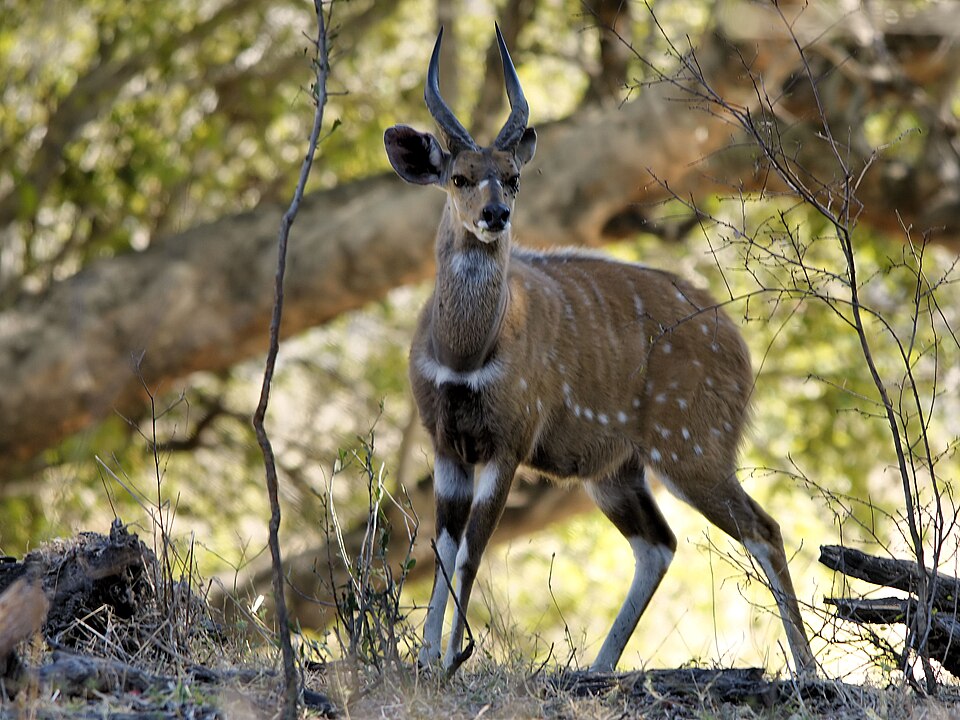
The bushbuck is a medium-sized antelope native to sub-Saharan Africa, recognizable by its reddish-brown coat marked with stripes and white spots that resemble a harness. Males carry spiral-twisted horns, which females lack. Discreet and rather solitary, it frequents wooded edges and scrubby areas near water sources. Its coat varies considerably by subspecies and region, providing effective camouflage in dense vegetation. It is one of the most widespread and well-studied antelopes on the African continent.
The body is sturdy, supported by relatively short legs, with a line of raised hair along the spine. The coat ranges from light brown to dark brown depending on the population, always decorated with white vertical stripes and spots on the flanks and hindquarters. Only males display spiral horns that can reach 50 cm in length.
Characteristics
Indicative values: they vary by subspecies, sex and region.
Habitat and distribution
The bushbuck prefers gallery forests, dense thickets, and wooded savannas close to water. It avoids open habitats, choosing areas with substantial plant cover for concealment. It is found in both lowland and moderately elevated terrain.
CURRENT RANGE
The species is widely distributed throughout sub-Saharan Africa, from Senegal to East Africa and southern Africa. It is absent from North Africa and is not found in Tunisia. Several subspecies are recognized according to region.
Behaviour
Essentially solitary and crepuscular to nocturnal, it moves cautiously while staying close to vegetation cover. When surprised, it freezes then bolts suddenly with erratic bounds to confuse the predator. Males defend a territory but tolerate overlap with multiple females.
Reproduction
The female gives birth after a gestation of approximately six to seven months, typically producing a single fawn per litter. The fawn remains hidden in dense vegetation during the first few weeks to avoid predators. Sexual maturity is reached at around one year of age.
Peculiarities
Its alarm call, a hoarse bark, is often used by other savanna animals as a danger signal. The pattern of white stripes and spots is unique to each individual, much like a fingerprint.
Threats and conservation
Subsistence hunting and habitat loss due to agricultural expansion are the main local threats. However, the species remains widely distributed and adapts relatively well to habitats modified by human activity.
Numbers and trends vary across sources and regions. See the IUCN assessment for the latest reference data.
Gallery
1 documented photographs.
References
Profile updated 03 September 2026 · Reviewed by the TunisieVet editorial team.
Comments (0)
No comments yet.
CONSERVATION STATUS
Least concern (LC)
IUCN source, latest published assessment.
Species health
Documented diseases for this species.
This information is provided for educational purposes only and is not a substitute for a veterinary consultation. If you have any concerns about your animal's health, consult a veterinarian.
Similar animals
Other species documented in Animalpedia.

Be among the first to use our app. Sign up and get early Google Play access.
Discover