
Presentation
The Hermann's tortoise (Testudo hermanni) is a small Mediterranean land turtle, recognizable by its rounded yellow and black shell. It frequents wooded and bushy areas around the Mediterranean, where it leads a diurnal and discreet life. A herbivorous species, it plays a role in the dispersal of the seeds of the plants it consumes. Long collected from the wild for the pet trade, it now benefits from legal protection in several countries. In Tunisia, it is present in certain northern regions and is the subject of conservation measures. Its slow growth and late maturity make it vulnerable to habitat disturbance.
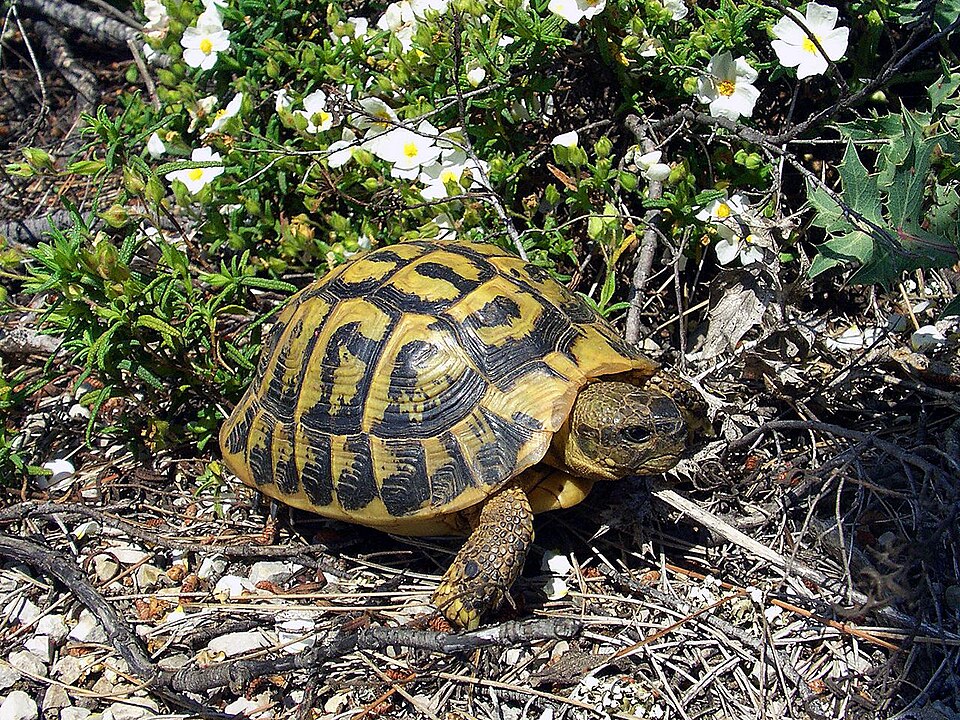
The domed carapace has a pattern of yellow and black plates that varies depending on the individual. The species generally measures between 15 and 20 cm as adults. The tail ends with a characteristic horny nail, more developed in the male. The sturdy, scaly legs are adapted to walking on dry, rocky ground.
Characteristics
Indicative values: they vary by subspecies, sex and region.
Habitat and distribution
The species frequents scrubland, maquis, light forests and scrubby areas with Mediterranean vegetation. It appreciates land well exposed to the sun, with soft soil allowing it to dig shelters. It avoids areas that are too humid or too densely wooded.
CURRENT RANGE
Hermann's tortoise is present around the Mediterranean basin, particularly in Southern Europe (Spain, France, Italy, Balkans) and in North Africa. In Tunisia, it is found in certain forest and bushy areas in the north of the country. Its populations are fragmented and declining in several regions.
Behaviour
This turtle is active especially in the morning and late afternoon, taking refuge in the shade during hot hours. It hibernates during the cold months by burying itself in leaf litter or soft soil. Solitary most of the year, it moves slowly over a restricted territory that it knows well. Males can be combative with each other during the breeding season.
Reproduction
Mating takes place in spring, preceded by displays where the male bites and pushes the female. It lays one to three clutches per season, each containing two to five eggs buried in a hole dug in the ground. Incubation lasts between two and three months depending on ambient temperature. The young are completely independent from the moment they hatch and receive no parental care.
Peculiarities
The horny nail at the end of the tail distinguishes this species from other closely related Mediterranean tortoises. Its significant longevity contrasts with its very slow growth. She can remain motionless for long periods of time, blending into her surroundings.
Threats and conservation
The destruction and fragmentation of its habitat by urbanization and agriculture strongly threaten the species. Forest and scrubland fires destroy entire populations. Illegal collection for the pet trade remains a significant pressure despite legal protections.
Numbers and trends vary across sources and regions. See the IUCN assessment for the latest reference data.
Gallery
1 documented photographs.
References
Profile updated 01 September 2026 · Reviewed by the TunisieVet editorial team.
Comments (0)
No comments yet.
CONSERVATION STATUS
Near threatened (NT)
IUCN source, latest published assessment.
Species health
Documented diseases for this species.
This information is provided for educational purposes only and is not a substitute for a veterinary consultation. If you have any concerns about your animal's health, consult a veterinarian.
To discover around: Hermann's tortoise
Videos, facts, stories and records linked to this species.
Similar animals
Other species documented in Animalpedia.

TunisieVet in your pocket 📱🐾 Access your veterinary services wherever you are. [ Download the app ]
Learn more