Presentation
The horseshoe crab is a marine arthropod often called a horseshoe crab because of its smooth, rounded shell. It is not a crustacean but a chelicerate, more closely related to spiders than to crabs. It has inhabited coastal seafloors for more than 400 million years, and its appearance has changed very little since then. Its blue blood, rich in hemocyanin, has properties used in biomedicine to detect bacterial contamination. It lives mainly on the Atlantic coasts of North America and Asia.
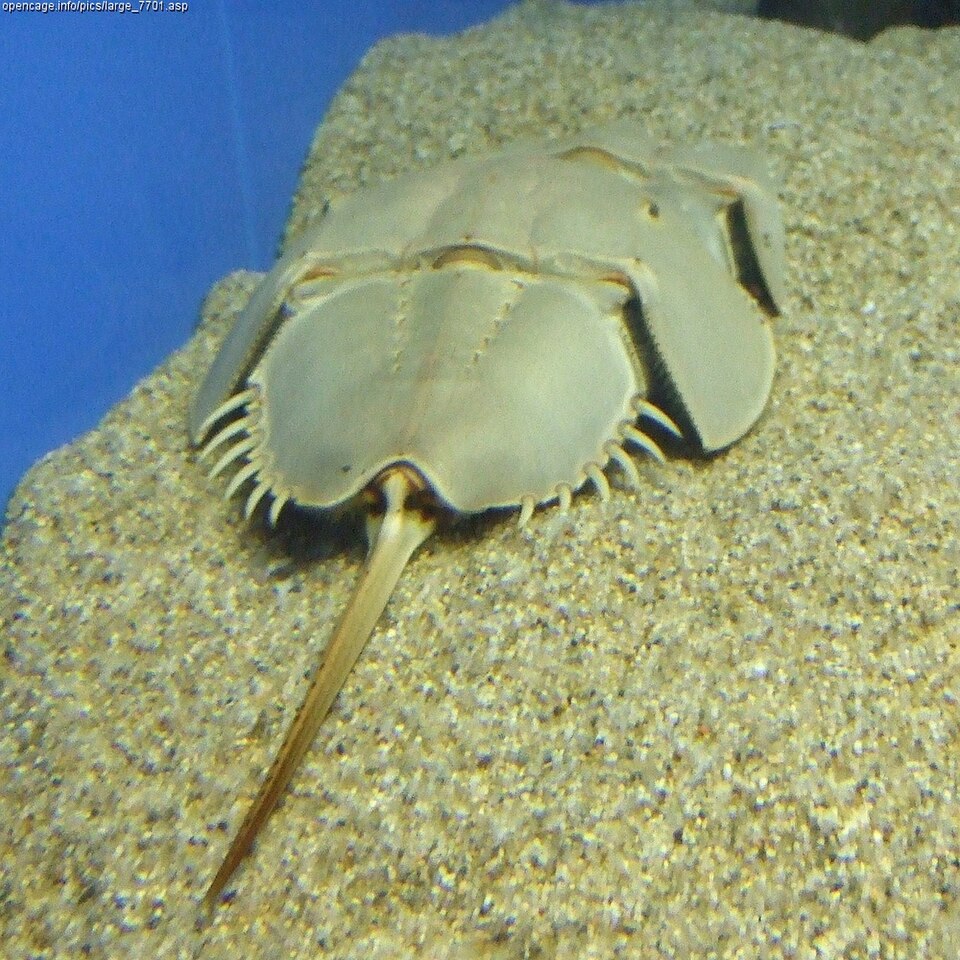
The horseshoe crab's body consists of a horseshoe-shaped cephalothoracic shell, a segmented abdomen, and a long, pointed tail spine. It has several pairs of eyes, including two lateral compound eyes, as well as locomotor legs positioned beneath the shell. Its coloring ranges from brown-green to dark brown depending on age and environment.
Characteristics
Indicative values: they vary by subspecies, sex and region.
Habitat and distribution
The horseshoe crab lives in shallow coastal waters, estuaries, and intertidal zones with sandy or muddy substrates. It favors sheltered shorelines where it can burrow easily into the seafloor. Juveniles tend to remain in the areas closest to the shore, while adults move into slightly deeper waters.
CURRENT RANGE
The horseshoe crab is found along the Atlantic coast of North America, from Maine to Mexico, as well as off the coasts of Southeast Asia, notably in India, China, and Japan for other species of the same group. It is absent from the coasts of Tunisia and the Mediterranean in general. No natural populations are recorded in Africa or Europe.
Behaviour
The horseshoe crab is primarily a nocturnal and benthic animal, moving slowly across sandy or muddy seafloors. It partially burrows into sand to protect itself from predators and temperature changes. During breeding season, large gatherings form on beaches, particularly during spring tides.
Reproduction
Reproduction occurs on beaches, where females dig nests in the sand to deposit their eggs. Males, which are smaller, cling to females using specialized claws to fertilize the eggs during spawning. A single female can lay several thousand eggs per season, but only a tiny fraction of the larvae reach adulthood.
Peculiarities
The horseshoe crab's blue blood, which contains copper, is used in medicine to manufacture tests that detect bacterial endotoxins in pharmaceutical products. This species is sometimes called a "living fossil" because its body shape has changed very little since the Paleozoic era. It also has a remarkable ability to regenerate its limbs and shell after molting.
Threats and conservation
Overharvesting for the biomedical industry and collection for bait threatens certain populations, particularly along the east coast of the United States. Degradation of coastal habitats and loss of spawning beaches due to urbanization are also contributing to its decline. Climate change and rising sea levels pose additional threats to its breeding sites.
Numbers and trends vary across sources and regions. See the IUCN assessment for the latest reference data.
Gallery
1 documented photographs.
References
Profile updated 28 August 2026 · Reviewed by the TunisieVet editorial team.
Comments (0)
No comments yet.
CONSERVATION STATUS
Vulnerable (VU)
IUCN source, latest published assessment.
Species health
Documented diseases for this species.
This information is provided for educational purposes only and is not a substitute for a veterinary consultation. If you have any concerns about your animal's health, consult a veterinarian.
Similar animals
Other species documented in Animalpedia.

📱 عندك صفحة على فايسبوك؟ باهي… أما وين موقعك؟ الصفحة وحدها ما تكفيش. موقعك يخلي الناس تلقاك، يعرفوك أكثر ويثقو في خدمتك. 🌐 موقع باسم مشروعك 📲 يخدم أربعة وعشرين ساعة 🤝 يعطي ثقة واحترافية .📈 يعاونك تكبّر خدمتك خلّيه موجود وين الناس تلوّج عليه 🚀نعملولك موقع يشرّف مشروعك
WhatsApp