
Presentation
The Humpback whale (Megaptera novaeangliae) is a large baleen cetacean belonging to the family Balaenopteridae. It is present in all the world's oceans, carrying out seasonal migrations between cold waters rich in food and warm waters suitable for reproduction. Recognizable by its long pectoral fins and its spectacular leaps out of the water, it is one of the most studied and observed species of whale. Its song, long and structured, constitutes one of the most complex animal vocalizations known. Once harshly hunted, the species has largely recovered since the ban on commercial hunting. It can occasionally be observed off the Tunisian coast, particularly in the Mediterranean, although these sightings remain rare.
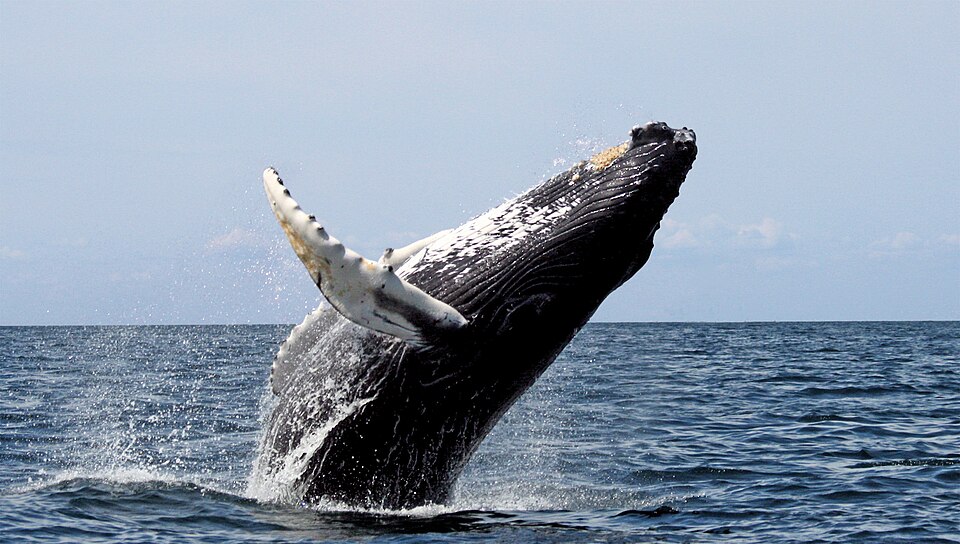
The Humpback whale is distinguished by its massive body, its large head decorated with tubercles and its very long pectoral fins which can reach a third of its total length. Its coat is generally black or dark gray on the back, with variable white markings on the belly and fins, specific to each individual. It has a characteristic hump in front of the dorsal fin, which gives it its common name. Its caudal fin, with its unique patterns, allows the individual identification of animals by researchers.
Characteristics
Indicative values: they vary by subspecies, sex and region.
Habitat and distribution
The Humpback whale mainly frequents coastal and offshore ocean waters, both cold and tropical depending on the season. It favors areas close to the coast for reproduction and birthing, offering calmer and protected waters. During feeding periods, they congregate in nutrient-rich areas, often near continental shelves.
CURRENT RANGE
The species is present in all the world's oceans, from polar regions to tropical areas. Populations move between high-latitude feeding areas (Arctic, Antarctic, Atlantic and North Pacific) and warm-water breeding areas near the equator. Occasional sightings have been reported in the Mediterranean, including off the coast of Tunisia, although this sea does not constitute a regular habitat for the species.
Behaviour
Humpback whale is migratory, traveling long distances each year between polar or temperate feeding zones and tropical breeding zones. It is renowned for its complex songs, emitted mainly by males during the breeding season, and for its spectacular aerial behaviors such as jumping out of the water. It lives alone or in small unstable groups, except during cooperative hunting where several individuals form a “bubble net” to capture their prey. The species is not aggressive towards humans and is the subject of significant tourist observation in several regions of the world.
Reproduction
The female gives birth to a single calf after a gestation of around 11 months, usually in warm tropical waters where she migrates specifically for giving birth. The little one, measuring around 4 to 5 meters at birth, is breastfed for around a year before weaning. Females reproduce on average every 2 to 3 years.
Peculiarities
The male's song, which can last several tens of minutes and be repeated for hours, is considered one of the most elaborate vocalizations in the animal kingdom. Its long pectoral fins, the largest in proportion to body size in all cetaceans, give it great maneuverability. The bubble net hunting technique illustrates a rare form of social cooperation among marine mammals.
Threats and conservation
Current major threats include ship strikes, entanglement in fishing gear, and underwater noise pollution that disrupts communication. Commercial hunting, once responsible for massive population declines, is now banned in most countries. Climate change, which affects the distribution of krill and small fish, represents an emerging threat to its feeding grounds.
Numbers and trends vary across sources and regions. See the IUCN assessment for the latest reference data.
Gallery
1 documented photographs.
References
Profile updated 27 August 2026 · Reviewed by the TunisieVet editorial team.
Comments (0)
No comments yet.
CONSERVATION STATUS
Least concern (LC)
IUCN source, latest published assessment.
Species health
Documented diseases for this species.
See the 8 diseases of this species Find a veterinarianThis information is provided for educational purposes only and is not a substitute for a veterinary consultation. If you have any concerns about your animal's health, consult a veterinarian.
To discover around: Humpback whale
Videos, facts, stories and records linked to this species.
RECORD
up to 5 m in length
The longest pectoral fins in the animal kingdom
Measured in adults, these pectoral fins represent about a third of the total body length,...
Similar animals
Other species documented in Animalpedia.

TunisieVet in your pocket 📱🐾 Access your veterinary services wherever you are. [ Download the app ]
Learn more