
Presentation
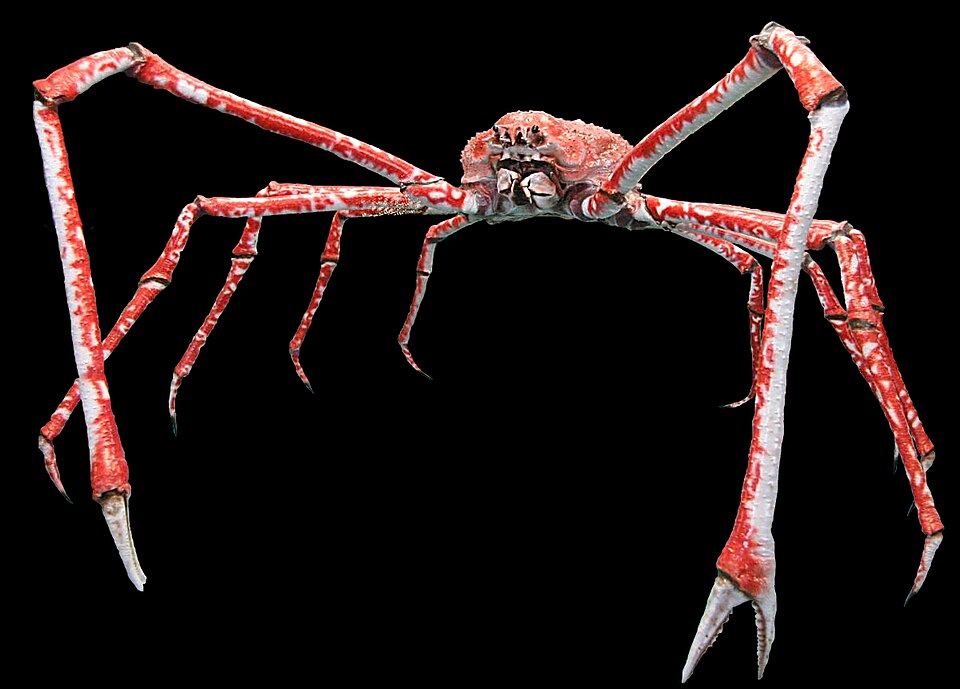
The Japanese spider crab is a marine crustacean renowned for its exceptional leg span, the largest known among present-day arthropods. Its relatively modest body contrasts with its disproportionately long and slender legs, which give it its common name. It inhabits the deep, cold waters of the Pacific Ocean off the coast of Japan. Its bumpy carapace and orange coloration marked with white spots allow it to blend in with rocky seabeds. This species fascinates both scientists and the general public in aquariums where it is sometimes exhibited. Its growth is slow and its lifespan can exceed several decades.
The body can measure up to 40 cm wide while the leg span reaches more than 3 metres. The carapace is covered with blunt tubercles and displays an orange hue with white marbling. The legs are slender, articulated, and disproportionate to the body, providing considerable reach for exploring the seafloor.
Characteristics
Indicative values: they vary by subspecies, sex and region.
Habitat and distribution
The species inhabits rocky and sandy seafloors at depths ranging from 50 to over 500 meters. Adults are found chiefly in deep, cool waters, while juveniles sometimes occupy more coastal zones. It tolerates a fairly wide range of depths depending on the season and breeding cycles.
CURRENT RANGE
The Japanese spider crab is endemic to waters surrounding the Japanese archipelago, particularly in the Pacific Ocean off Honshu. It is found mainly in Suruga Bay and surrounding waters. Its distribution remains limited to this region of the northwestern Pacific.
Behaviour
It is a solitary and slow-moving animal, active mainly at dusk and during the night. It moves cautiously over rocky seabeds thanks to its long legs, which provide good stability. When threatened, it tends to freeze or camouflage itself rather than flee quickly; its size and robust carapace protect it from many predators.
Reproduction
Breeding occurs mainly in winter, when individuals migrate toward shallower waters to mate. The female then carries thousands of eggs beneath her abdomen until they hatch. The planktonic larvae drift with the currents before gradually metamorphosing into benthic juveniles.
Peculiarities
Its lifespan is estimated to exceed 50 years in some cases, making it one of the longest-lived crustaceans known. The species molts regularly throughout its life—a risky process during which it is especially vulnerable. It is also valued in certain countries as a delicacy despite its imposing size.
Threats and conservation
Targeted commercial fishing, particularly for consumption in Japan, represents the primary pressure on populations. Its slow growth rate and maturation make it vulnerable to overharvesting. Management measures and regulated fishing seasons exist in some Japanese zones.
Numbers and trends vary across sources and regions. See the IUCN assessment for the latest reference data.
Gallery
1 documented photographs.
References
Profile updated 06 September 2026 · Reviewed by the TunisieVet editorial team.
Comments (0)
No comments yet.
CONSERVATION STATUS
Data deficient (DD)
IUCN source, latest published assessment.
Species health
Documented diseases for this species.
This information is provided for educational purposes only and is not a substitute for a veterinary consultation. If you have any concerns about your animal's health, consult a veterinarian.
To discover around: Japanese spider crab
Videos, facts, stories and records linked to this species.
RECORD
up to 3.7 m leg span
The largest living arthropod by wingspan
Measurement taken between the tips of the outstretched legs in the largest specimens captu...
Similar animals
Other species documented in Animalpedia.

TunisieVet in your pocket 📱🐾 Access your veterinary services wherever you are. [ Download the app ]
Learn more