
Presentation
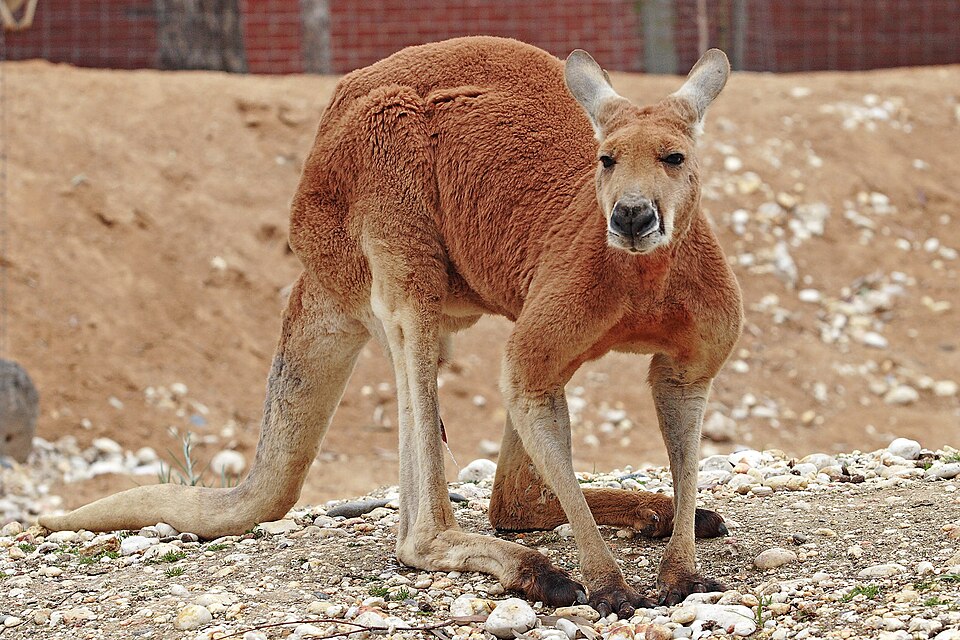
Red kangaroo is the largest living marsupial and one of the largest marsupials ever known. Featuring distinctive reddish fur, it is perfectly adapted to Australia's arid and semi-arid environments. It is an iconic animal representing the unique fauna of the Australian continent.
The Red kangaroo has a distinctive morphology with highly developed hind legs, a muscular and powerful tail serving as a balancer and fifth limb, and short and poorly developed front legs. Males generally display a more intense reddish coloration than females, which may exhibit gray or brown tints.
Did you know?
How does the baby kangaroo reach its mother's pouch?
Characteristics
Indicative values: they vary by subspecies, sex and region.
Habitat and distribution
The Red kangaroo inhabits desert and steppe areas of central and eastern Australia. It prefers semi-arid environments with scattered herbaceous vegetation, where it can move freely. Unlike many other kangaroos, it is more tolerant of the hottest, driest areas of the continent.
CURRENT RANGE
Red kangaroo is found exclusively in Australia, mainly in the central and eastern interior regions of the continent. Its range covers a large region encompassing areas of New South Wales, Queensland, the Northern Territory and South Australia. The species is not present in Tunisia.
Behaviour
The Red kangaroo is a mainly crepuscular and nocturnal animal, particularly active during the cool hours of the day. It moves in spectacular leaps of up to 8 to 10 meters in length, making it one of the fastest land animals. It generally lives in groups called “mobs” which can bring together several dozen individuals.
Reproduction
Red kangaroo has a reproductive system characteristic of marsupials, with a very short gestation of around 30 days. The young, called joey, are born very developed and complete their growth in the mother's marsupial pouch for 5 to 6 months. The female can become pregnant shortly after the birth of the first young.
Peculiarities
One of the most remarkable features of the Red kangaroo is its unique locomotion technique: above a certain speed, hopping (jumping) becomes more energy efficient than ordinary walking, allowing it to reach speeds of 60 km/h. Its tail plays a crucial role in its balance and can support its weight when standing still, forming a sort of natural tripod.
Threats and conservation
The Red kangaroo currently faces no major threats. The species has a stable and well-established population in Australia, and is not considered threatened with extinction. Its conservation status remains favorable.
Numbers and trends vary across sources and regions. See the IUCN assessment for the latest reference data.
Gallery
1 documented photographs.
References
UICN — Liste rouge des espèces menacées
Profile updated 29 August 2026 · Reviewed by the TunisieVet editorial team.
Comments (0)
No comments yet.
CONSERVATION STATUS
Least concern (LC)
IUCN source, latest published assessment.
Species health
Documented diseases for this species.
This information is provided for educational purposes only and is not a substitute for a veterinary consultation. If you have any concerns about your animal's health, consult a veterinarian.
Related species
To discover around: Red kangaroo
Videos, facts, stories and records linked to this species.
Similar animals
Other species documented in Animalpedia.

TunisieVet in your pocket 📱🐾 Access your veterinary services wherever you are. [ Download the app ]
Learn more