
Presentation
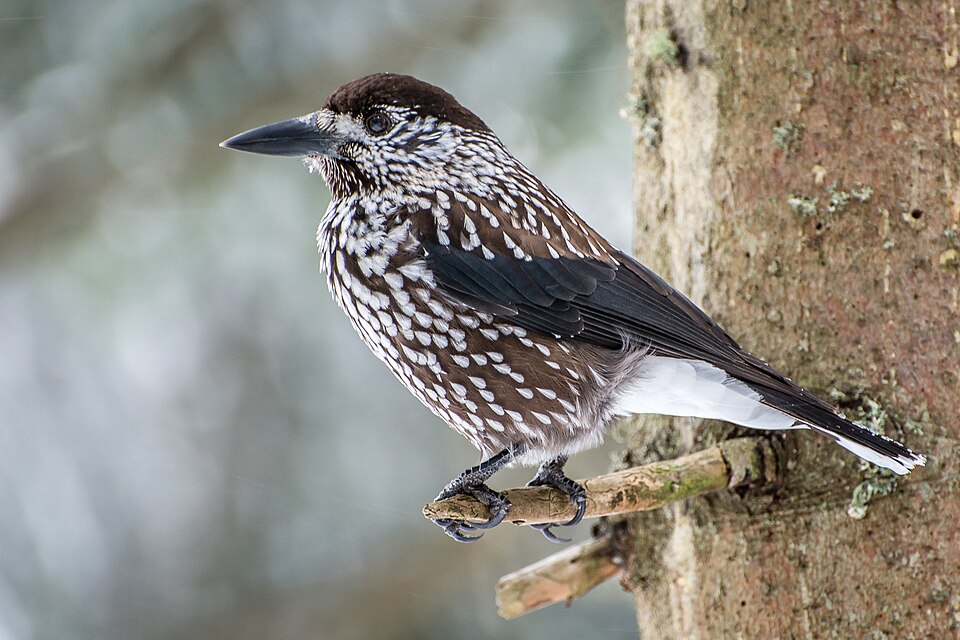
The spotted nutcracker (Nucifraga caryocatactes) is a passerine bird in the crow family, recognized by its chocolate-brown plumage speckled with white. It inhabits coniferous forests across Europe and Asia, where it maintains a close relationship with seed-bearing pines. Its robust, pointed beak allows it to extract seeds from cones. This bird is famous for its exceptional spatial memory, capable of relocating thousands of food caches buried under snow. It plays an important ecological role in dispersing seeds of certain mountain pine species.
The spotted nutcracker measures approximately 32 to 35 cm in length with a wingspan of 49 to 53 cm. Its dark brown plumage is scattered with white spots across the body, except on the crown. It has a long, straight, and powerful beak suited for extracting conifer seeds. Its tail is short and tipped with white, visible in flight.
Characteristics
Indicative values: they vary by subspecies, sex and region.
Habitat and distribution
The nutcracker favors montane coniferous forests, particularly stands of Swiss stone pine, spruce, and larch. It is typically found at high elevation, between 1000 and 2500 meters depending on the region. It avoids areas lacking seed-bearing conifers. Its habitat is closely linked to the availability of conifer cones.
CURRENT RANGE
The species is found in the mountain ranges of Europe, notably the Alps, the Carpathians, and certain Scandinavian regions, as well as in the vast boreal forests of Asia extending to Japan. It is absent from North Africa and Tunisia. Its distribution follows that of seed-bearing coniferous forests.
Behaviour
The spotted nutcracker is a solitary bird or lives in pairs, except during periods of abundant food availability. It possesses a remarkable spatial memory that allows it to relocate its seed caches even beneath a thick layer of snow. Its behavior is territorial around nesting and storage areas. It is generally unafraid of humans in frequented mountain regions.
Reproduction
The female typically lays 3 to 4 eggs in late winter, often in March, taking advantage of seed reserves she has accumulated. The nest is built in a coniferous tree at a good height, sheltered from wind and predators. Incubation lasts approximately 18 days and is carried out mainly by the female. Young birds leave the nest after three to four weeks but remain dependent on their parents for several additional weeks.
Peculiarities
The nutcracker can remember the location of several thousand food caches spread across vast territories. This exceptional cognitive ability makes it a model for studying the neuroscience of spatial memory. Its association with Swiss stone pine is so close that the tree depends in part on the bird for seed dispersal.
Threats and conservation
Deforestation and climate change affecting montane forests represent the primary threats to the species. Reduction in stands of seed-bearing pines can locally affect populations. The species remains widely distributed overall and is not subject to major conservation concerns.
Numbers and trends vary across sources and regions. See the IUCN assessment for the latest reference data.
Gallery
1 documented photographs.
References
Profile updated 04 September 2026 · Reviewed by the TunisieVet editorial team.
Comments (0)
No comments yet.
CONSERVATION STATUS
Least concern (LC)
IUCN source, latest published assessment.
Species health
Documented diseases for this species.
This information is provided for educational purposes only and is not a substitute for a veterinary consultation. If you have any concerns about your animal's health, consult a veterinarian.
Similar animals
Other species documented in Animalpedia.

TunisieVet in your pocket 📱🐾 Access your veterinary services wherever you are. [ Download the app ]
Learn more