
Presentation
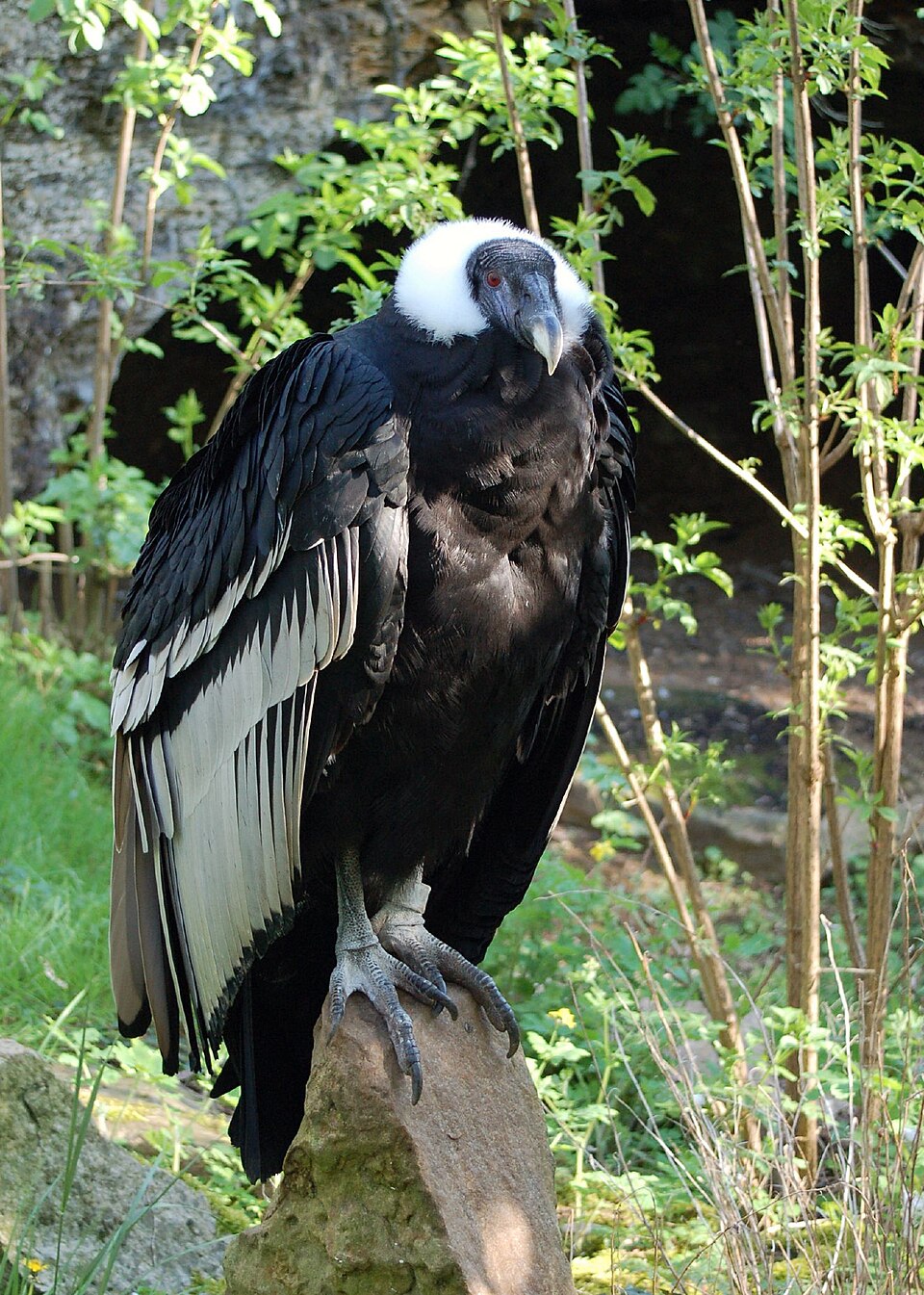
The Andean Condor is one of the largest flying birds in the world, recognizable by its black plumage adorned with a white ruff and its reddish bald head. This large vulture soars long distances by exploiting the updrafts of the Andean mountains. An exclusive scavenger, it plays an essential health role in the ecosystems it frequents. His exceptional stature and longevity make him an emblematic figure of South American culture. The species is threatened by human activities, including poisoning and hunting. It is the subject of conservation programs in several Andean countries.
The Andean Condor has predominantly black plumage with large white patches on the wings in adult males. Its head and neck are featherless, exposing grayish to reddish skin that varies depending on the bird's emotional state. The male has a fleshy crest called a caruncle, which is absent in the female. Its claws are poorly suited to grasping live prey, unlike other raptors.
Characteristics
Indicative values: they vary by subspecies, sex and region.
Habitat and distribution
The Andean Condor frequents the high altitudes of the Andes, where it nests on inaccessible rocky cliffs. It also exploits steppe and open grassland areas at lower altitudes to forage. It sometimes ventures to the Pacific coasts to feed on stranded marine carcasses.
CURRENT RANGE
The species is distributed along the Andes chain, from Venezuela and Colombia in the north to Tierra del Fuego in the south. The largest populations today are found in Chile, Argentina and Bolivia. It has disappeared from certain parts of its historical range, notably in Venezuela where it is extremely rare.
Behaviour
The Andean Condor is an essentially solitary bird or lives in small groups, particularly around common feeding and resting sites. It spends much of the day gliding effortlessly on thermal currents, thus conserving its energy. It establishes social hierarchies around carcasses, where the dominant ones eat first. It is a diurnal animal that roosts at night on steep cliffs that are difficult to access.
Reproduction
The Andean Condor reaches sexual maturity late, around the age of six to eight years. Pairs are monogamous and reproduce every two years, with the female generally laying a single egg on the ground or in a rocky crevice. Incubation lasts about two months and both parents participate in raising the young. The chick remains dependent on its parents for almost a year after fledging.
Peculiarities
The Andean Condor has one of the largest wingspans among current flying birds. It can fly for hours without flapping its wings, letting itself be carried by warm air currents. It is also one of the longest-lived birds, with some captive individuals having exceeded seventy years.
Threats and conservation
The main threats to the Andean Condor are secondary poisoning, when it consumes carcasses contaminated with pesticides or intended to eliminate other predators, as well as illegal hunting. The degradation of its habitat and the reduction in populations of large wild herbivores are also reducing its food resources. Its low reproductive capacity makes populations very vulnerable to these pressures.
Numbers and trends vary across sources and regions. See the IUCN assessment for the latest reference data.
Gallery
1 documented photographs.
References
Profile updated 03 September 2026 · Reviewed by the TunisieVet editorial team.
Comments (0)
No comments yet.
CONSERVATION STATUS
Vulnerable (VU)
IUCN source, latest published assessment.
Species health
Documented diseases for this species.
See the 6 diseases of this species Find a veterinarianThis information is provided for educational purposes only and is not a substitute for a veterinary consultation. If you have any concerns about your animal's health, consult a veterinarian.
To discover around: Condor
Videos, facts, stories and records linked to this species.
RECORD
up to 3.3m
Largest wingspan among terrestrial raptors
Measurement of maximum wing span recorded in wild adult males.
Similar animals
Other species documented in Animalpedia.

TunisieVet in your pocket 📱🐾 Access your veterinary services wherever you are. [ Download the app ]
Learn more