
Presentation
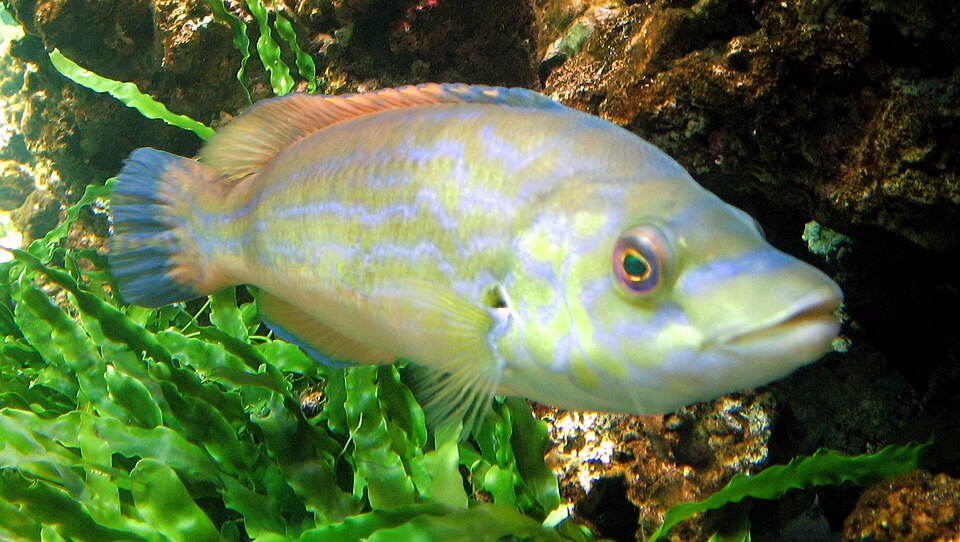
The Wrasse is a marine fish belonging to the Labridae family, very widespread in the Mediterranean and in the Atlantic near the coasts. It is characterized by an elongated body, often bright colors and a great diversity of species with varied habits. This fish generally lives near rocky bottoms, seagrass beds and reefs where it finds shelter and food. It plays an important ecological role by regulating certain populations of benthic invertebrates. In Tunisia, several species of Wrasses are commonly observed by divers and fished locally. Its flesh is appreciated in certain Mediterranean culinary preparations.
Wrasse has a laterally compressed body, covered with large cycloid scales. Its mouth is protractile, equipped with fleshy lips and prominent teeth adapted to capturing hard prey. Coloration varies greatly depending on species and sex, ranging from green to red through variegated patterns. Some species change sex during their life, going from female to male.
Characteristics
Indicative values: they vary by subspecies, sex and region.
Habitat and distribution
The Wrasse frequents rocky bottoms, Posidonia beds and shallow coastal reefs. It likes areas rich in crevices offering refuge from predators. It is found from the surface to several tens of meters deep depending on the species. Some species also tolerate slightly brackish waters near coastal lagoons.
CURRENT RANGE
Wrasse is widely distributed in the Mediterranean and the Eastern Atlantic, from the European coasts to the North African coasts. It is present all along the Tunisian coast, particularly around islands and rocky areas. Some closely related species also exist in other temperate and tropical seas around the world. Its distribution strongly depends on the nature of the coastal substrate.
Behaviour
The Wrasse is a diurnal fish, active during the day and inactive at night, during which time it sometimes burrows into the sand or takes refuge between rocks. It is generally territorial and defends a specific area of its habitat. Some species live in small hierarchical groups dominated by a male. It shows curious behavior towards divers and can approach areas frequented by humans.
Reproduction
Wrasse reproduces by laying eggs in open water, with external fertilization. Many species are protogynous hermaphrodites, with females capable of transforming into dominant males. The eggs are pelagic and drift with the current until the larvae hatch. The breeding season depends on water temperature and generally occurs in spring and summer.
Peculiarities
Wrasse is known for its protogynous hermaphroditism, a trait shared by many species in the family. Some species sleep by secreting a protective cocoon of mucus at night. Others practice symbiotic cleansing, ridding other fish of external parasites. Its diversity of colors makes it a popular fish among divers and marine aquarists.
Threats and conservation
Local overfishing and degradation of coastal rocky habitats threaten some Wrasses populations. Marine pollution and the destruction of Posidonia meadows are reducing its refuge and reproduction areas. Climate change also affects the distribution of some temperature-sensitive species. Overall, however, most species remain common and not very threatened.
Numbers and trends vary across sources and regions. See the IUCN assessment for the latest reference data.
Gallery
1 documented photographs.
References
Profile updated 31 August 2026 · Reviewed by the TunisieVet editorial team.
Comments (0)
No comments yet.
CONSERVATION STATUS
Least concern (LC)
IUCN source, latest published assessment.
Species health
Documented diseases for this species.
Find a veterinarianThis information is provided for educational purposes only and is not a substitute for a veterinary consultation. If you have any concerns about your animal's health, consult a veterinarian.
Similar animals
Other species documented in Animalpedia.

TunisieVet in your pocket 📱🐾 Access your veterinary services wherever you are. [ Download the app ]
Learn more