
Presentation
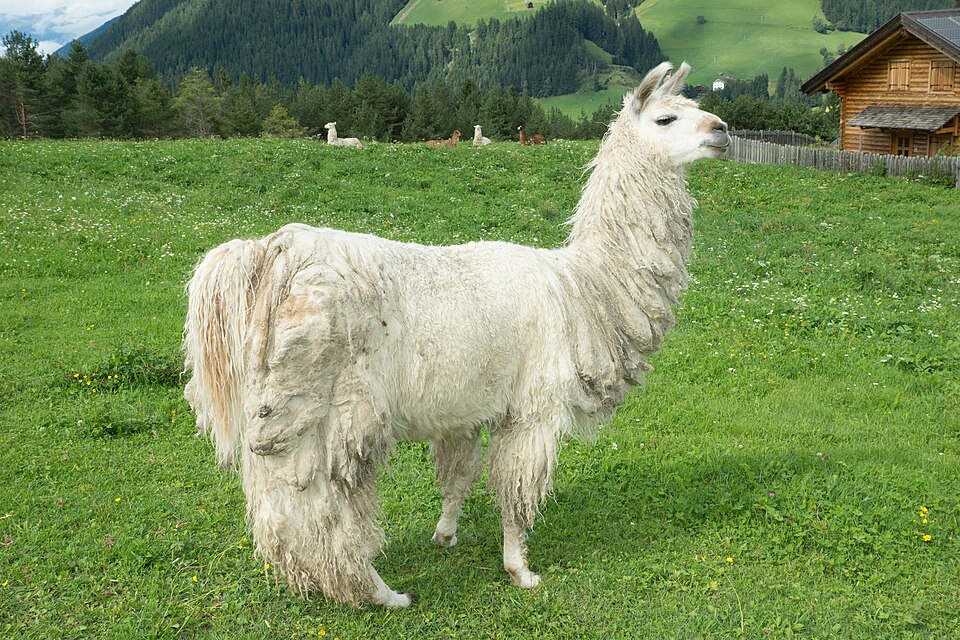
The Lama (Lama gLama) is a large South American camelid domesticated for millennia by Andean peoples. It is mainly raised for carrying loads, its wool and sometimes its meat. Robust and adapted to difficult terrain, it is a traditional pack animal in the Andes. Its slender silhouette, long neck and large movable ears easily distinguish it from other camelids. Today, it is also bred outside South America as a pet or hobby animal.
The Lama has a body covered in a thick woolly fleece, thin legs and a long flexible neck. Its ears are long and curved, and its upper lip is split. It does not have a hump unlike the camel or dromedary.
Characteristics
Indicative values: they vary by subspecies, sex and region.
Habitat and distribution
In its native range, the Lama is raised mainly in the highlands and mountainous areas of the Andes. It adapts well to cold, dry climates as well as rugged terrain. Outside of South America, it is raised on farms and meadows in varied climates.
CURRENT RANGE
Lama is native to the Andean regions of South America, including Peru, Bolivia, Chile, and Argentina. It was later introduced to many countries around the world for breeding and recreation. Its presence outside South America remains linked to domestic breeding.
Behaviour
The Lama is a social animal that lives in hierarchical herds. It communicates by vocalizations, postures and sometimes by spitting when it feels threatened or in competition with a conspecific. Docile towards humans when well socialized, he can nevertheless be wary of strangers.
Reproduction
The Lama female carries her young for approximately 11 to 12 months before giving birth to a single young, called a cria. Reproduction generally takes place during the day, which would limit the risks for the newborn in its original natural environment. Weaning occurs after several months, and sexual maturity is reached around 2 to 3 years of age.
Peculiarities
Lama is known for spitting when expressing displeasure, a behavior often misinterpreted by the public. It can carry loads representing a significant proportion of its own weight over long distances in the mountains. Contrary to popular belief, it does not have a bump.
Threats and conservation
As a domestic species, the Lama is not threatened with extinction. The main risks for reared individuals concern parasitic diseases and extreme climatic conditions in the event of poor breeding management. Its global population is stable thanks to continuous breeding.
Numbers and trends vary across sources and regions. See the IUCN assessment for the latest reference data.
Gallery
1 documented photographs.
References
Profile updated 20 August 2026 · Reviewed by the TunisieVet editorial team.
Comments (0)
No comments yet.
CONSERVATION STATUS
Least concern (LC)
IUCN source, latest published assessment.
Species health
Documented diseases for this species.
See the 8 diseases of this species Find a veterinarianThis information is provided for educational purposes only and is not a substitute for a veterinary consultation. If you have any concerns about your animal's health, consult a veterinarian.
To discover around: Lama
Videos, facts, stories and records linked to this species.
Similar animals
Other species documented in Animalpedia.

TunisieVet in your pocket 📱🐾 Access your veterinary services wherever you are. [ Download the app ]
Learn more