
Presentation
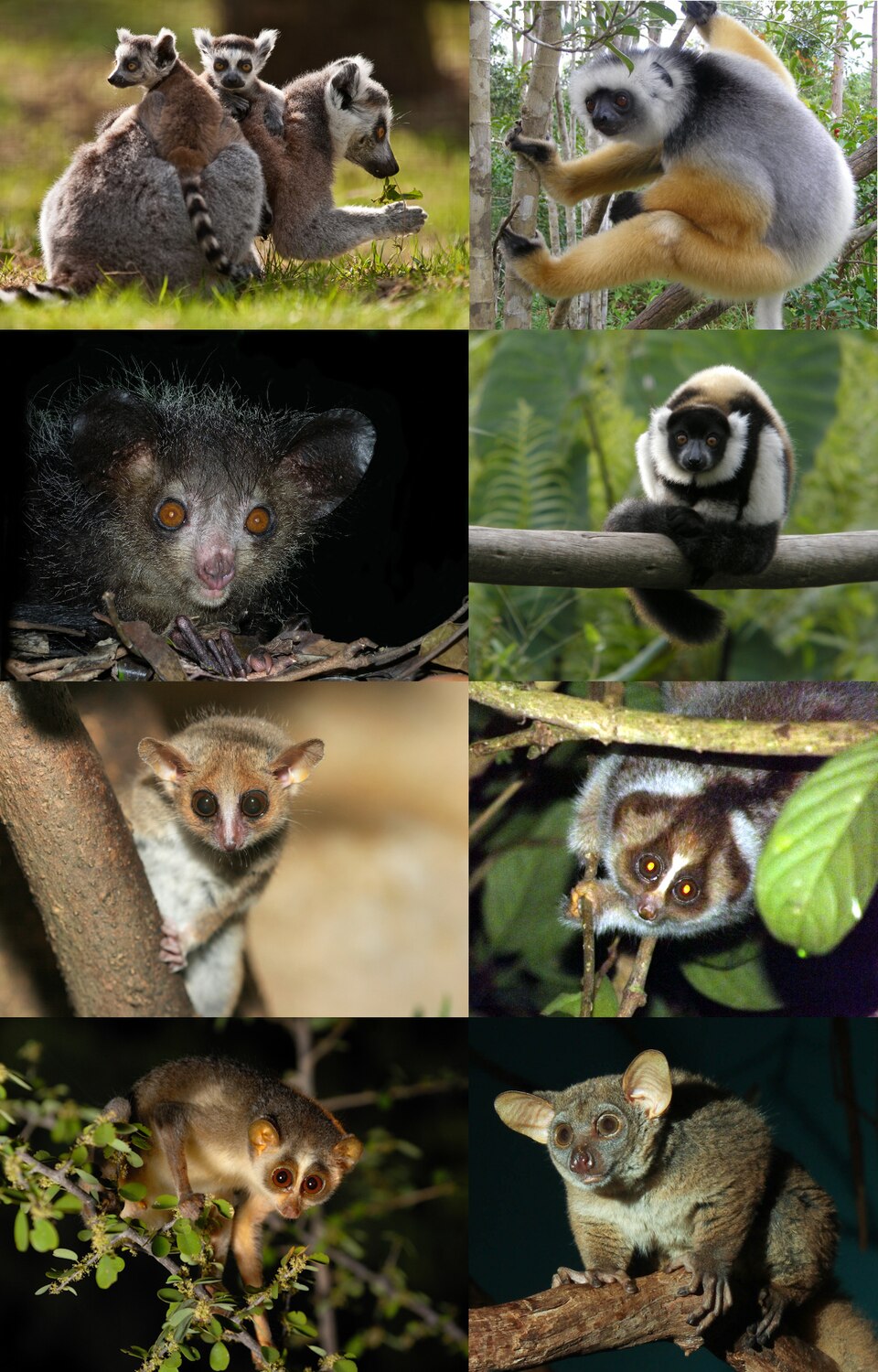
The Lemurs form a group of primitive primates (Strepsirrhines) endemic to Madagascar and some neighboring islands of the Comoros. This term actually refers to more than a hundred different species, ranging from tiny mouse lemurs measuring a few centimeters to the indri, the largest living Lemur. Isolated on Madagascar for millions of years, they have evolved independently of other primates and occupy a wide diversity of ecological niches. Their diversity and exceptional endemism make them an emblematic group for conservation, the majority of species being today threatened by deforestation. They are mostly arboreal, although some species such as the ring-tailed lemur spend significant time on the ground.
Lemurs feature elongated fox-like snouts, large, often reflective eyes adapted for night vision, and hands with grooming claws on some fingers. Their brains are proportionally smaller than those of monkeys. Size varies enormously between species, from tiny mouse lemurs to large indris.
Characteristics
Indicative values: they vary by subspecies, sex and region.
Habitat and distribution
Most Lemurs live in the tropical rainforests or dry deciduous forests of Madagascar. Some species have adapted to the semi-desert thorny forests of the south of the island. The arboreal layer constitutes their main habitat, although some terrestrial species such as the ring-tailed lemur also frequent open rocky areas.
CURRENT RANGE
Lemurs are exclusively endemic to Madagascar, with the exception of a few populations introduced on the Comoros Islands. Their distribution covers different types of forests on the island, from the humid eastern forests to the dry, thorny forests of the southwest. Each species generally occupies a restricted geographical area, which accentuates their vulnerability to deforestation.
Behaviour
Lemurs are mostly diurnal or cathemeral depending on the species, although some are strictly nocturnal. They live in structured social groups, often dominated by females, and communicate through vocalizations, scent markings and facial expressions. Mutual grooming strengthens social bonds within the group. Some species, such as the ring-tailed lemur, engage in “scent fights” between rival males.
Reproduction
Breeding is seasonal in most species, with a gestation of approximately 4 to 5 months depending on size. Females generally give birth to a single young, sometimes two, which they carry attached to their stomach and then to their back. Weaning occurs after several months, and sexual maturity is reached between 1.5 and 3 years depending on the species.
Peculiarities
Lemurs are only found naturally on the island of Madagascar, the result of unique evolutionary isolation over 60 million years. The aye-aye has a thin, elongated third finger unique among primates, used as a percussion and extraction tool. The ring-tailed lemur is recognizable by its long black and white ringed tail which it cannot grasp.
Threats and conservation
Deforestation linked to slash-and-burn agriculture constitutes the main threat to all Lemurs species. Hunting for bushmeat and the illegal trade in exotic pets are further exacerbating their decline. Lemurs are among the most threatened groups of mammals in the world, with a large proportion of species classified as critically endangered or endangered.
Numbers and trends vary across sources and regions. See the IUCN assessment for the latest reference data.
Gallery
1 documented photographs.
References
Profile updated 26 August 2026 · Reviewed by the TunisieVet editorial team.
Comments (0)
No comments yet.
CONSERVATION STATUS
Critically endangered (CR)
IUCN source, latest published assessment.
Species health
Documented diseases for this species.
This information is provided for educational purposes only and is not a substitute for a veterinary consultation. If you have any concerns about your animal's health, consult a veterinarian.
To discover around: Lemur
Videos, facts, stories and records linked to this species.
Similar animals
Other species documented in Animalpedia.
