
Presentation
The Gray wolf is a large wild carnivore belonging to the Canidae family. It is the ancestor of the domestic dog and one of the largest terrestrial predators on the Eurasian and North American continent. A highly social animal, it lives and hunts in packs organized according to a well-defined hierarchy.
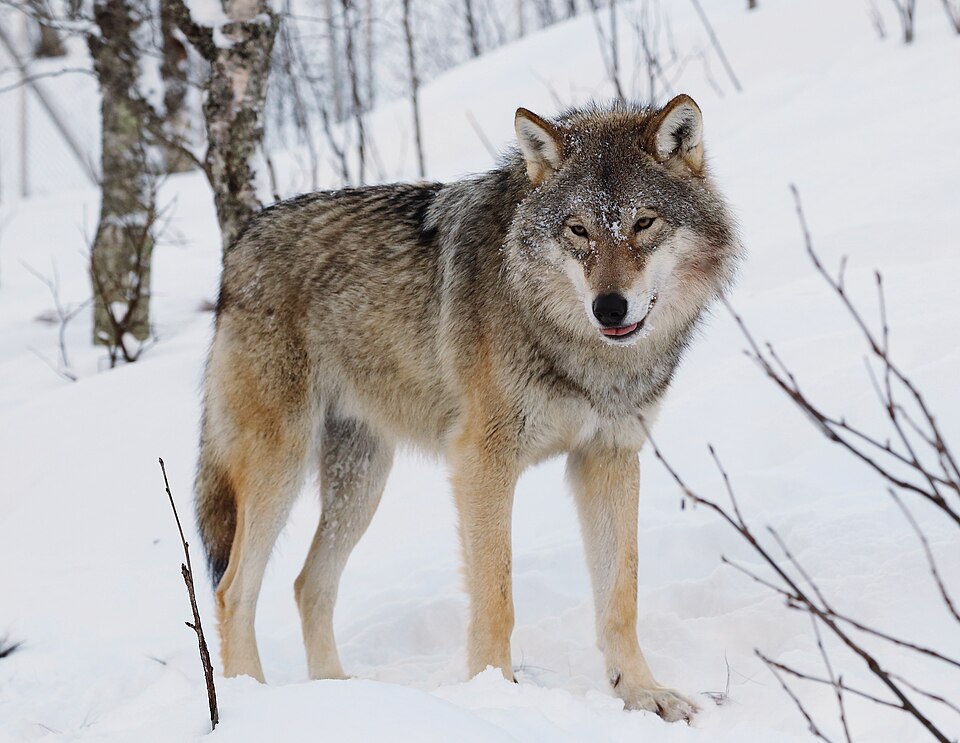
The Gray wolf has a thick, shaggy coat that is gray, brown or black depending on the region. Its ears are erect and triangular, its eyes are amber to yellow, and its legs are long and muscular suitable for running. Its robust body structure and powerful jaw make it perfectly adapted to predation.
Did you know?
Why do wolves howl?
Characteristics
Indicative values: they vary by subspecies, sex and region.
Habitat and distribution
The Gray wolf adapts to many habitats: deciduous and coniferous forests, mountains, steppes, tundra and semi-deserts. It prefers regions with low human density and an abundance of wild prey. Its territory is very vast: a pack generally occupies between 50 and 200 km² depending on the availability of food resources.
CURRENT RANGE
Gray wolf is present in the northern hemisphere, particularly in Eurasia (Northern Europe, Russia, Central Asia) and North America. Its historical range was much wider, but human persecution has confined it to remote areas. Absent from Tunisia, the species only exists in protected areas away from large human concentrations.
Behaviour
The Gray wolf is a very social animal, organizing its life in packs of 4 to 10 individuals on average. The pack follows a hierarchical order led by a dominant breeding pair. Wolves communicate through howls, yips and body positions. They are active especially at dawn and dusk, traveling several dozen kilometers daily to hunt.
Reproduction
The Gray wolf breeds once a year. Mating takes place mainly in winter (January to March). After a gestation of approximately 63 days, the female gives birth to 4 to 6 cubs on average. The young remain in a den for the first few weeks, breastfed by the mother and cared for by other members of the pack. They become independent around the age of two to three years.
Peculiarities
The howl of the wolf is a social adaptation allowing group cohesion and the demarcation of the territory. Capable of traveling 40 km in a single night, the wolf has remarkable endurance. Its high intelligence and social learning allow it to pass on hunting strategies between generations. The Gray wolf is considered the direct ancestor of the domestic dog, domestication occurring approximately 15,000 to 40,000 years ago.
Threats and conservation
Although classified as “Least Concern” by the IUCN, the Gray wolf still faces threats. Direct human persecution (hunting, poisoning) remains the main cause of mortality. Habitat destruction, the scarcity of wild prey and conflicts with livestock farming threaten its populations. The fragmentation of its distribution area limits genetic exchanges between isolated populations.
Numbers and trends vary across sources and regions. See the IUCN assessment for the latest reference data.
Gallery
1 documented photographs.
References
UICN — Liste rouge des espèces menacées
Profile updated 30 August 2026 · Reviewed by the TunisieVet editorial team.
Comments (0)
No comments yet.
CONSERVATION STATUS
Least concern (LC)
IUCN source, latest published assessment.
Species health
Documented diseases for this species.
See the 4 diseases of this species Find a veterinarianThis information is provided for educational purposes only and is not a substitute for a veterinary consultation. If you have any concerns about your animal's health, consult a veterinarian.
Related species
To discover around: Gray wolf
Videos, facts, stories and records linked to this species.
Similar animals
Other species documented in Animalpedia.

TunisieVet in your pocket 📱🐾 Access your veterinary services wherever you are. [ Download the app ]
Learn more