
Presentation
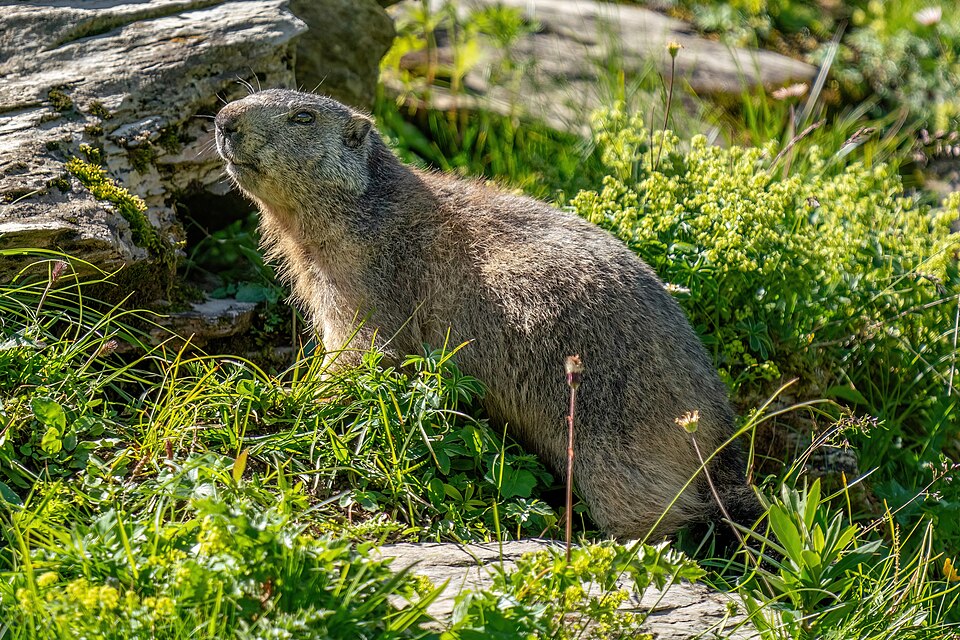
Marmot is a large burrowing rodent living in colonies in high altitude grasslands and rocky areas. Its stocky body, short, clawed legs and dense fur adapt it to a cold climate and an underground lifestyle. It is renowned for its whistled alarm call, which warns the colony of the presence of a predator. Active mainly during the day, it spends the winter in deep hibernation in its burrow. It is an emblematic animal of the mountainous massifs of Europe, often observed near hiking trails.
The Marmot measures between 40 and 60 cm in length, tail not included, for a weight that varies greatly depending on the season. Its gray-brown to reddish coat provides good camouflage among rocks and grass. It has long, continuously growing incisors, typical of rodents, as well as powerful claws adapted to digging burrows.
Did you know?
Why do some animals hibernate?
Characteristics
Indicative values: they vary by subspecies, sex and region.
Habitat and distribution
Marmot occupies alpine meadows, high altitude pastures and rocky areas of mountain ranges. It digs complex burrows in sufficiently deep soil, near grassy areas for feeding. It avoids dense forests and favors open environments offering good visibility against predators.
CURRENT RANGE
The species is present mainly in the mountainous massifs of Europe, notably the Alps, the Pyrenees and certain chains of central Europe where it has been reintroduced. Other species close to Marmots exist in North America and Asia. It is completely absent from North Africa and has no natural population in Tunisia.
Behaviour
The Marmot is a social animal living in family colonies structured around a system of shared burrows. It communicates by high-pitched whistles serving as a collective alarm against predators such as eagles or foxes. It spends a large part of the year, often more than six months, in hibernation, significantly slowing down its metabolism and body temperature.
Reproduction
Mating takes place after hibernation, in spring. After a gestation of about a month, the female gives birth to two to seven young in the family burrow. The young remain dependent for several weeks and reach sexual maturity around two to three years.
Peculiarities
The Marmot hibernates in groups in a burrow blocked from the inside, a strategy that limits collective heat loss. Its whistled alarm call is recognizable and differs depending on the nature of the perceived threat. It can lose up to a third of its body weight during hibernation.
Threats and conservation
Populations of Marmots are generally stable and are not considered threatened. Locally, they can suffer from the degradation of high-altitude pastures, climate change affecting the duration of hibernation, or increased predation by certain raptors and canids. Supervised hunting exists in certain regions but remains regulated.
Numbers and trends vary across sources and regions. See the IUCN assessment for the latest reference data.
Gallery
1 documented photographs.
References
Profile updated 21 August 2026 · Reviewed by the TunisieVet editorial team.
Comments (0)
No comments yet.
CONSERVATION STATUS
Least concern (LC)
IUCN source, latest published assessment.
Species health
Documented diseases for this species.
See the 8 diseases of this species Find a veterinarianThis information is provided for educational purposes only and is not a substitute for a veterinary consultation. If you have any concerns about your animal's health, consult a veterinarian.
To discover around: Marmot
Videos, facts, stories and records linked to this species.
Similar animals
Other species documented in Animalpedia.

TunisieVet in your pocket 📱🐾 Access your veterinary services wherever you are. [ Download the app ]
Learn more