
Presentation
The Common ostrich is the largest living bird today. Incapable of flying, it compensates with exceptional terrestrial locomotion, reaching speeds of 70 km/h. Its massive body, long muscular legs and long neck make it a fascinating and easily recognizable animal.
The male's plumage is black, while females and juveniles display grayish-brown plumage. The head and neck, partially bare, have reddish or bluish skin depending on the population. The vestigial wings are not used for flight but for thermal regulation and courtship. The legs, devoid of feathers, are robust with only two toes.
Did you know?
Do ostriches really stick their heads in the sand?
Characteristics
Indicative values: they vary by subspecies, sex and region.
Habitat and distribution
The Ostrich frequents arid and semi-arid open environments: deserts, savannahs and steppes of Africa. It appreciates areas where vegetation is sparse and prefers flat land, adapting remarkably to conditions of extreme drought and prolonged absence of water.
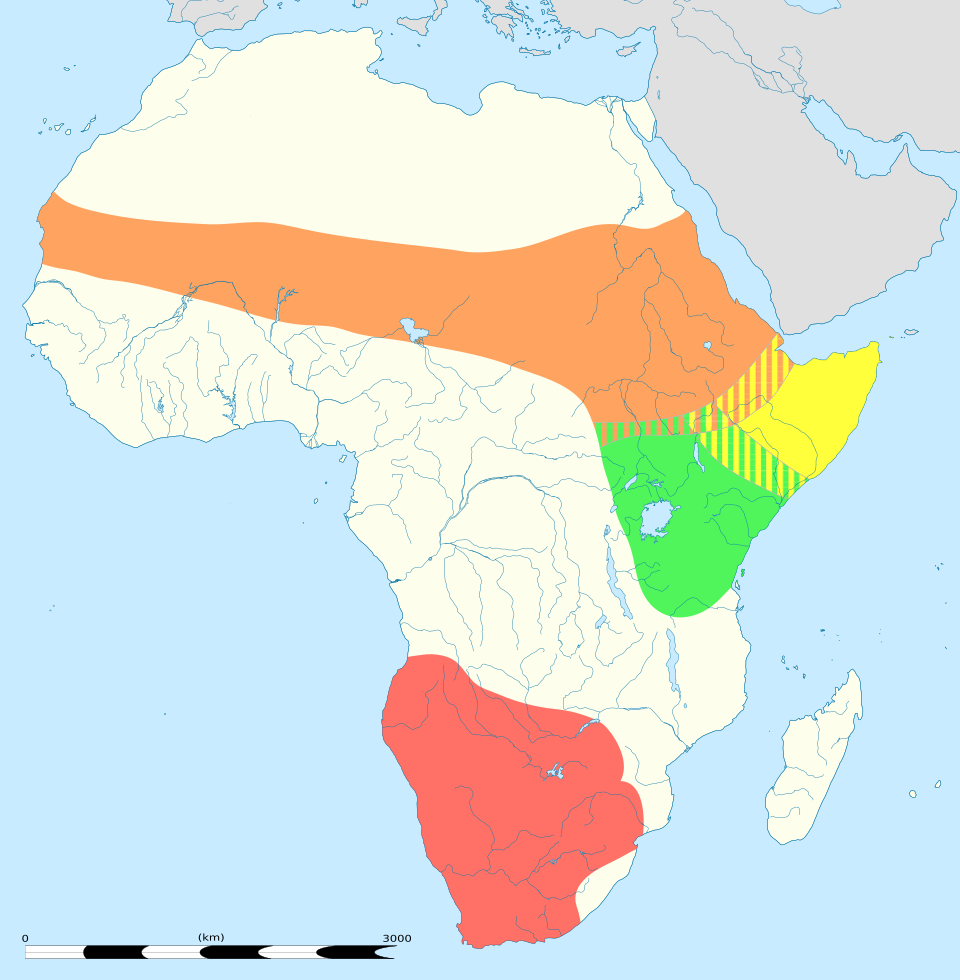
CURRENT RANGE
The Ostrich is widely distributed in sub-Saharan Africa, from the southern Sahara to the semi-arid lands of the south of the continent. Formerly present in North Africa, its population has declined dramatically. It is absent from Tunisia in the wild, although historical observations have documented its previous presence in southern desert regions.
Behaviour
Terrestrial and diurnal, the Ostrich lives in flexible social groups that can reach several dozen individuals. She has excellent vision and keen hearing. Although generally calm, it can become aggressive during the breeding season. Its rapid running is its main defense against predators.
Reproduction
Ostriches are polyandrous: a female can mate with several males. The nest is a simple hollow dug in the sand where the female lays 4 to 8 eggs. Incubation lasts approximately 42 to 46 days, carried out by the dominant male at night and females during the day. The chicks follow the adults a few months before independence.
Peculiarities
The Ostrich produces the largest eggs in the animal kingdom: around 1.4 kg each. She can travel long distances without drinking, storing body water with great efficiency. Its eyes are larger than its brain, giving it exceptional surveillance of its surroundings. It practices thermoregulation through its wings and plumage.
Threats and conservation
The Ostrich remains little threatened overall and maintains a favorable conservation status. However, it is subject to local pressures linked to illegal hunting, habitat loss due to agricultural and pastoral expansion, as well as climate change which affects the availability of food and water resources.
Numbers and trends vary across sources and regions. See the IUCN assessment for the latest reference data.
Gallery
1 documented photographs.
References
UICN — Liste rouge des espèces menacées
Profile updated 29 August 2026 · Reviewed by the TunisieVet editorial team.
Comments (0)
No comments yet.
CONSERVATION STATUS
Least concern (LC)
IUCN source, latest published assessment.
Species health
Documented diseases for this species.
See the 4 diseases of this species Find a veterinarianThis information is provided for educational purposes only and is not a substitute for a veterinary consultation. If you have any concerns about your animal's health, consult a veterinarian.
Related species
To discover around: Common ostrich
Videos, facts, stories and records linked to this species.
Similar animals
Other species documented in Animalpedia.

TunisieVet in your pocket 📱🐾 Access your veterinary services wherever you are. [ Download the app ]
Learn more