Presentation
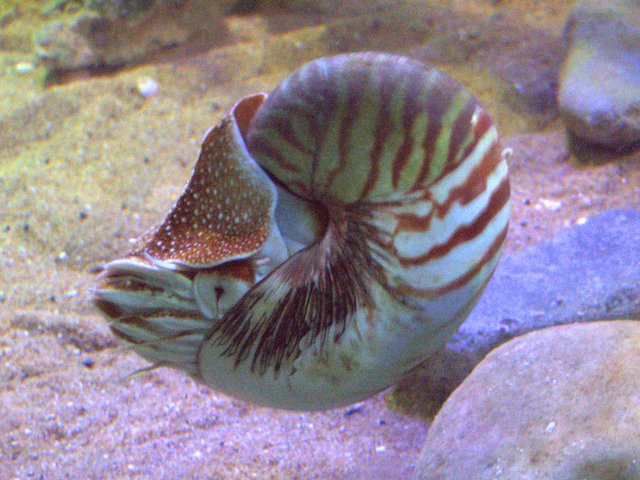
The nautilus is a marine cephalopod mollusk distinguished by an external spiral shell divided into compartmented chambers. It belongs to an ancient group that appeared long before dinosaurs, and is considered a living fossil because its body form has changed little over millions of years. The animal occupies the last chamber of its shell, with the other chambers filled with gas to provide buoyancy. It has many tentacles without suckers, unlike other cephalopods, which it uses to capture prey. Its eyes are rudimentary, functioning like a pinhole camera without a true lens. It lives in the deep waters of the Indo-Pacific, rising at night toward shallower depths to feed.
The pearly shell, coiled in a logarithmic spiral, is divided into about thirty chambers connected by a tube called the siphuncle. This siphuncle allows the animal to regulate the amount of gas and liquid in the chambers, controlling its buoyancy. The nautilus has nearly ninety retractable tentacles without suckers, used for grasping. Unlike other cephalopods, it has no ink sac.
Characteristics
Indicative values: they vary by subspecies, sex and region.
Habitat and distribution
The nautilus inhabits deep marine waters along reef slopes and coral drop-offs, generally between 100 and 500 metres deep. It tolerates high pressure thanks to the strength of its chambered shell. It rises at night towards shallower zones to feed, then descends again at daybreak.
CURRENT RANGE
The species is found in the Indo-Pacific Ocean, particularly around the coral reefs of Australia, the Philippines, and several archipelagos in Southeast Asia. It is not present in the Mediterranean or off the Tunisian coast.
Behaviour
The nautilus undergoes daily vertical migrations, remaining in the depths during the day to avoid predators and rising at night to feed. It moves by jet propulsion, expelling water through a muscular funnel called the hyponome. Its metabolism is slow, allowing it to survive on little food. It is a solitary animal except during breeding periods.
Reproduction
The nautilus reproduces through oviparity and fertilization occurs internally after direct mating between individuals. The female lays a small number of large eggs, which she attaches to a rocky substrate in shallow waters. Embryonic development is lengthy, potentially lasting around one year before hatching. Juvenile nautiluses are born already equipped with a small functional shell.
Peculiarities
The nautilus is often referred to as a living fossil because its body plan has changed very little over more than 400 million years. Its logarithmic spiral shell is frequently cited as a natural example of remarkable mathematical proportions. It represents one of the few living cephalopods to possess a visible external shell.
Threats and conservation
Overfishing driven by the trade in its decorative shell represents the primary threat to nautilus populations. Its slow growth and low fecundity make the species particularly vulnerable to overexploitation. International trade in certain nautilus species is now regulated.
Numbers and trends vary across sources and regions. See the IUCN assessment for the latest reference data.
Gallery
1 documented photographs.
References
Profile updated 13 September 2026 · Reviewed by the TunisieVet editorial team.
Comments (0)
No comments yet.
CONSERVATION STATUS
Vulnerable (VU)
IUCN source, latest published assessment.
Species health
Documented diseases for this species.
Find a veterinarianThis information is provided for educational purposes only and is not a substitute for a veterinary consultation. If you have any concerns about your animal's health, consult a veterinarian.
To discover around: Nautilus
Videos, facts, stories and records linked to this species.
Similar animals
Other species documented in Animalpedia.