Presentation
The lyrebird, or superb lyrebird, is a ground-dwelling bird native to Australia, famous for its spectacular lyre-shaped tail in adult males. It is one of the largest songbirds in the world, capable of running quickly on the ground despite wings poorly suited for sustained flight. It is best known for its exceptional vocal mimicry abilities, reproducing both the calls of other birds and mechanical or artificial sounds. It lives mainly in the humid forests of southeastern Australia, where it forages on the ground by scratching through leaf litter. Its courtship display, combining complex song and tail fanning, makes it one of the most studied birds for its vocal behavior. Shy and elusive, it remains difficult to observe in its natural habitat.
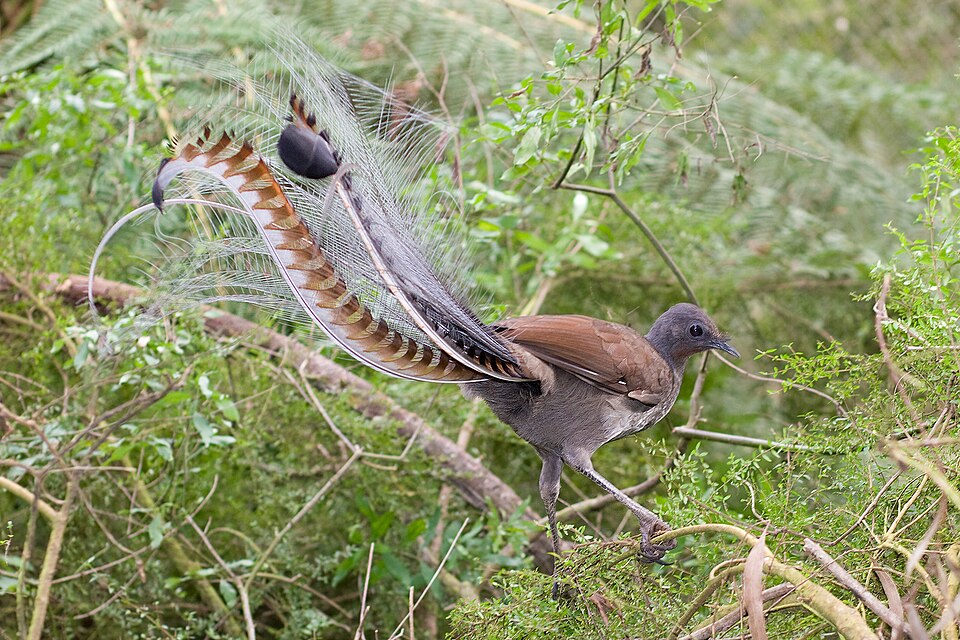
The male is distinguished by a long ornamental tail composed of filamentous feathers and two large curved tail feathers that resemble a lyre. The overall plumage is brown-grey and subdued, providing good camouflage on the ground. The legs are powerful, adapted for scratching the soil and running. The bill is robust and slightly curved, useful for foraging through forest leaf litter.
Characteristics
Indicative values: they vary by subspecies, sex and region.
Habitat and distribution
The lyrebird favours temperate rainforests and dense tropical forests with rich leaf litter on the forest floor. It requires substantial vegetation cover for protection from predators and for finding food on the ground. It is found in both lowland and forested mountain regions.
CURRENT RANGE
The species is endemic to south-eastern Australia, including the forested regions of New South Wales, Victoria, and part of Queensland. It has also been successfully introduced to Tasmania. It does not occur naturally anywhere else in the world.
Behaviour
It is essentially a ground-dwelling bird, capable of flying over short distances but preferring to walk and run. It is territorial, especially the male during breeding season, and defends its territory through song. Its ability to accurately mimic a wide variety of sounds, including artificial ones, is a remarkable and well-documented behavioral trait. It leads a solitary or paired life, with activity mainly during the day.
Reproduction
The breeding season occurs during the austral winter, when the male performs an elaborate display combining song and tail fanning. The female builds a domed, enclosed nest on the ground or on a stump, working alone. She lays a single egg and incubates it alone for about six weeks. The chick remains dependent on its mother for several months after hatching.
Peculiarities
Its vocal mimicry ability is considered among the most sophisticated in the bird world, including reproduction of artificial sounds such as camera shutters and chainsaws. The male's tail, fanned during display, creates a unique visual signal among birds. This complex vocal behaviour makes the species emblematic for studying sound learning in animals.
Threats and conservation
The species is threatened locally by deforestation and degradation of its forest habitat. Forest fires, increasingly frequent in Australia, pose a growing threat to populations. Introduced predators such as foxes can also affect certain populations.
Numbers and trends vary across sources and regions. See the IUCN assessment for the latest reference data.
Gallery
1 documented photographs.
References
Profile updated 03 September 2026 · Reviewed by the TunisieVet editorial team.
Comments (0)
No comments yet.
CONSERVATION STATUS
Least concern (LC)
IUCN source, latest published assessment.
Species health
Documented diseases for this species.
Find a veterinarianThis information is provided for educational purposes only and is not a substitute for a veterinary consultation. If you have any concerns about your animal's health, consult a veterinarian.
To discover around: Lyrebird
Videos, facts, stories and records linked to this species.
RECORD
Accurate reproduction of dozens of distinct sounds
The best vocal mimic in the avian world
Assessed through field observation of males imitating bird calls and ambient artificial so...
Similar animals
Other species documented in Animalpedia.

Be among the first to use our app. Sign up and get early Google Play access.
Discover