
Presentation
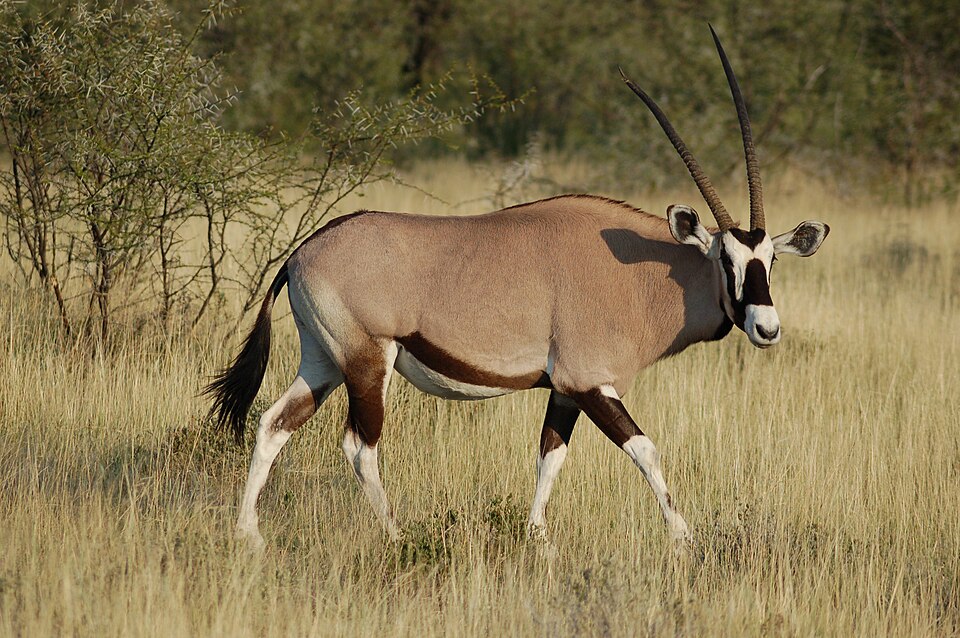
The Oryx is a large, robust antelope characterized by long, thin, straight horns present in both sexes. Its light coat, often white or beige, contrasts with black markings on the face and legs, an adaptation to life in arid environments. Several species exist, including the Oryx scimitar, formerly present in North Africa and now reintroduced in reserves, notably in Tunisia. This animal lives in herds and tolerates extreme temperatures thanks to remarkable physiological adaptations. It is today the subject of conservation programs due to its worrying status in the wild.
The Oryx has a muscular body, long, thin legs, and ringed horns that can exceed a meter in length. Its light coat reflects heat and facilitates thermoregulation in desert areas. The face has distinctive black markings contrasting with the white of the coat.
Characteristics
Indicative values: they vary by subspecies, sex and region.
Habitat and distribution
The Oryx inhabits the desert areas, arid steppes and dry savannahs of Africa. It is well adapted to sandy and rocky soils as well as extreme climates with large temperature variations. In Tunisia, it lives in fenced reserves reproducing its natural habitat.
CURRENT RANGE
Historically widespread in the Sahara and arid regions of Africa, the Scimitar-horned Oryx has disappeared in the wild in much of its original range. Populations remain in the Arabian Peninsula for the Arabian Oryx, while reintroduction programs exist in North Africa. Tunisia is home to reintroduced populations in national parks.
Behaviour
The Oryx generally lives in herds that can number from a few individuals to several dozen, led by a dominant male. It adopts gregarious behavior and moves long distances in search of pasture. When faced with a predator, it uses its horns as an effective defense weapon.
Reproduction
The female gives birth to a single young after a gestation of approximately eight to nine months. The young remain hidden in the vegetation for the first days before joining the herd. Sexual maturity is reached around two years of age.
Peculiarities
Oryx can survive without drinking for long periods of time due to physiological mechanisms limiting water loss. Its body temperature can vary slightly without triggering excessive sweating, thus saving water. Its sharp horns make it an animal capable of defending itself even against large predators.
Threats and conservation
The Oryx has suffered greatly from intensive hunting and the loss of its natural habitat. The scimitar-horned Oryx is considered extinct in the wild, surviving only through reintroduction programs. Desertification and competition with domestic livestock remain threats to reintroduced populations.
Numbers and trends vary across sources and regions. See the IUCN assessment for the latest reference data.
Gallery
1 documented photographs.
References
Profile updated 21 August 2026 · Reviewed by the TunisieVet editorial team.
Comments (0)
No comments yet.
CONSERVATION STATUS
Extinct in the wild (EW)
IUCN source, latest published assessment.
Species health
Documented diseases for this species.
See the 8 diseases of this species Find a veterinarianThis information is provided for educational purposes only and is not a substitute for a veterinary consultation. If you have any concerns about your animal's health, consult a veterinarian.
Related species
To discover around: Oryx
Videos, facts, stories and records linked to this species.
Similar animals
Other species documented in Animalpedia.

TunisieVet in your pocket 📱🐾 Access your veterinary services wherever you are. [ Download the app ]
Learn more