Presentation
The sea urchin is a marine invertebrate belonging to the class Echinodermata, characterized by a globular body protected by a rigid calcified shell called a test, covered with mobile spines. These spines, which vary in length depending on the species, serve both as protection against predators and as support for movement. Beneath the test are small retractable tube feet linked to a water-vascular system, which allow slow locomotion across the seafloor. The sea urchin possesses a complex chewing apparatus located on the underside of the body, called Aristotle's lantern, which it uses to scrape algae. It is found in nearly all oceans worldwide, from shallow coastal areas to the ocean depths. It plays an important ecological role in regulating algae populations on rocky substrates.
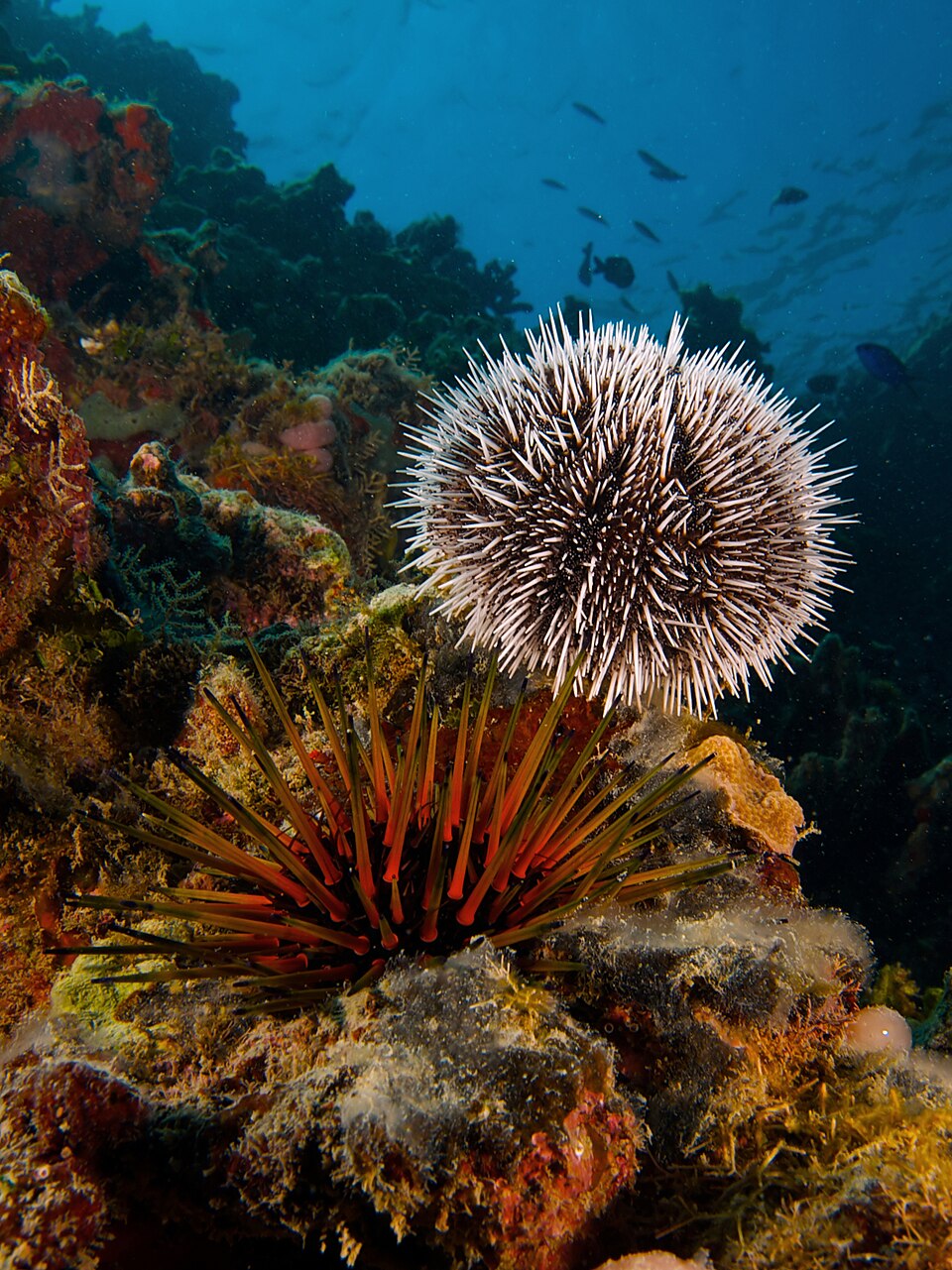
The sea urchin's body is spherical or slightly flattened, covered with a rigid calcified test made up of fused plates. It is covered with mobile spines articulated on tubercles, with coloration and length varying by species, from dark purple to olive green. Five rows of tubular tube feet enable attachment to rocks and allow slow movement.
Characteristics
Indicative values: they vary by subspecies, sex and region.
Habitat and distribution
The sea urchin lives mainly on rocky substrates, seagrass meadows, and shallow coastal zones, where it finds shelter and food. Some species can also inhabit sandy bottoms or abyssal depths. It particularly favors clear, well-oxygenated waters of the Mediterranean and temperate to tropical oceans.
CURRENT RANGE
Sea urchins are found in all seas and oceans worldwide, from tropical zones to polar regions. They are particularly abundant in the Mediterranean, including the coasts of Tunisia, as well as in the Atlantic and Pacific. Their distribution depends largely on the availability of rocky substrates and algae.
Behaviour
The sea urchin is a slow-moving animal and mainly nocturnal, hiding during the day in rock crevices or beneath debris. It moves using its tube feet and spines, which also serve as a means of defence when attacked. Some species can excavate small cavities in rock to establish a lasting shelter.
Reproduction
Sea urchins reproduce through external fertilization: individuals release their gametes—eggs and sperm—directly into seawater. The resulting planktonic larvae, called pluteus, drift for several weeks before undergoing metamorphosis and settling on the seabed. Sexual maturity is generally reached after one to two years, depending on the species and environmental conditions.
Peculiarities
The sea urchin lacks a centralized nervous system but has a diffuse nerve network that nonetheless allows it to react quickly to light and touch stimuli. Some species, such as the diadema sea urchin, possess venomous spines capable of causing sharp pain in humans. The empty test of a dead sea urchin retains a remarkable geometric structure, often studied for its symmetry.
Threats and conservation
Overfishing, particularly for the gonads considered a delicacy for human consumption, threatens some sea urchin populations locally. Climate change and ocean acidification also weaken their calcareous test. Degradation of seagrass meadows and coastal pollution further reduce their natural habitats.
Numbers and trends vary across sources and regions. See the IUCN assessment for the latest reference data.
Gallery
1 documented photographs.
References
Profile updated 01 September 2026 · Reviewed by the TunisieVet editorial team.
Comments (0)
No comments yet.
CONSERVATION STATUS
Least concern (LC)
IUCN source, latest published assessment.
Species health
Documented diseases for this species.
This information is provided for educational purposes only and is not a substitute for a veterinary consultation. If you have any concerns about your animal's health, consult a veterinarian.
Similar animals
Other species documented in Animalpedia.

Be among the first to use our app. Sign up and get early Google Play access.
Discover