
Presentation
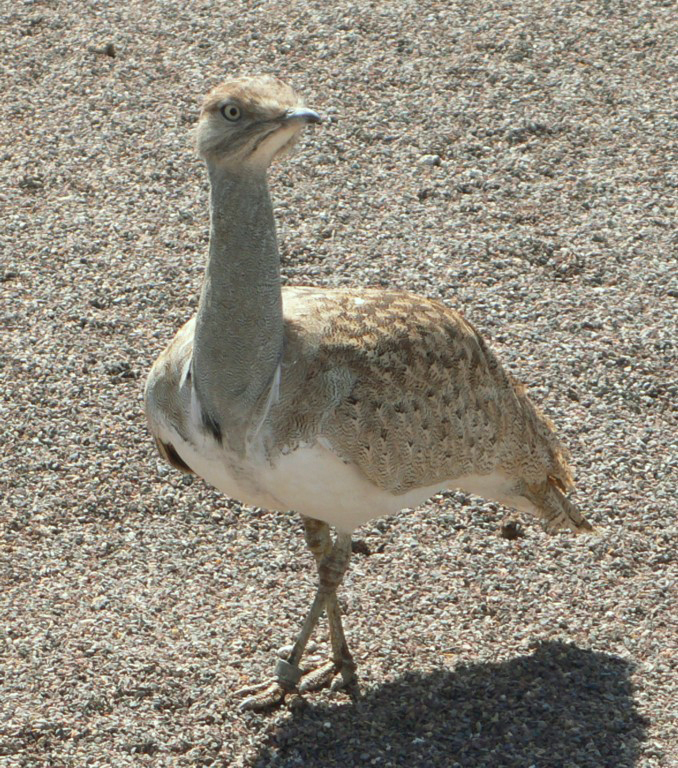
The Houbara bustard is a large terrestrial desert bird, belonging to the Otididae family. Characterized by its majestic appearance and its ability to adapt to arid environments, it represents one of the most emblematic species of the North African desert regions.
Houbara bustard has tan-brown plumage with dark patterns that camouflage it remarkably in its desert habitat. The male sports a distinctive white collar on the neck and an erect crest of long feathers during courtship displays. Its legs are long and powerful, suitable for rapid walking over rough terrain.
Characteristics
Indicative values: they vary by subspecies, sex and region.
Habitat and distribution
Houbara bustard frequents sandy and gravel deserts as well as arid and semi-arid steppes. It prefers flat or slightly undulating terrain with sparse vegetation. It avoids densely wooded areas and requires open spaces to detect predators and move easily.
CURRENT RANGE
Houbara bustard is distributed across North Africa, the Middle East and Central Asia. Its range extends from Morocco to Mongolia, via the Sahara and the surrounding semi-arid regions. The overall distribution is fragmented due to habitat degradation.
Behaviour
The Houbara bustard is generally secretive and solitary, although it may gather in small groups outside the breeding season. She is able to fly despite her weight, but prefers to move on foot. The male performs spectacular courtship displays, puffing out his neck and displaying his feathers to attract females.
Reproduction
The female lays 2 to 3 eggs in a discreet depression in the ground, without a real nest. Incubation lasts approximately 22 to 25 days, carried out by the female alone. The chicks are precocial and mobile a few hours after hatching. Reproductive success is highly dependent on food availability and climatic conditions.
Peculiarities
The Houbara bustard has a remarkable thermoregulation capacity, allowing it to withstand the climatic extremes of the desert. It can remain immobile for long periods of time, giving it excellent camouflage. It is also able to use the water contained in plants, reducing its dependence on free water sources.
Threats and conservation
The Houbara bustard is threatened by intensive hunting, capture for falconry and the degradation of its desert habitats due to overgrazing. Population declines are also linked to the use of pesticides and climate change which reduces food availability.
Numbers and trends vary across sources and regions. See the IUCN assessment for the latest reference data.
Gallery
1 documented photographs.
References
UICN — Liste rouge des espèces menacées
Profile updated 01 September 2026 · Reviewed by the TunisieVet editorial team.
Comments (0)
No comments yet.
CONSERVATION STATUS
Vulnerable (VU)
IUCN source, latest published assessment.
Species health
Documented diseases for this species.
Find a veterinarianThis information is provided for educational purposes only and is not a substitute for a veterinary consultation. If you have any concerns about your animal's health, consult a veterinarian.
Related species
Similar animals
Other species documented in Animalpedia.

TunisieVet in your pocket 📱🐾 Access your veterinary services wherever you are. [ Download the app ]
Learn more