
Presentation
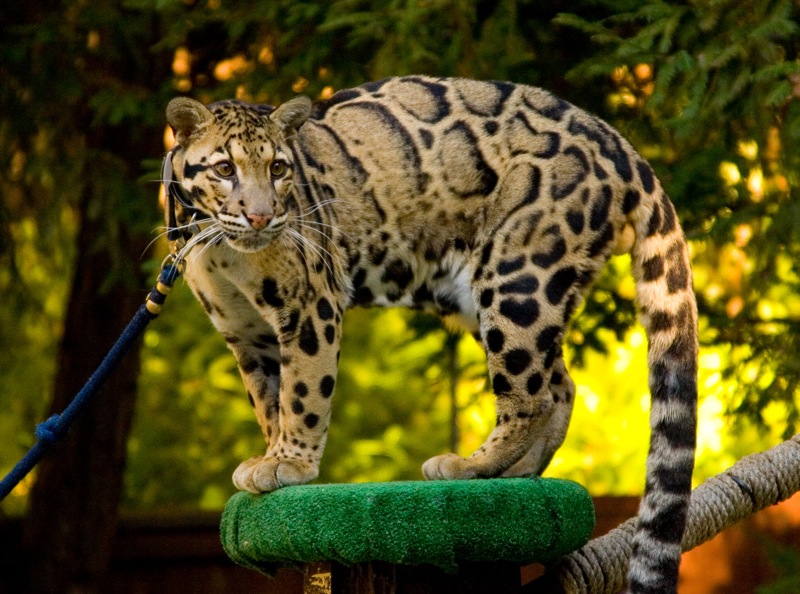
The clouded leopard is a medium-sized wild cat native to the forests of Southeast Asia and the Himalaya. Its grey-yellowish coat is marked with large cloud-shaped spots bordered in black, which gives the species its name. It possesses the proportionally longest canine teeth of all living cats relative to skull size. An excellent climber, it spends much of its time in trees where it hunts and rests. This is a discreet and solitary species, rarely observed in its natural habitat. Today it is threatened by deforestation and poaching.
The body is elongated and muscular, with short, sturdy legs adapted for life in the trees. The tail is particularly long, almost equal to body length, and serves as a balance aid when moving through the branches. Flexible joints allow exceptional rotation of the ankles, enabling it to descend tree trunks head first.
Characteristics
Indicative values: they vary by subspecies, sex and region.
Habitat and distribution
The species inhabits dense tropical and subtropical forests, as well as certain wooded mountain areas. It favors habitats with continuous canopy coverage that allow it to move from tree to tree.
CURRENT RANGE
The clouded leopard is found in southern and southeastern Asia, notably in southern China, Nepal, Bhutan, Myanmar, Thailand, Vietnam, and mainland Malaysia. It has disappeared from certain regions it once inhabited due to habitat fragmentation.
Behaviour
Solitary and primarily nocturnal, the clouded leopard is very discreet and difficult to observe. It marks its territory through scratching and urine deposits. An excellent swimmer, it can also cross watercourses if necessary.
Reproduction
The female gives birth to a litter of 2 to 4 cubs after a gestation period of approximately 85 to 95 days. The young are born blind and are entirely dependent on their mother during the first few weeks. They reach sexual maturity at around two years of age.
Peculiarities
Its oversized canine teeth sometimes earn it the nickname "miniature saber-toothed tiger." Its exceptional joint flexibility allows it to perform acrobatic feats unique among felids, such as moving while suspended from branches.
Threats and conservation
Deforestation linked to agriculture and logging significantly reduces its natural habitat. Poaching for its fur, bones, and teeth, used in certain traditional markets, poses a major threat. Illegal trade in live animals also affects wild populations.
Numbers and trends vary across sources and regions. See the IUCN assessment for the latest reference data.
Gallery
1 documented photographs.
References
Profile updated 05 September 2026 · Reviewed by the TunisieVet editorial team.
Comments (0)
No comments yet.
CONSERVATION STATUS
Vulnerable (VU)
IUCN source, latest published assessment.
Species health
Documented diseases for this species.
This information is provided for educational purposes only and is not a substitute for a veterinary consultation. If you have any concerns about your animal's health, consult a veterinarian.
Related species
To discover around: Clouded Leopard
Videos, facts, stories and records linked to this species.
Similar animals
Other species documented in Animalpedia.

TunisieVet in your pocket 📱🐾 Access your veterinary services wherever you are. [ Download the app ]
Learn more