
Presentation
The Seal is a marine mammal belonging to the pinniped group, present mainly in the cold and temperate seas of the northern hemisphere as well as in Antarctica. It is distinguished from sea lions by the absence of visible external ears and by swimming propelled mainly by the hind limbs. This aquatic carnivore feeds mainly on fish and cephalopods. Well adapted to the cold thanks to a thick layer of fat, it alternates phases of life at sea and periods of rest on the coasts, ice floes or rocks. Several species of Seals exist throughout the world, of varying sizes and distributions. Some populations are threatened by historical hunting, pollution and climate change.
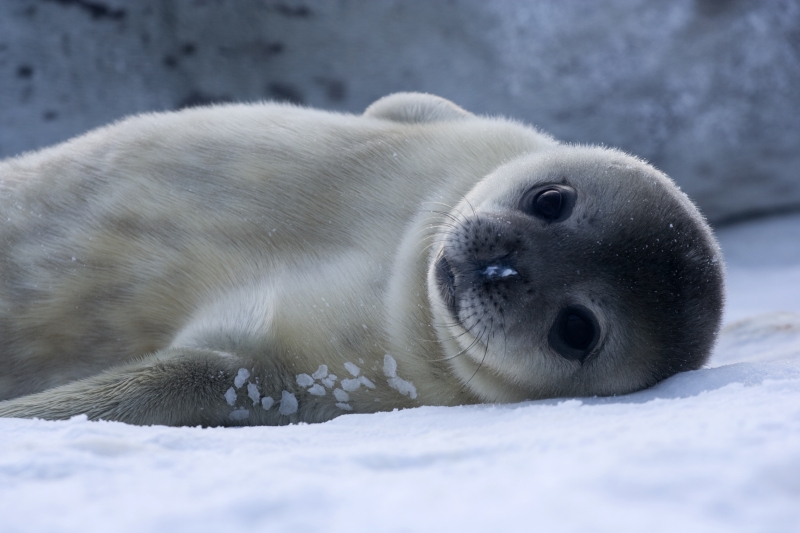
The Seal has a streamlined body covered in short, dense fur, adapted to aquatic life. Its limbs are transformed into fins, without an external ear flap unlike sea lions. A thick layer of subcutaneous fat (blubber) allows it to resist the cold of polar and temperate waters. Its large, round eyes facilitate vision in depth and in low light.
Characteristics
Indicative values: they vary by subspecies, sex and region.
Habitat and distribution
The Seal lives in cold to temperate oceans and seas, as well as on rocky coasts, beaches and sea ice where it rests and gives birth. Some species also frequent estuaries and sheltered coastal areas. It alternates its time between the sea, where it hunts, and land or ice, where it rests and reproduces.
CURRENT RANGE
Seals are widely distributed in the cold and temperate seas of the Northern Hemisphere, including the Arctic, Baltic Sea, North Atlantic and North Pacific. Some species also live in Antarctica and sub-Antarctic seas. One species, the Mediterranean monkfish Seal, is historically present in the Mediterranean, including on some coasts of North Africa, but its populations are extremely small today. The Seal is not a common species in Tunisia today.
Behaviour
The Seal is a gregarious animal that often forms groups on beaches, ice floes or rocks to rest between two fishing sessions. It is an excellent swimmer and diver, capable of remaining submerged for several minutes to several tens of minutes depending on the species. On land, its movements are clumsy because its hind limbs are poorly adapted to terrestrial locomotion. It communicates by vocalizations and can be curious towards humans in certain protected areas.
Reproduction
The female gives birth to a single young per year, generally on the ice floe, a beach or isolated rocks. Breastfeeding is short but very rich in fat, allowing the little one to gain weight quickly. Sexual maturity is reached between 3 and 6 years depending on the species. In many species, males defend a territory or a group of females during the breeding season.
Peculiarities
The Seal is able to significantly slow its heart rate when diving in order to conserve available oxygen. Some species can dive several hundred meters deep to hunt. Its fur and fat allow it to live in waters close to 0°C without difficulty. Unlike sea lions, it cannot bring its hind limbs under its body to walk on land.
Threats and conservation
Historically, commercial hunting for fur and blubber has greatly reduced some populations. Today, the main threats are marine pollution, accidental catches in fishing nets and global warming which is reducing sea ice. Some species, such as the Mediterranean monk Seal, are seriously threatened with extinction.
Numbers and trends vary across sources and regions. See the IUCN assessment for the latest reference data.
Gallery
1 documented photographs.
References
Profile updated 25 August 2026 · Reviewed by the TunisieVet editorial team.
Comments (0)
No comments yet.
CONSERVATION STATUS
Least concern (LC)
IUCN source, latest published assessment.
Species health
Documented diseases for this species.
Find a veterinarianThis information is provided for educational purposes only and is not a substitute for a veterinary consultation. If you have any concerns about your animal's health, consult a veterinarian.
To discover around: Seal
Videos, facts, stories and records linked to this species.
RECORD
up to 4,000 kg / 6 m
The largest pinniped
Measurement observed in the adult male of the southern elephant seal, the largest known sp...
Similar animals
Other species documented in Animalpedia.
