
Presentation
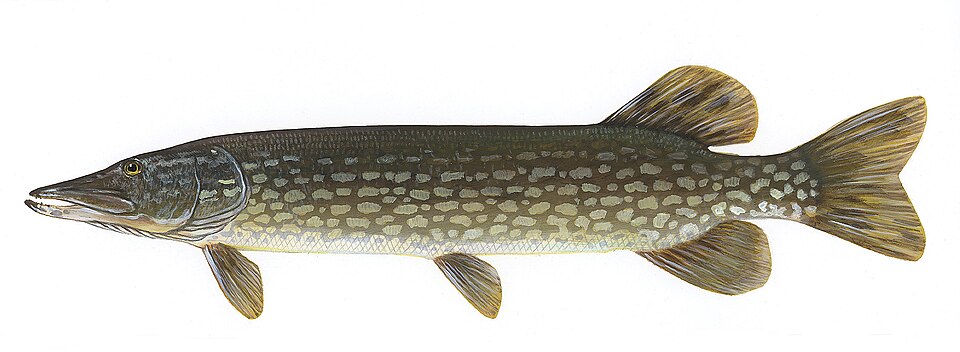
The Pike (Esox lucius) is a carnivorous freshwater fish, known for its elongated body and powerful, beak-like jaw. A solitary predator, it lives in ambush among aquatic vegetation to surprise its prey. Widespread in the northern hemisphere, it occupies rivers, lakes and calm water ponds. This fish is very popular with sport fishermen for its combativeness. It is not naturally present in Tunisia.
The Pike has an elongated spindle-shaped body, a flat head, and a mouth with numerous sharp, inward-facing teeth. Its color varies from olive green to brown, marbled with light spots providing effective camouflage. The dorsal fin, drawn back towards the rear of the body, contributes to its dazzling acceleration during the attack.
Characteristics
Indicative values: they vary by subspecies, sex and region.
Habitat and distribution
The Pike frequents calm or slow-moving fresh waters: lakes, ponds, slow-moving rivers and wetlands lined with vegetation. It particularly likes dense seagrass meadows which provide cover for hunting while lying in wait. It tolerates a wide range of temperatures but avoids water that is too fast or too low in oxygen.
CURRENT RANGE
The species is widely distributed in the northern hemisphere, Europe, Asia and North America. It has also been introduced into many bodies of water outside its native range for sport fishing purposes. Pike is absent from natural waters of North Africa, including Tunisia.
Behaviour
Solitary and territorial, the Pike defends a hunting zone that it occupies sustainably. It generally remains motionless near seagrass beds or banks, saving its energy between attacks. Its behavior is essentially diurnal, with peaks of predatory activity at dawn and dusk.
Reproduction
Breeding occurs in spring when the water warms, often in flooded or shallow areas rich in vegetation. The female lays several thousand eggs which adhere to aquatic plants, without subsequent parental care. The fry grow quickly and become piscivorous from the first weeks.
Peculiarities
The Pike may adopt cannibalistic behavior towards younger individuals of its species. Its capacity for sudden acceleration, thanks to its backward dorsal fin, makes it a formidable hunter despite its apparent immobility. It can live for several decades in favorable conditions.
Threats and conservation
The degradation of wetlands and the disappearance of aquatic grass beds are reducing its breeding habitats. Freshwater pollution and fragmentation of rivers by dams also affect local populations. Sport overfishing can locally unbalance certain populations, although the species remains abundant overall.
Numbers and trends vary across sources and regions. See the IUCN assessment for the latest reference data.
Gallery
1 documented photographs.
References
Profile updated 28 August 2026 · Reviewed by the TunisieVet editorial team.
Comments (0)
No comments yet.
CONSERVATION STATUS
Least concern (LC)
IUCN source, latest published assessment.
Species health
Documented diseases for this species.
See the 4 diseases of this species Find a veterinarianThis information is provided for educational purposes only and is not a substitute for a veterinary consultation. If you have any concerns about your animal's health, consult a veterinarian.
Similar animals
Other species documented in Animalpedia.

TunisieVet in your pocket 📱🐾 Access your veterinary services wherever you are. [ Download the app ]
Learn more