
Presentation
The Plaice, or common Plaice, is a marine flatfish belonging to the family Pleuronectidae, widely distributed in the temperate waters of the Northeast Atlantic and some European seas. Recognizable by its flattened body and its orange dorsal spots, it lives lying on its side at the bottom of the sea, its two eyes having migrated to the same side of the head during its development. A benthic species par excellence, it feeds on invertebrates that it finds in the sediment. Very popular in commercial fishing and European gastronomy, it constitutes an economically important fishing resource. Its life cycle includes a symmetrical pelagic larval phase followed by a spectacular metamorphosis. It is not present in Tunisian waters.
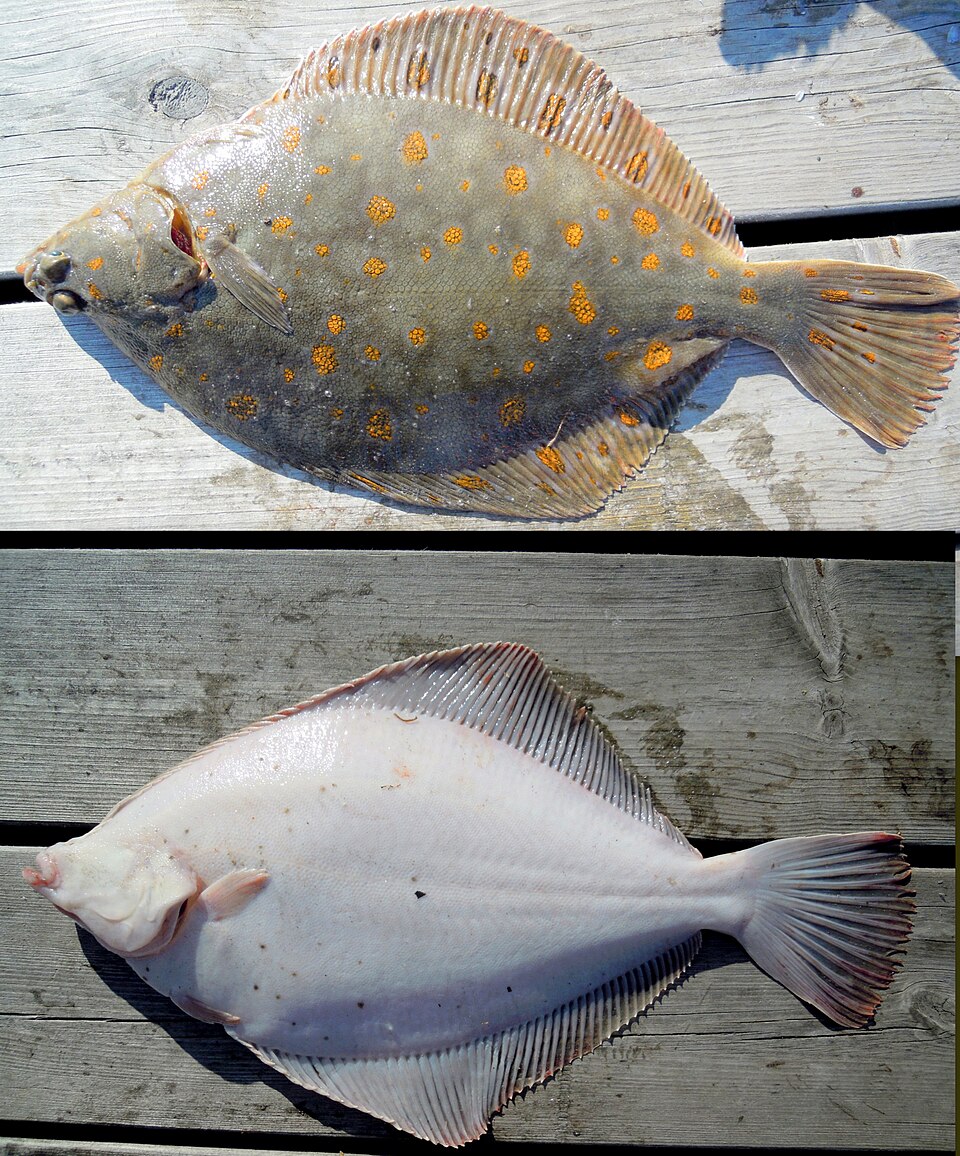
Plaice has a flattened, oval-shaped body, with two eyes located on the right side of the head, the result of larval metamorphosis. Its upper surface is greenish-brown to brownish, decorated with characteristic orange to reddish spots, while its underside is white. The skin is smooth, devoid of scales visible to the naked eye, and the body is laterally compressed. This body asymmetry constitutes a major adaptation to benthic life.
Characteristics
Indicative values: they vary by subspecies, sex and region.
Habitat and distribution
The Plaice lives on the sandy or muddy bottoms of temperate seas, generally between a few meters and a hundred meters deep. It favors coastal areas, estuaries and shallow bays during its juvenile phase. Adults can be found in deeper waters, especially during the winter breeding season.
CURRENT RANGE
Plaice is present in the Northeast Atlantic, from the Barents Sea to the Bay of Biscay, as well as in the North Sea, the English Channel, the Baltic Sea and parts of the Mediterranean. It is particularly common in European coastal waters. This species is not present in Tunisia nor in the southern Mediterranean.
Behaviour
The Plaice is a benthic fish that spends most of its time immobile on or slightly buried in the sediment. It moves in lateral undulations and can make short, rapid movements to escape predators or capture prey. Its hunting activity is mainly diurnal, guided by sight despite its asymmetrical eye position. It is a rather sedentary species, however carrying out seasonal migrations towards deeper waters in winter.
Reproduction
Breeding takes place in winter, usually between January and March, in relatively deep waters off the coast. Females lay several hundred thousand pelagic eggs which drift with the ocean currents. The larvae, initially symmetrical and swimming in open water, undergo a metamorphosis during which one eye migrates to the other side of the head. After this transformation, the young Plaices settle on the seafloor, often in shallow coastal areas serving as nurseries.
Peculiarities
The most notable characteristic of Plaice is ocular migration during larval metamorphosis, a phenomenon shared by all flatfishes. Its dorsal orange spots, which vary depending on the individual, allow easy identification of the species. Its ability to slightly change its coloration to blend into the substrate is another remarkable camouflage adaptation.
Threats and conservation
The Plaice is the subject of significant commercial fishing in Europe, in particular by bottom trawling, which can locally affect certain populations. The degradation of coastal habitats serving as nurseries, linked to pollution and coastal urbanization, constitutes an additional threat. Overall, however, stocks remain considered stable in a large part of its range.
Numbers and trends vary across sources and regions. See the IUCN assessment for the latest reference data.
Gallery
1 documented photographs.
References
Profile updated 29 August 2026 · Reviewed by the TunisieVet editorial team.
Comments (0)
No comments yet.
CONSERVATION STATUS
Least concern (LC)
IUCN source, latest published assessment.
Species health
Documented diseases for this species.
See the 4 diseases of this species Find a veterinarianThis information is provided for educational purposes only and is not a substitute for a veterinary consultation. If you have any concerns about your animal's health, consult a veterinarian.
Similar animals
Other species documented in Animalpedia.

TunisieVet in your pocket 📱🐾 Access your veterinary services wherever you are. [ Download the app ]
Learn more