
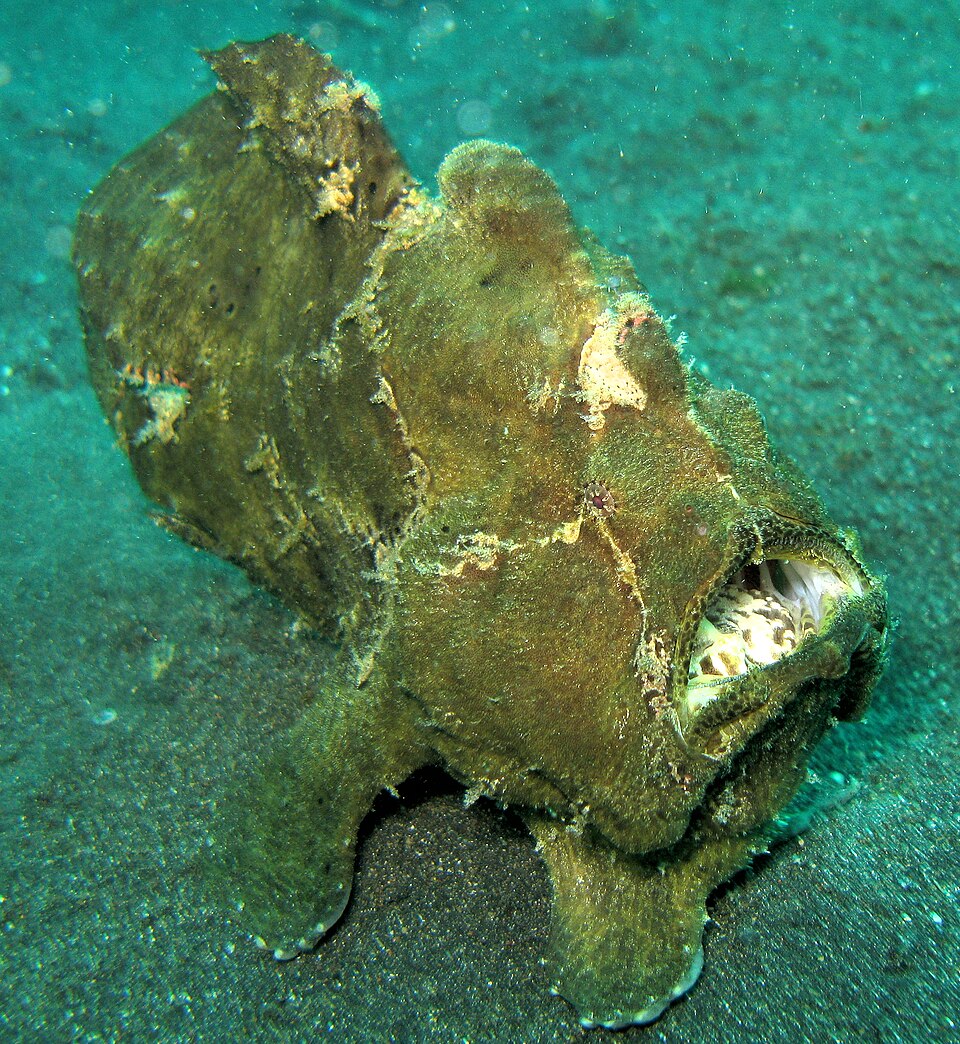
Presentation
The anglerfish, or deep-sea angler, refers to a group of abyssal fish of the order Lophiiformes, famous for their bioluminescent illicium that serves to attract prey. This predator lives in the dark depths of the ocean, often beyond 1000 meters. Its globular body, dark skin, and large mouth armed with sharp teeth give it a striking appearance. Some species display extreme sexual dimorphism, with the male being tiny and parasitic on the female. This fish fascinates as much as it illustrates the extreme adaptations to life in the abyssal environment.
The anglerfish has a rounded, gelatinous body, poorly suited for fast swimming. Its most notable feature is the illicium, a dorsal extension topped by a bioluminescent lure called an esca. Its jaws are prominent and armed with fine teeth directed inward, preventing captured prey from escaping.
Characteristics
Indicative values: they vary by subspecies, sex and region.
Habitat and distribution
Anglerfish inhabit mainly the abyssal zones of the ocean, between 1,000 and 4,000 metres in depth. Some coastal species, such as the monkfish, live rather on shallow seabeds. Near-total darkness and high pressure characterise its preferred environment.
CURRENT RANGE
Anglerfish species are found in all the world's oceans, from the Atlantic to the Pacific via the Indian Ocean. Abyssal forms are widely distributed throughout ocean depths, while coastal species occur on continental shelves. No populations of typical deep-dwelling forms have been recorded in the Mediterranean Sea, although coastal anglerfish are present there.
Behaviour
It is a solitary and sedentary animal, spending most of its time motionless waiting for prey. In this way it conserves energy in an environment where food is scarce. Some species perform slow vertical migrations through the water column.
Reproduction
In several abyssal species, the male, much smaller than the female, attaches to her body by biting and gradually fuses with her, becoming dependent on her bloodstream. This sexual parasitism ensures a partner is available in the darkness of the deep ocean. The female then releases large quantities of floating eggs dispersed by currents.
Peculiarities
The anglerfish's bioluminescent lure results from symbiosis with light-producing bacteria. The male's sexual parasitism on the female represents one of the most extreme reproductive adaptations in the animal kingdom. Its ability to distend its stomach allows it to ingest prey of very large relative size.
Threats and conservation
Living in remote abyssal zones, the anglerfish is little affected by direct fishing. Plastic pollution and climate change, which alter deep-sea ecosystems, represent potential long-term threats. Data on the actual state of its populations remain limited, however.
Numbers and trends vary across sources and regions. See the IUCN assessment for the latest reference data.
Gallery
1 documented photographs.
References
Profile updated 07 September 2026 · Reviewed by the TunisieVet editorial team.
Comments (0)
No comments yet.
CONSERVATION STATUS
Data deficient (DD)
IUCN source, latest published assessment.
Species health
Documented diseases for this species.
Find a veterinarianThis information is provided for educational purposes only and is not a substitute for a veterinary consultation. If you have any concerns about your animal's health, consult a veterinarian.
Similar animals
Other species documented in Animalpedia.

TunisieVet in your pocket 📱🐾 Access your veterinary services wherever you are. [ Download the app ]
Learn more