
Presentation
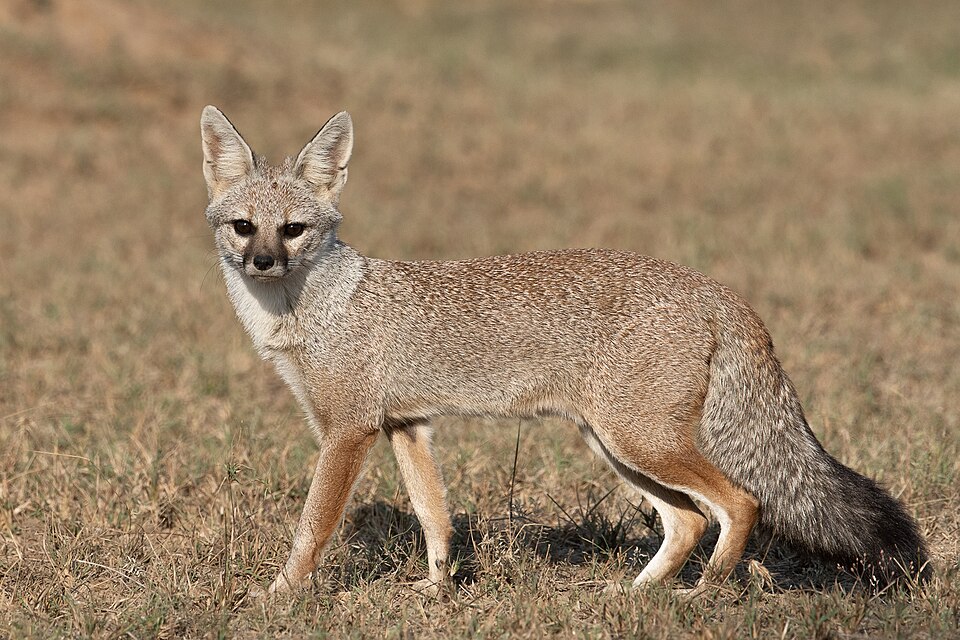
The Bengal fox (Vulpes bengalensis) is a small canid native to the Indian subcontinent. It inhabits open plains, semi-arid regions, and cultivated areas where it digs complex burrow systems. Elusive and mainly nocturnal or crepuscular, it feeds on a wide variety of small prey and plant material. Its grayish coat and slender build make it a predator well-suited to dry habitats. The species remains widely distributed but faces increasing pressure from habitat loss.
The Bengal fox measures approximately 18 to 24 inches in body length, with a bushy tail of 10 to 12 inches tipped by a distinctive black point. Its coat is silvery gray to light brown on the back, paler on the underside. The ears are large and pointed, adapted for effective nocturnal hunting acoustics. The body is slender with relatively long legs compared to other small canids.
Characteristics
Indicative values: they vary by subspecies, sex and region.
Habitat and distribution
The species favors open grasslands, semi-arid zones, and agricultural areas in India and neighboring regions. It avoids dense forests and highly humid zones, preferring open terrain suitable for burrowing. It can adapt to proximity with inhabited rural areas. Steppe and dry savanna landscapes constitute its preferred habitat.
CURRENT RANGE
The Bengal fox is endemic to the Indian subcontinent, occurring in India, Nepal, Pakistan, and Bangladesh. Its range follows the open and semi-arid plains of the region. It does not occur naturally outside this geographic area. The species remains widely distributed throughout its range.
Behaviour
Primarily a nocturnal and crepuscular species, it rests during the day in burrows dug in loose soil. Pairs are often monogamous and occupy a territory defended against other foxes. Communication occurs through vocalizations, scent marking, and body language. The Bengal fox is rather shy and avoids direct contact with humans.
Reproduction
Breeding occurs once annually, typically in late winter. After a gestation period of approximately 50 to 53 days, the female gives birth to 2 to 4 pups in a burrow. Both parents participate in raising the young, which become independent around 6 months of age. Sexual maturity is generally reached during the first year.
Peculiarities
Its bushy tail with a black tip, proportionally longer than that of other foxes, is a distinctive feature. It possesses highly developed sense of smell and hearing that compensate for less effective vision in nocturnal conditions. Unlike other canids, it generally avoids dense forested areas.
Threats and conservation
The primary threat is conversion of natural habitats into intensive agricultural land or urbanized areas. It is sometimes victim to road collisions and accidental trapping intended for other species. Traditional hunting for its fur or certain local beliefs persist in some areas. Diseases transmitted by domestic dogs also pose a risk.
Numbers and trends vary across sources and regions. See the IUCN assessment for the latest reference data.
Gallery
1 documented photographs.
References
Profile updated 05 September 2026 · Reviewed by the TunisieVet editorial team.
Comments (0)
No comments yet.
CONSERVATION STATUS
Least concern (LC)
IUCN source, latest published assessment.
Species health
Documented diseases for this species.
See the 4 diseases of this species Find a veterinarianThis information is provided for educational purposes only and is not a substitute for a veterinary consultation. If you have any concerns about your animal's health, consult a veterinarian.
Related species
To discover around: Bengal Fox
Videos, facts, stories and records linked to this species.
Similar animals
Other species documented in Animalpedia.

TunisieVet in your pocket 📱🐾 Access your veterinary services wherever you are. [ Download the app ]
Learn more