
Presentation
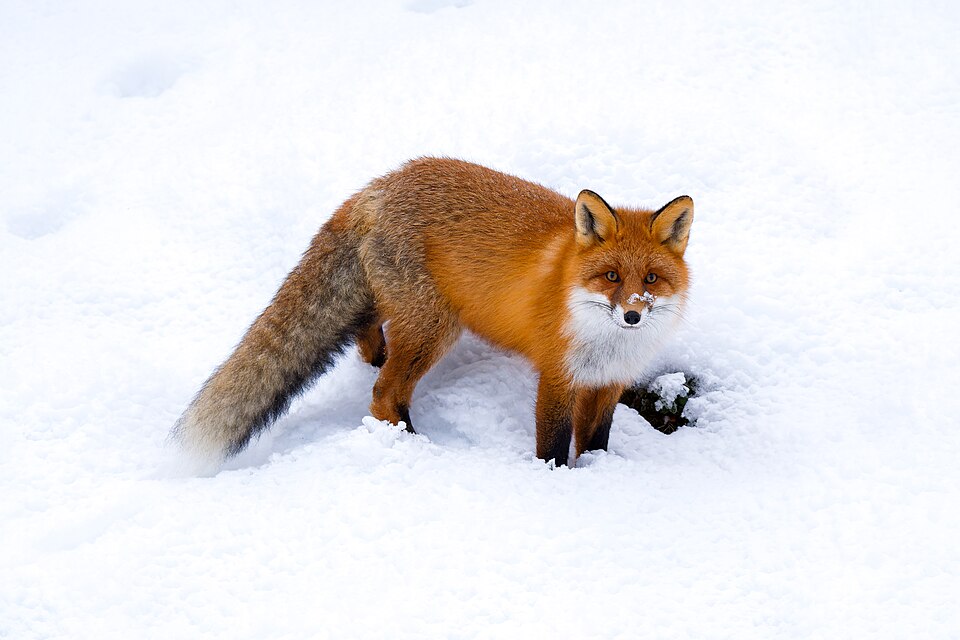
The Red fox is a slender and graceful canid, easily recognizable by its bright reddish-orange fur and bushy tail marked with a black band. It is the largest and most cosmopolitan of foxes, capable of adapting to a wide variety of environments, from rural areas to city centers.
Red fox has a dominant red to rusty coat, with a creamy white belly and throat. The front legs have characteristic black markings, and the white tail at the tip is one of its distinctive features. Its pointed ears and amber-yellow eyes give it an alert and intelligent expression.
Characteristics
Indicative values: they vary by subspecies, sex and region.
Habitat and distribution
Red fox is remarkably adaptable and colonizes a wide diversity of habitats: mixed forests, steppes, heaths, grasslands, agricultural lands and urban areas. It prefers mosaic landscapes offering both open areas for hunting and wooded refuges or burrows.
CURRENT RANGE
The Red fox is the most widely distributed fox species in the world. It occupies the Northern Hemisphere (North America, Europe, Northern Asia) and has colonized Australia since the 19th century. Its range extends from northern Scandinavia to North Africa.
Behaviour
A mainly nocturnal animal, the Red fox is solitary or lives in small family groups. It is very territorial and marks its space with odorous traces. Intelligent and cautious, it has excellent hearing and a remarkable sense of smell which allow it to locate its prey under the snow or the ground.
Reproduction
The breeding season extends from December to February. After mating accompanied by an elaborate nuptial ceremony, the female gives birth to 4 to 6 young, called foxes, after a gestation of approximately 52 days. Both parents raise and educate the young for 3 to 4 months.
Peculiarities
The Red fox has a remarkable ability to locate rodents under the snow thanks to its exceptional hearing: it jumps vertically to pounce on its hidden prey. In urban environments, it has developed sophisticated adaptive behaviors to take advantage of human resources while avoiding threats. It is one of the few species to have expanded its range in recent centuries.
Threats and conservation
Currently, the Red fox faces no major threats to its survival on a global scale, benefiting from its remarkable adaptability and wide distribution. Locally, it may be hunted for its fur or as a predator of livestock, but these pressures remain limited and do not affect its conservation status.
Numbers and trends vary across sources and regions. See the IUCN assessment for the latest reference data.
Gallery
1 documented photographs.
References
UICN — Liste rouge des espèces menacées
Profile updated 02 September 2026 · Reviewed by the TunisieVet editorial team.
Comments (0)
No comments yet.
CONSERVATION STATUS
Least concern (LC)
IUCN source, latest published assessment.
Species health
Documented diseases for this species.
See the 4 diseases of this species Find a veterinarianThis information is provided for educational purposes only and is not a substitute for a veterinary consultation. If you have any concerns about your animal's health, consult a veterinarian.
Related species
To discover around: Red fox
Videos, facts, stories and records linked to this species.
Similar animals
Other species documented in Animalpedia.

TunisieVet in your pocket 📱🐾 Access your veterinary services wherever you are. [ Download the app ]
Learn more