
Presentation
The frilled shark is a species of deep-sea shark considered a living fossil due to its primitive anatomy, similar to that of prehistoric sharks. Its elongated, eel-like body, its six pairs of fringed gill slits, and its jaws lined with trident-shaped teeth give it an unusual reptilian appearance compared to modern sharks. It inhabits the deep waters of the ocean, far from coasts, making sightings exceptionally rare. Little studied in its natural environment, it is known mainly through accidental catches by trawlers or observations from submersibles. Its morphology reflects a shark lineage that emerged tens of millions of years ago and has changed little since. It holds significant scientific interest for understanding the evolution of selachians.
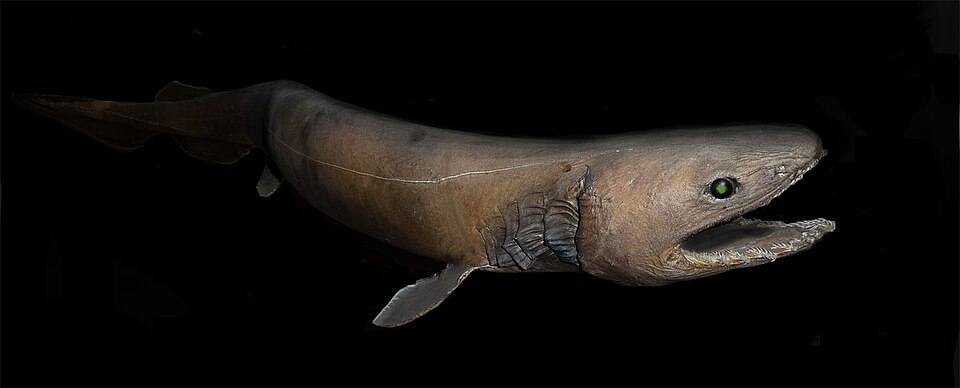
The body is slender and serpentine, dark brown to gray, lacking the streamlined forms typical of modern sharks. The head is flattened with a wide terminal mouth that is not on the underside as in most sharks. The six pairs of gills, with the first forming a collar under the throat, are visible and give it its common name.
Characteristics
Indicative values: they vary by subspecies, sex and region.
Habitat and distribution
The species inhabits deep waters, generally between 500 and 1,500 metres, along continental slopes and ocean ridges. It frequents both temperate and subtropical zones, provided there are sufficiently deep and cold waters. It is sometimes observed at shallower depths in certain areas where cold waters rise close to the surface.
CURRENT RANGE
The frilled shark is scattered throughout the Atlantic, Pacific, and Indian Oceans, primarily off the coasts of Japan, Norway, France, southern Africa, Australia, and New Zealand. Its exact range remains poorly understood due to the rarity of observations and captures. It has not been recorded in Tunisian waters.
Behaviour
It is a solitary and secretive species whose behavior remains largely unknown due to its deep and inaccessible habitat. Some researchers suspect it may undulate its body in an eel-like manner to surprise its prey. Its activity and vertical movements in the water column remain poorly documented.
Reproduction
The frilled shark is ovoviviparous: eggs develop and hatch inside the female's body, which then gives birth to fully formed young. Gestation is estimated to be particularly prolonged, potentially exceeding one year, making it one of the longest in the animal kingdom. The number of young per litter is generally low, ranging from a few individuals to about ten.
Peculiarities
Its archaic appearance and resemblance to fossil species have earned it the nickname 'living fossil'. The trident-like shape of its teeth and its fringed gills are unique among present-day sharks. Its rarity and abyssal habitat make it a quasi-mythical species, often associated with accounts of 'sea monsters'.
Threats and conservation
The species is not directly targeted by fishing but can be caught accidentally by bottom trawls intended for other species. Degradation of deep-sea habitats linked to certain fishing practices could represent an indirect threat. Data are lacking to precisely assess the impact of human activities on its populations.
Numbers and trends vary across sources and regions. See the IUCN assessment for the latest reference data.
Gallery
1 documented photographs.
References
Profile updated 07 September 2026 · Reviewed by the TunisieVet editorial team.
Comments (0)
No comments yet.
CONSERVATION STATUS
Near threatened (NT)
IUCN source, latest published assessment.
Species health
Documented diseases for this species.
This information is provided for educational purposes only and is not a substitute for a veterinary consultation. If you have any concerns about your animal's health, consult a veterinarian.
To discover around: Frilled Shark
Videos, facts, stories and records linked to this species.
RECORD
approximately 3.5 years (disputed estimate) / typically 1 to 2 years
Longest known gestation period in a vertebrate
Estimate based on the analysis of embryo growth in captured females.
Similar animals
Other species documented in Animalpedia.

TunisieVet in your pocket 📱🐾 Access your veterinary services wherever you are. [ Download the app ]
Learn more