Presentation
The scallop is a marine bivalve mollusk belonging to the family Pectinidae, identifiable by its fan-shaped shell with distinctive radiating ribs. It lives on sandy or gravelly seabeds in temperate and tropical waters worldwide. Unlike most bivalves, it can swim by rapid contractions, clapping its shells together to propel itself through the water—a behavior that helps it escape certain predators. Its mantle is lined with numerous small light-sensitive eyes, a rare feature among mollusks. As a filter feeder, it nourishes itself on plankton and organic particles suspended in the water. Highly valued for its adductor muscle, it is subject to significant commercial fishing, including in the Mediterranean and off Tunisia.
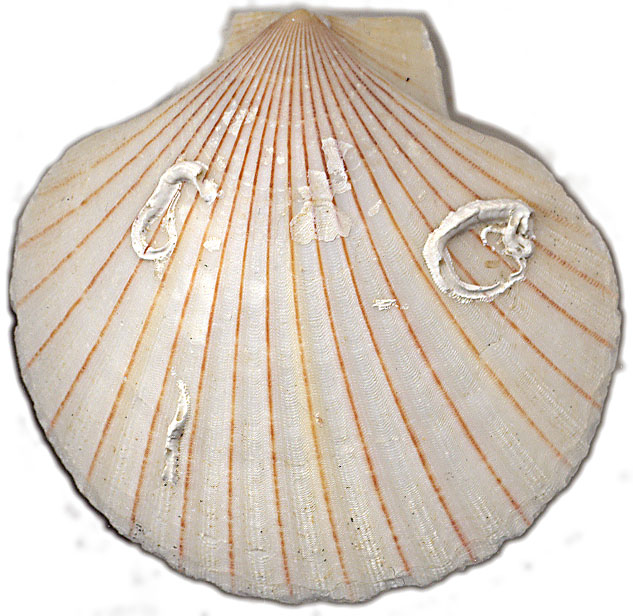
The scallop displays a fan-shaped shell made of two valves marked with prominent radiating ribs. Its color ranges from white to red-orange or brown depending on the species and environment. The central adductor muscle, which closes the shell, is the part most consumed by humans. The mantle border bears multiple sensory tentacles and small eyes.
Characteristics
Indicative values: they vary by subspecies, sex and region.
Habitat and distribution
Scallops live on sandy or gravelly seabeds, typically between a few meters and about one hundred meters in depth. They prefer coastal zones and well-oxygenated continental shelves. Some species attach to the substrate by a byssus, while others remain free and mobile on the seafloor.
CURRENT RANGE
Scallops are found in most seas throughout the world, from temperate to tropical waters. They are notably present in the Mediterranean, Atlantic, Pacific, and certain areas of the Indian Ocean. The Mediterranean, including the Tunisian coast, is home to several species that are commercially exploited.
Behaviour
The scallop is a bivalve mollusk capable of swimming by rapid contractions, clapping its two shells together to expel a jet of water. This movement allows it to escape certain predators such as starfish. It has numerous small blue eyes arranged along the mantle edge, sensitive to changes in light and movement. Most of the time, it remains resting on the seabed or partially buried, with its shells slightly open to filter the water.
Reproduction
Most scallops are hermaphrodites, producing both male and female gametes. Fertilization is external, with gametes released directly into the water during seasonal spawning events. Planktonic larvae drift for several weeks before settling on a substrate and metamorphosing into benthic juveniles.
Peculiarities
Scallops have up to a hundred small eyes lining their mantle, capable of detecting movement and light changes. Their ability to swim by clapping their shells is a rare feature among bivalves, most of which are sessile or have limited mobility. They are also among the rare bivalve mollusks harvested primarily for their muscle rather than for their entire flesh.
Threats and conservation
Overfishing is the primary threat facing some scallop populations, particularly in areas of intensive fishing. Seafloor degradation caused by trawling and coastal pollution also affect their habitats. Ocean warming and acidification could eventually weaken shell formation.
Numbers and trends vary across sources and regions. See the IUCN assessment for the latest reference data.
Gallery
1 documented photographs.
References
Profile updated 30 August 2026 · Reviewed by the TunisieVet editorial team.
Comments (0)
No comments yet.
CONSERVATION STATUS
Least concern (LC)
IUCN source, latest published assessment.
Species health
Documented diseases for this species.
Find a veterinarianThis information is provided for educational purposes only and is not a substitute for a veterinary consultation. If you have any concerns about your animal's health, consult a veterinarian.
Similar animals
Other species documented in Animalpedia.

Be among the first to use our app. Sign up and get early Google Play access.
Discover