Presentation
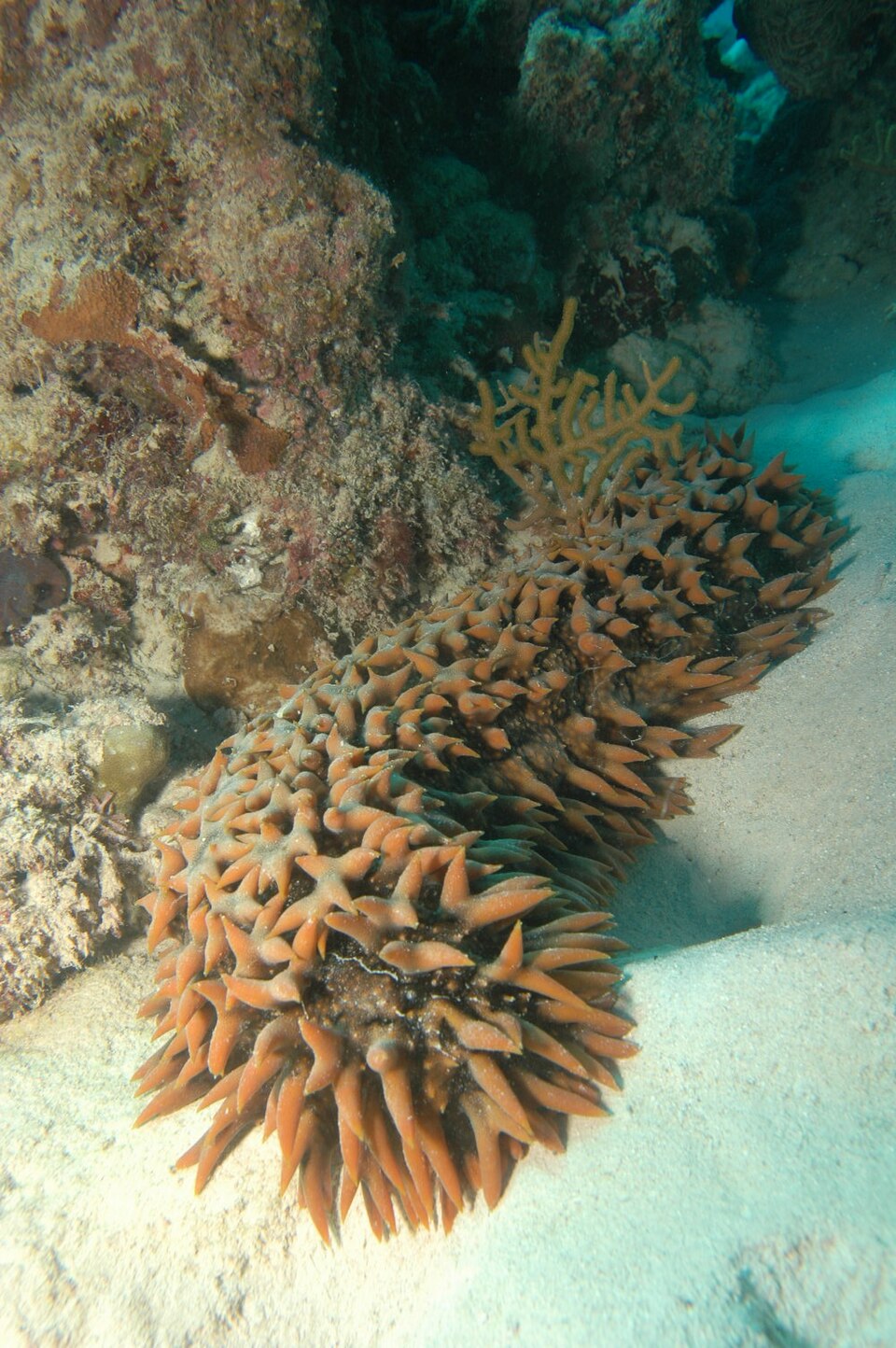
The sea cucumber, or holothurian, is a soft-bodied marine invertebrate belonging to the class Holothuroidea, related to sea urchins and starfish. Its soft, elongated, cylindrical body resembles a cucumber in shape, which is the origin of its common name. It lives on or buried in the seabed, where it plays an important role in recycling organic matter in the sediment. More than 1,700 species are distributed across all oceans, from shallow waters to the deepest abyssal zones. Some species are harvested commercially for human consumption, particularly in Asia, where they are known as bêche-de-mer. Its rough skin contains tiny calcareous structures called sclerites, visible under a microscope.
The body is soft, without a shell or carapace, and displays the characteristic pentagonal radial symmetry of echinoderms. The mouth, surrounded by buccal tentacles, is located at one end and the anus at the other. The skin, often rough or slimy, contains an internal skeleton reduced to small calcareous pieces scattered throughout.
Characteristics
Indicative values: they vary by subspecies, sex and region.
Habitat and distribution
Sea cucumbers live on the seafloor, whether sandy, muddy, coral reef, or rocky areas. They are found from the coastal zone down to the ocean depths. They particularly favour soft substrates rich in organic matter.
CURRENT RANGE
Sea cucumbers are present in all the world's oceans, from tropical to polar waters. They are particularly diverse in the coral reefs of the Indo-Pacific. In the Mediterranean, several species are common, including along the Tunisian coast.
Behaviour
The animal moves very slowly across the seabed using small tube feet or by muscular contraction. It is generally inactive during the day and feeds mainly at night. When threatened by a predator, some species can expel part of their internal organs (defensive evisceration) or release stinging filaments, before regenerating them.
Reproduction
Reproduction is most often sexual, with separate release of male and female gametes directly into the water, resulting in external fertilization. The larvae that develop are planktonic and disperse before metamorphosing into benthic juveniles. Some species can also reproduce by fission, dividing into two parts that each regenerate into a complete individual.
Peculiarities
Some species breathe partly through a system called a respiratory tree located near the anus, which pumps seawater. The sea cucumber has a remarkable capacity to regenerate its internal organs after evisceration. Its flesh is used in traditional medicine and Asian cuisine under the name sea cucumber or bêche-de-mer.
Threats and conservation
Overfishing for the Asian sea cucumber market is the main threat to many sea cucumber populations. Degradation of coastal habitats, particularly coral reefs and seagrass beds, also reduces their living areas. Some species with high commercial value are now locally depleted.
Numbers and trends vary across sources and regions. See the IUCN assessment for the latest reference data.
Gallery
1 documented photographs.
References
Profile updated 15 September 2026 · Reviewed by the TunisieVet editorial team.
Comments (0)
No comments yet.
CONSERVATION STATUS
Data deficient (DD)
IUCN source, latest published assessment.
Species health
Documented diseases for this species.
This information is provided for educational purposes only and is not a substitute for a veterinary consultation. If you have any concerns about your animal's health, consult a veterinarian.
To discover around: Sea Cucumber
Videos, facts, stories and records linked to this species.
Similar animals
Other species documented in Animalpedia.