
Presentation
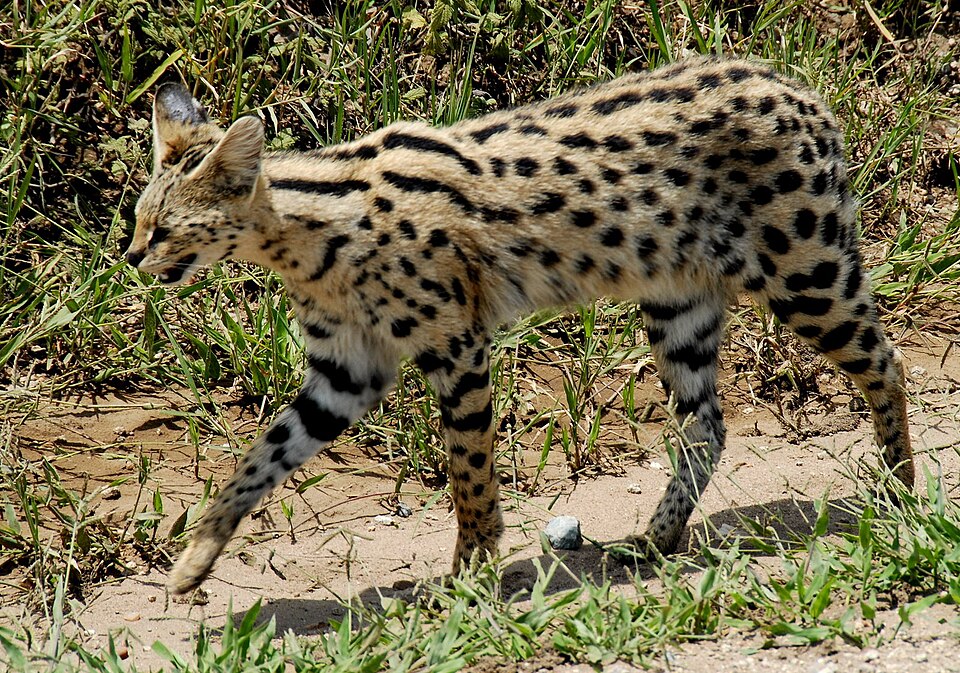
The Serval is a medium-sized feline native to Africa, recognizable by its long legs, large rounded ears and spotted coat similar to that of the cheetah. It has the most slender body and the most atypical proportions among the small felines, with particularly long limbs in relation to its body mass. Solitary and discreet, it hunts mainly at dusk and at night in the tall grass of humid savannahs. Its elegant silhouette and curious behavior make it a species sometimes sought after as an exotic pet, although its keeping poses ethical and regulatory questions. It remains less threatened overall than other African felines, but locally vulnerable to the degradation of wetlands.
The Serval has a slender body supported by long legs, particularly suited to jumping and running in tall grass. Its oversized ears give it exceptional hearing, essential for locating prey in dense vegetation. Its tawny coat spotted with black varies depending on the population, some having melanistic forms that are almost completely black.
Characteristics
Indicative values: they vary by subspecies, sex and region.
Habitat and distribution
The Serval mainly frequents grassy savannahs and wetlands bordering rivers and swamps in sub-Saharan Africa. It likes environments with tall vegetation to hide while remaining close to permanent water points. It generally avoids dense forests and arid areas lacking plant cover.
CURRENT RANGE
The species is widely distributed in sub-Saharan Africa, from Senegal to eastern and southern Africa. An isolated population also remains in North Africa, notably in Morocco, but it is absent from Tunisia in the wild. Its numbers vary greatly depending on the availability of wetlands and hunting pressure.
Behaviour
The Serval is a solitary and territorial animal, active especially at dawn, dusk and night. It communicates by scent marking and a variety of vocalizations, including a characteristic bark. A good swimmer and excellent jumper, it generally avoids contact with humans in the wild.
Reproduction
The female gives birth after a gestation of approximately two to three months, giving birth to a litter of one to four young. The young are born blind and remain hidden in a burrow or dense vegetation during the first weeks. Weaning occurs around four to five months, and independence is achieved around a year.
Peculiarities
Serval has the proportionally longest legs of any feline relative to its body size. It is also at the origin, by hybridization with the domestic cat, of the breed of companion cat called Savannah.
Threats and conservation
The destruction and drying of wetlands constitutes the main threat to the species. The Serval is also hunted for its fur and sometimes persecuted as a predator of poultry. The illegal trade in exotic pets puts additional pressure on some local populations.
Numbers and trends vary across sources and regions. See the IUCN assessment for the latest reference data.
Gallery
1 documented photographs.
References
Profile updated 18 August 2026 · Reviewed by the TunisieVet editorial team.
Comments (0)
No comments yet.
CONSERVATION STATUS
Least concern (LC)
IUCN source, latest published assessment.
Species health
Documented diseases for this species.
See the 8 diseases of this species Find a veterinarianThis information is provided for educational purposes only and is not a substitute for a veterinary consultation. If you have any concerns about your animal's health, consult a veterinarian.
To discover around: Serval
Videos, facts, stories and records linked to this species.
RECORD
around 50% success
The best hunting success rate among felines
Estimated proportion of hunting attempts resulting in capture, observed in wild servals in...
Similar animals
Other species documented in Animalpedia.

TunisieVet in your pocket 📱🐾 Access your veterinary services wherever you are. [ Download the app ]
Learn more