
Presentation
The Peregrine falcon is a medium-sized raptor, reputed to be the fastest bird in the world. With its slender silhouette and pointed wings, it embodies the excellence of fighter flight. Present on all continents except Antarctica, it is an aerial predator par excellence, specializing in capturing birds in flight.
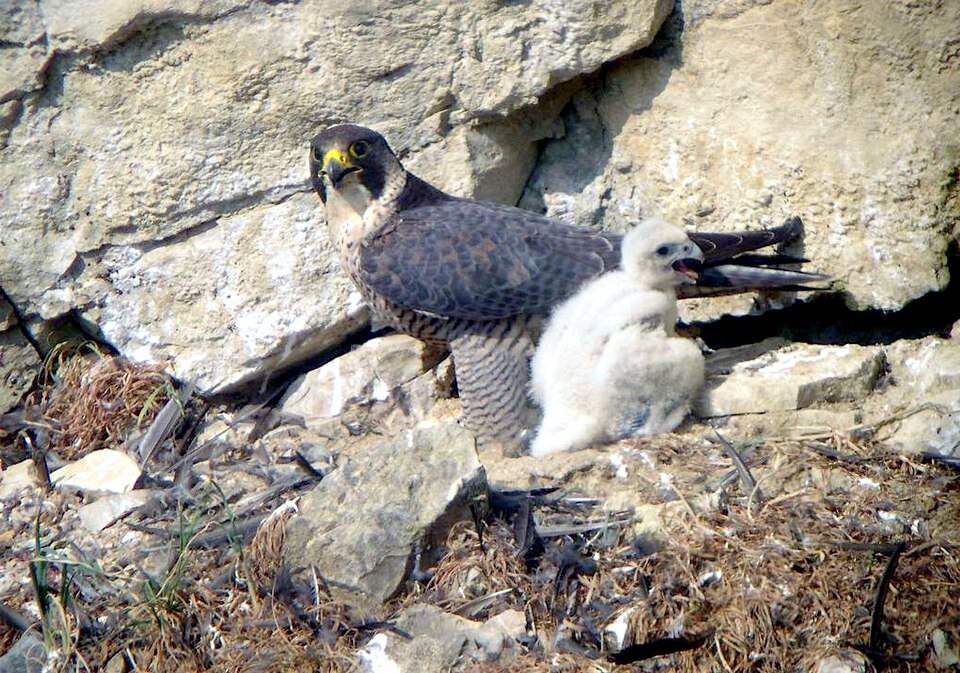
Distinctive morphology with blue-gray back and whitish breast streaked with black. The black face mask contrasts sharply with the white cheeks. The pointed wings and short tail give it a very aerodynamic silhouette. Sexual dimorphism is marked: the female is larger than the male.
Did you know?
What is the fastest animal in the world?
Characteristics
Indicative values: they vary by subspecies, sex and region.
Habitat and distribution
Opportunistic in its habitat choices, the Peregrine falcon occupies rugged mountains, coastal cliffs and modern urban environments. It also frequents open rural areas provided there are cliffs or high structures for nesting. The main thing is the availability of winged prey and a safe, high nesting site.
CURRENT RANGE
Cosmopolitan, the Peregrine falcon is present on all continents except Antarctica. It inhabits tropical as well as temperate and subarctic zones. Some populations are migratory (particularly in Northern Europe), while others are permanent residents. The largest concentrations are found in coastal and mountainous areas.
Behaviour
A solitary and territorial hunter, the Peregrine falcon is active especially at dawn and dusk. It adopts a spectacular hunting strategy: the dive dive, where it drops down and pecks at its prey from above. In normal flight it is very agile, capable of sharp turns and instantaneous changes of direction. It is a rather discreet bird on the ground.
Reproduction
Monogamous and faithful to its partner and its nesting site for several years. The female generally lays 3 to 4 eggs in a basic nest on cliffs or tall buildings. Incubation lasts approximately 30 days. The young leave the nest after 5 to 6 weeks and fly away after 8 to 10 weeks. Only one generation per year.
Peculiarities
The Peregrine falcon holds a remarkable record: when diving, it can reach speeds exceeding 300 km/h, making it the fastest land animal. Its eyes are exceptional, endowed with vision 8 times greater than that of humans, allowing it to detect its prey from more than a kilometer away. Its nostrils have special baffles that regulate airflow during extreme dives.
Threats and conservation
Once threatened by direct persecution and pesticides (particularly DDT which caused shell thinning), Peregrine falcon has benefited from successful reintroduction programs. Today it is well legally protected in most regions. Residual threats include collisions with structures, nest disturbance and ongoing pollution.
Numbers and trends vary across sources and regions. See the IUCN assessment for the latest reference data.
Gallery
1 documented photographs.
References
UICN — Liste rouge des espèces menacées
Profile updated 01 September 2026 · Reviewed by the TunisieVet editorial team.
Comments (0)
No comments yet.
CONSERVATION STATUS
Least concern (LC)
IUCN source, latest published assessment.
Species health
Documented diseases for this species.
This information is provided for educational purposes only and is not a substitute for a veterinary consultation. If you have any concerns about your animal's health, consult a veterinarian.
Related species
To discover around: Peregrine falcon
Videos, facts, stories and records linked to this species.
Similar animals
Other species documented in Animalpedia.

TunisieVet in your pocket 📱🐾 Access your veterinary services wherever you are. [ Download the app ]
Learn more