
Presentation
Chimpanzee is a large African primate, one of the closest living relatives of humans with whom it shares approximately 98% of its DNA. This intelligent and social animal lives in hierarchical groups in the forests and savannahs of West and Central Africa. Endowed with a great capacity for learning and adaptation, the Chimpanzee uses tools and has a complex social culture transmitted between generations.
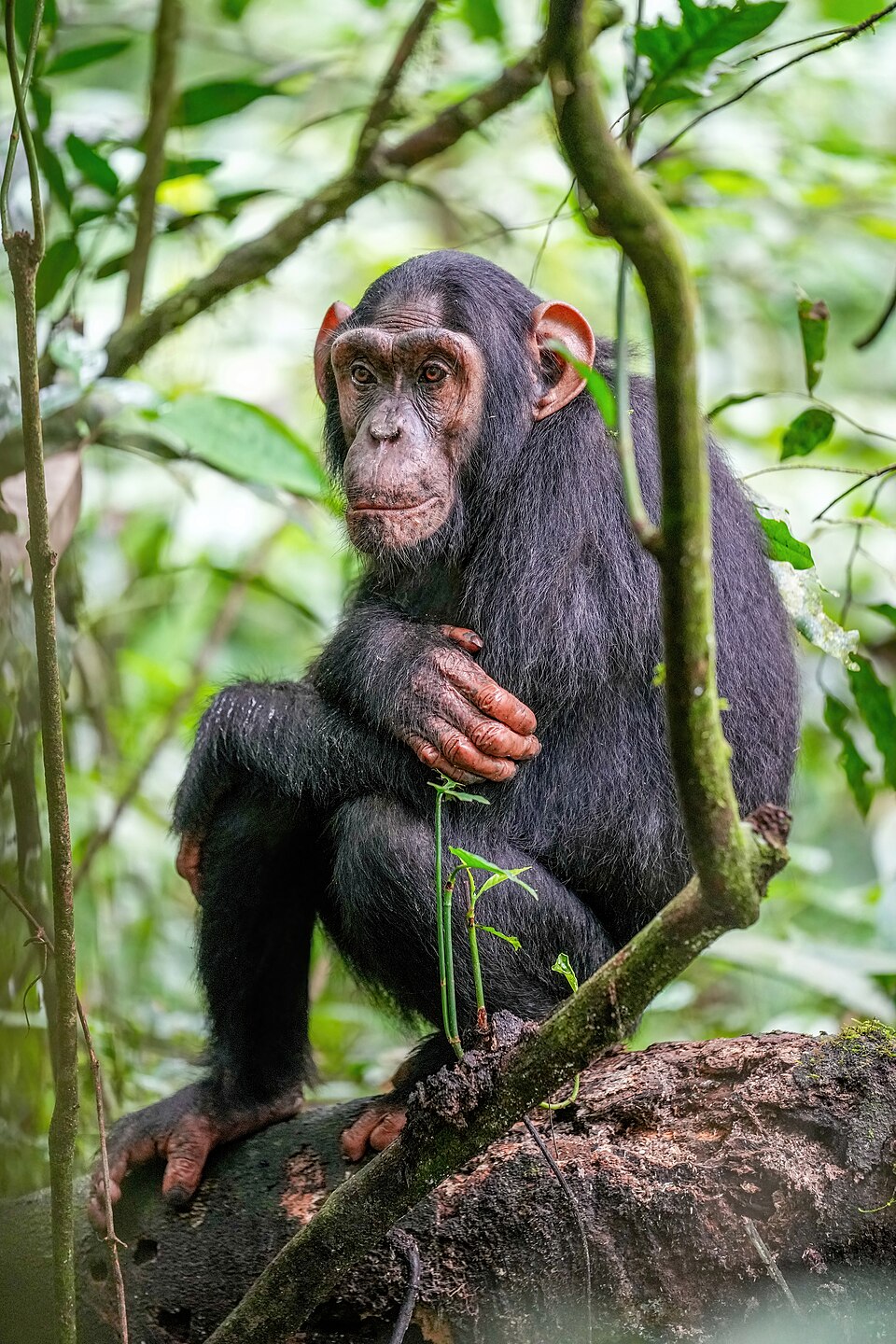
The Chimpanzee has a massive body covered in black or dark brown hair, with large, protruding ears, a bare face, and very long arms, significantly longer than the legs. His exceptional intelligence is manifested by great behavioral flexibility, excellent memory and remarkable problem-solving ability. Its hands have opposable thumbs allowing fine gripping, while its feet retain a certain flexibility adapted to arboreal and terrestrial life.
Characteristics
Indicative values: they vary by subspecies, sex and region.
Habitat and distribution
The Chimpanzee inhabits the dense tropical forests and wooded savannahs of West and Central Africa, where it mainly occupies the arboreal stages. It seeks environments with high availability of fruit, water sources and trees suitable for building sleeping nests. These forest and semi-forest environments constitute essential habitats for the survival of the species, which can cover vast territories depending on seasonal resources.
CURRENT RANGE
Chimpanzee is distributed in West and Central Africa, with fragmented populations extending from Senegal to Tanzania. The largest concentrations are in Uganda, the Democratic Republic of Congo, Tanzania and Ivory Coast. The species is not present in Tunisia. Its range has shrunk considerably over the last century, with current populations isolated from each other by areas converted to agriculture or urbanization.
Behaviour
The Chimpanzee is a highly social animal living in communities of 15 to 150 individuals led by a dominant male. These groups practice fission-fusion: individuals disperse and regroup depending on available resources. Chimpanzees communicate through complex vocalizations, gestures and facial expressions, and possess a rich emotional life including empathy, play and humor. They make and use tools for various tasks, a behavior transmitted culturally within groups.
Reproduction
The Chimpanzee female reaches sexual maturity around 13-14 years old, while males reproduce from 15-16 years old. Gestation lasts about 8.5 months and usually results in the birth of a single calf, rarely twins. The mother cares for the young for 5 to 6 years, a crucial period for social learning and skill acquisition. Breastfeeding can last 5 years and maternal dependence extends well beyond weaning.
Peculiarities
The Chimpanzee is distinguished by his sophisticated use of tools: he makes sticks to extract termites, leaf sponges to collect water, and uses stones to crack nuts. It has distinct cultural traditions between groups, including regional vocal variations and specific hunting practices. Remarkably, Chimpanzee recognizes its reflection in a mirror, demonstrating self-awareness, and exhibits complex mourning behaviors towards deceased peers.
Threats and conservation
The Chimpanzee faces major threats: habitat loss due to deforestation and agricultural expansion, poaching for the bushmeat trade, and capture for animal trafficking. Diseases, notably Ebola and other zoonoses, have caused massive mortality in certain populations. Conflict with humans is intensifying as territories fragment, and climate change threatens the availability of essential food resources.
Numbers and trends vary across sources and regions. See the IUCN assessment for the latest reference data.
Gallery
1 documented photographs.
References
UICN — Liste rouge des espèces menacées
Profile updated 30 August 2026 · Reviewed by the TunisieVet editorial team.
Comments (0)
No comments yet.
CONSERVATION STATUS
Endangered (EN)
IUCN source, latest published assessment.
Species health
Documented diseases for this species.
This information is provided for educational purposes only and is not a substitute for a veterinary consultation. If you have any concerns about your animal's health, consult a veterinarian.
To discover around: Chimpanzee
Videos, facts, stories and records linked to this species.
Similar animals
Other species documented in Animalpedia.

TunisieVet in your pocket 📱🐾 Access your veterinary services wherever you are. [ Download the app ]
Learn more