
Presentation
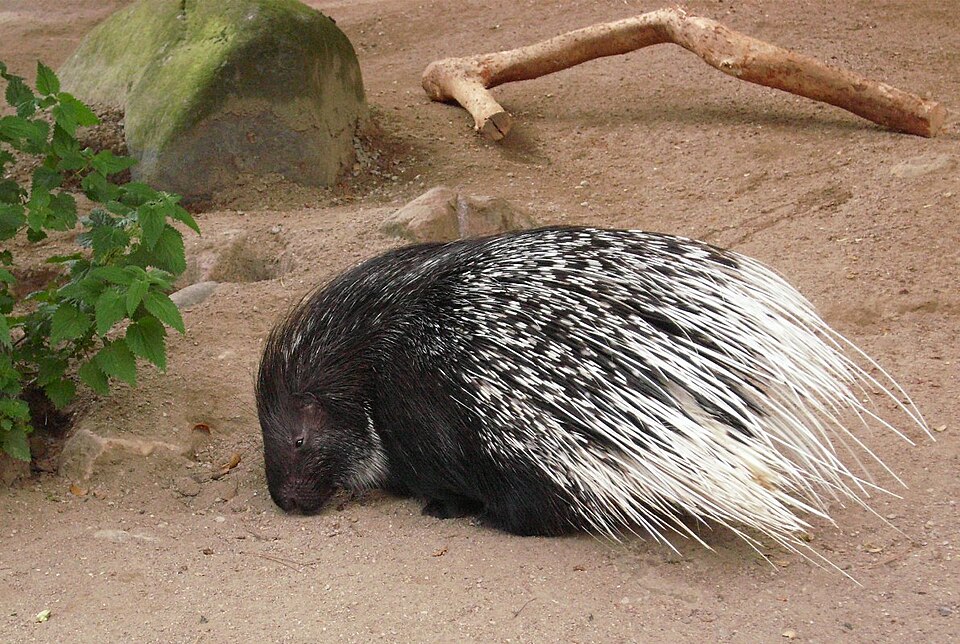
The Crested porcupine is a large rodent, easily recognizable by its black and white quills that bristle its body. This robust and stocky animal moves slowly but has a formidable natural defense. Mainly nocturnal and solitary, it frequents a wide range of habitats in North and South Africa.
Its most striking feature is its remarkable cape of thorns, composed of long, pointed and very sharp quills, black with white bands. The head bears a crest of erectile hairs. The body is stocky and massive, adapted to its underground life. The legs are short but powerful, equipped with sturdy claws for digging.
Characteristics
Indicative values: they vary by subspecies, sex and region.
Habitat and distribution
The Crested porcupine frequents open forests, rocky mountainous areas, arid steppes and shrubby savannahs. It adapts to very varied environments, from sea level to medium altitudes. However, it avoids absolute deserts and dense humid forests. It digs burrows in areas with sufficiently loose soil.
CURRENT RANGE
Widely distributed in North and Sub-Saharan Africa, Crested porcupine is present from Morocco to East and Central Africa. Its range includes Mediterranean Africa, the Sahelian regions and the savannahs of East Africa. In the Mediterranean, it even reaches Italy and the Balkans.
Behaviour
A nocturnal and crepuscular animal, the Crested porcupine is generally solitary or in pairs. It spends the day in deep burrows which it digs or reoccupies. At night, he goes out to look for his food. When threatened, it bristles its quills and can vibrate loudly to impress the aggressor. Its high-pitched cries signal distress.
Reproduction
Reproduction takes place mainly in autumn and winter. After a gestation of approximately 110 days, the female gives birth to 1 to 4 young, usually 2 to 3. The young are born with soft spines which harden quickly. They are weaned around 3 to 4 months and become independent.
Peculiarities
Contrary to popular belief, the Porcupine cannot throw its quills from a distance; they detach easily on contact but are not projectiles. Its hollow, lightly barbed quills dig deep and cause painful wounds. Its highly developed sense of smell allows it to locate its underground food. It produces characteristic paw prints when moving.
Threats and conservation
The species is not globally threatened and remains common in many regions. However, it can be hunted for its meat or traditionally used thorns, and it comes into conflict with farmers due to crop damage. Habitat loss in some fragmented areas poses a local threat.
Numbers and trends vary across sources and regions. See the IUCN assessment for the latest reference data.
Gallery
1 documented photographs.
References
UICN — Liste rouge des espèces menacées
Profile updated 02 September 2026 · Reviewed by the TunisieVet editorial team.
Comments (0)
No comments yet.
CONSERVATION STATUS
Least concern (LC)
IUCN source, latest published assessment.
Species health
Documented diseases for this species.
This information is provided for educational purposes only and is not a substitute for a veterinary consultation. If you have any concerns about your animal's health, consult a veterinarian.
Related species
To discover around: Crested porcupine
Videos, facts, stories and records linked to this species.
Similar animals
Other species documented in Animalpedia.

TunisieVet in your pocket 📱🐾 Access your veterinary services wherever you are. [ Download the app ]
Learn more