
Presentation
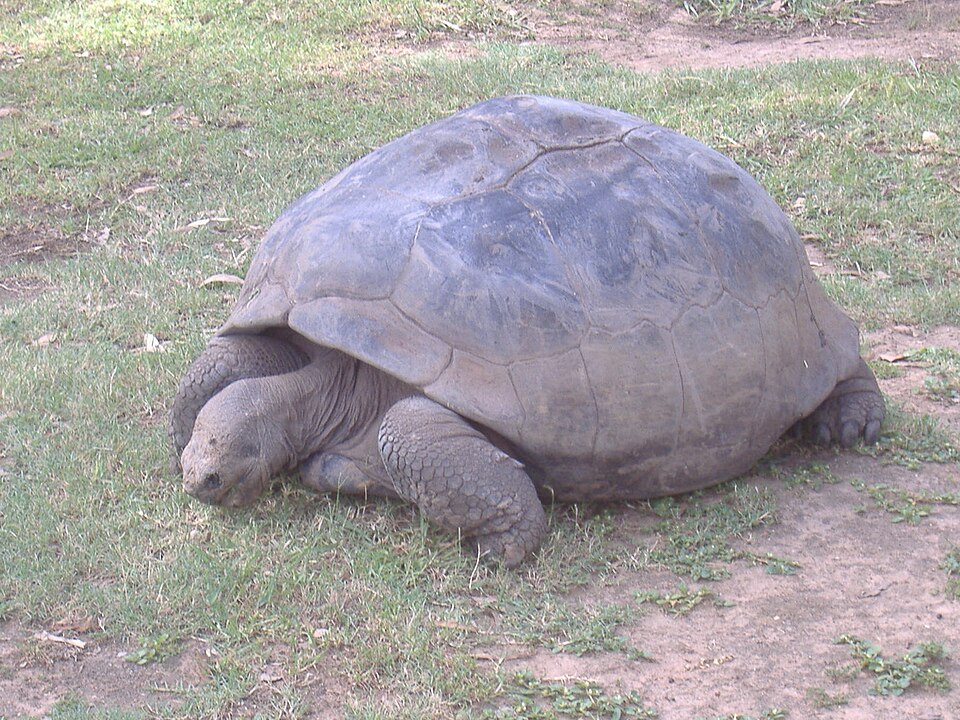
The Galapagos tortoise is the largest living land turtle, endemic to the Galapagos archipelago in Ecuador. It is distinguished by its massive shell, the shape of which varies depending on the island, domed into a dome or into a saddle. This species can live for more than a century and reach remarkable sizes. It played an important historical role in Charles Darwin's observations on evolution. Today distributed into several subspecies or species depending on the islands, it remains a symbol of Galapagian fauna. Its slowness and longevity make it an emblematic animal among large terrestrial reptiles.
The carapace can be over 1.5 meters long and the legs are thick, adapted to carrying considerable weight. The neck is long, especially in saddle-shelled individuals living in arid areas. The skin is thick, grayish to brownish, resistant to dehydration. Males are generally larger than females.
Characteristics
Indicative values: they vary by subspecies, sex and region.
Habitat and distribution
The species occupies varied environments across the archipelago, ranging from arid coastal areas to humid highlands and volcano forests. Saddle-shelled populations live in dry areas where low vegetation is rare, while those with dome shells frequent more humid and grassy areas at altitude. She needs water points or muddy areas to cool off. Its isolated island habitat explains the great morphological diversity between populations.
CURRENT RANGE
The species is endemic to the Galapagos archipelago, located in the Pacific Ocean approximately 1000 km from the coast of continental Ecuador. It is spread over several main islands such as Isabela, Santa Cruz and San Cristóbal. Each island or volcano often hosts a distinct population, considered by some taxonomists to be a species in its own right.
Behaviour
A solitary, diurnal animal, it spends much of the day feeding and basking in the sun or mud to regulate its temperature. She is known for her very slow pace and placid behavior. Wetland turtles sometimes migrate to higher elevations during the dry season to find water and food. Males may adopt dominant postures during encounters, including stretching their necks.
Reproduction
Reproduction is not linked to a strict season but intensifies during the hot and humid season. After mating, the female digs a nest in the sand or loose earth where she lays between 2 and 16 eggs. Incubation lasts 4 to 8 months and the temperature of the nest determines the sex of the young. Young turtles are completely independent from hatching and grow very slowly.
Peculiarities
This turtle can survive long periods without food or water, which led to the species being massively exploited by whalers and pirates in the 19th century as a reserve of fresh meat. Charles Darwin studied it during his voyage on the Beagle in 1835, contributing to his thoughts on natural selection. The diversity of shell shapes across islands is a classic example of evolutionary adaptation.
Threats and conservation
The species has suffered a severe decline due to historical hunting and the introduction of predators and competitors such as rats, goats and pigs. The destruction of its habitat by these invasive species remains a persistent threat. Conservation and captive breeding programs, notably on Santa Cruz Island, have helped restore certain populations.
Numbers and trends vary across sources and regions. See the IUCN assessment for the latest reference data.
Gallery
1 documented photographs.
References
Profile updated 01 September 2026 · Reviewed by the TunisieVet editorial team.
Comments (0)
No comments yet.
CONSERVATION STATUS
Vulnerable (VU)
IUCN source, latest published assessment.
Species health
Documented diseases for this species.
This information is provided for educational purposes only and is not a substitute for a veterinary consultation. If you have any concerns about your animal's health, consult a veterinarian.
To discover around: Galapagos tortoise
Videos, facts, stories and records linked to this species.
RECORD
up to approximately 1.8 m carapace / more than 400 kg
The largest living land turtle
Measurement taken on the largest known wild or captive individuals.
Similar animals
Other species documented in Animalpedia.
