
Presentation
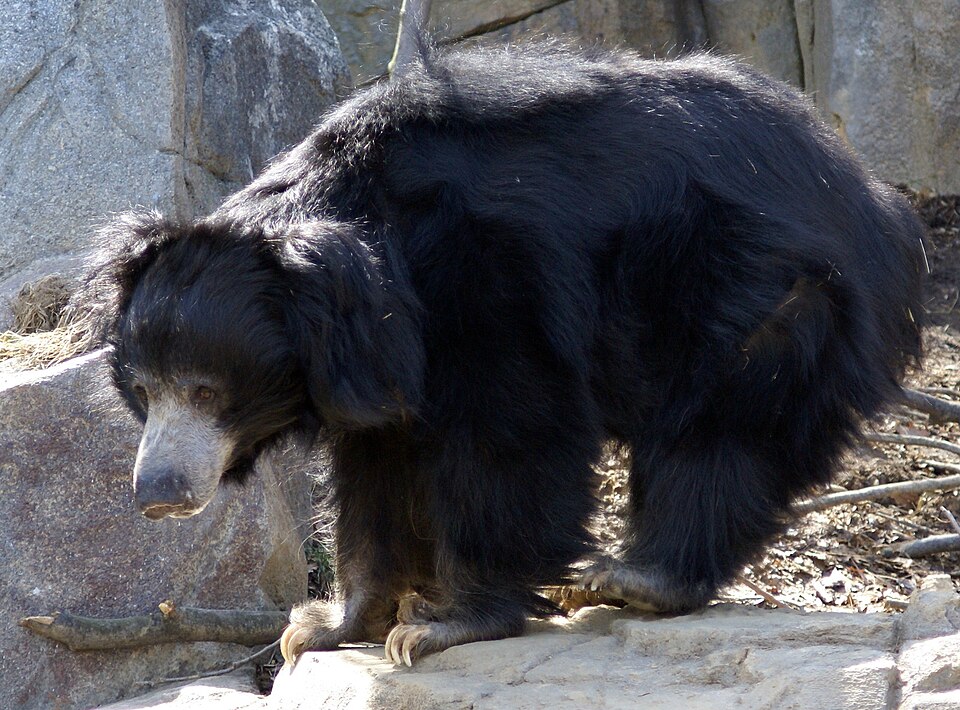
The sloth bear (Melursus ursinus) is a species of bear native to the Indian subcontinent, recognizable by its shaggy black coat and long snout adapted to searching for insects. It feeds largely on termites and ants, which it sucks up noisily using movable lips devoid of upper incisors. This anatomical feature gives it its common name. The species is nocturnal to crepuscular and most often lives solitary. It is threatened by the destruction of its forest habitat and by poaching. It is subject to protection measures in several South Asian countries.
The sloth bear has a long, black, shaggy coat, often adorned with a white or cream V-shaped patch on the chest. Its snout is elongated and mobile, hairless, and its protractile lips allow it to suck up insects. It lacks upper incisors, which facilitates this particular feeding technique. Its front claws are long and curved, adapted to digging termite mounds.
Characteristics
Indicative values: they vary by subspecies, sex and region.
Habitat and distribution
sloth bear frequents dry and humid tropical forests, as well as wooded savannah and grassy grassland areas of the Indian subcontinent. It favors regions rich in termite mounds and fruit trees. Its habitat also extends to low mountain areas in parts of its range.
CURRENT RANGE
The species occurs mainly in India, Sri Lanka, Nepal and Bhutan. It has disappeared from parts of its historic range due to habitat fragmentation. Its population is today fragmented into several isolated centers across the Indian subcontinent.
Behaviour
sloth bear is primarily nocturnal and crepuscular, an adaptation that allows it to avoid daytime heat and certain predators. It is mainly solitary, except during the breeding season or when a female is accompanied by her young. The species is known for its sometimes unpredictable behavior and can be aggressive if surprised. She climbs trees with agility despite a general slow pace.
Reproduction
The female generally gives birth to a litter of one to two cubs after a gestation of about seven months. Births take place in a burrow or sheltered den. The young stay with their mother for about two to three years, during which time she sometimes carries them on her back. Sexual maturity is reached around the age of three.
Peculiarities
The sloth bear can suck termites through a gap left by the absence of its upper incisors, producing a characteristic noise audible several meters away. Females frequently carry their cubs on their backs, a rare behavior among ursids. The species is sometimes used historically as a show animal in South Asia, a practice now banned.
Threats and conservation
Deforestation and the conversion of natural habitats into agricultural land greatly reduce the territories available for the species. Poaching, particularly for gallbladder used in traditional medicine, poses a persistent threat. Conflicts with human populations, linked to agricultural expansion, also lead to direct mortality.
Numbers and trends vary across sources and regions. See the IUCN assessment for the latest reference data.
Gallery
1 documented photographs.
References
Profile updated 25 August 2026 · Reviewed by the TunisieVet editorial team.
Comments (0)
No comments yet.
CONSERVATION STATUS
Vulnerable (VU)
IUCN source, latest published assessment.
Species health
Documented diseases for this species.
This information is provided for educational purposes only and is not a substitute for a veterinary consultation. If you have any concerns about your animal's health, consult a veterinarian.
To discover around: sloth bear
Videos, facts, stories and records linked to this species.
Similar animals
Other species documented in Animalpedia.

TunisieVet in your pocket 📱🐾 Access your veterinary services wherever you are. [ Download the app ]
Learn more