
Presentation
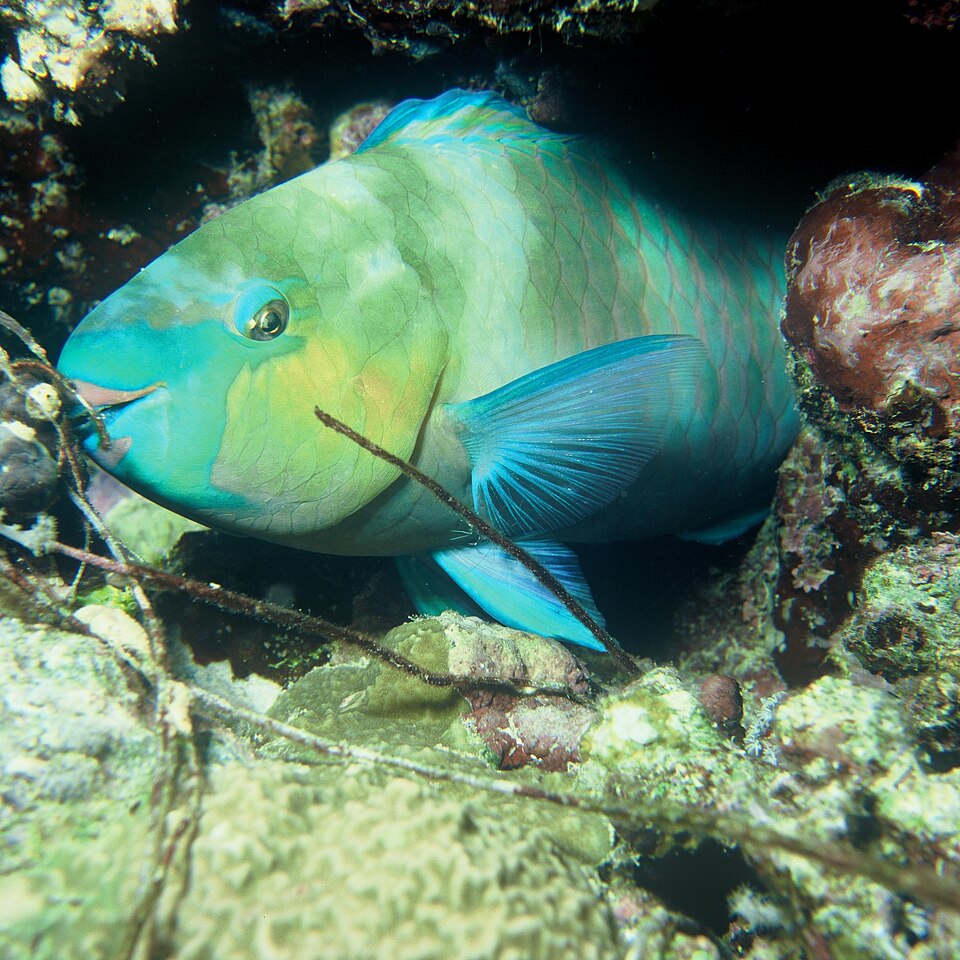
The Parrotfish is a tropical marine fish belonging to the family Scaridae, known for its bright colors and fused, beak-like mouth. It lives mainly on coral reefs where it feeds on algae by grazing on coral. Its powerful beak allows it to scrape hard surfaces and plays an essential role in the production of coral sand. There are around a hundred species distributed in the warm seas of the world. Some species change sex and color throughout their lives, a phenomenon called sequential hermaphroditism. At night, some individuals secrete a protective cocoon of mucus around their body.
The body is oval and laterally compressed, covered in brightly colored scales ranging from blue to green to pink and orange. The mouth is made up of fused teeth forming a robust beak reminiscent of a parrot, hence its name. The fins are well developed, suitable for slow but precise swimming near reefs.
Characteristics
Indicative values: they vary by subspecies, sex and region.
Habitat and distribution
The Parrotfish lives in coral reefs and shallow, clear marine waters of tropical and subtropical areas. It also sometimes frequents seagrass meadows and coastal rocky areas. Its presence is closely linked to the health of the coral ecosystems on which it depends for food and shelter.
CURRENT RANGE
The species is widely distributed in tropical and subtropical seas, including the Indo-Pacific, the Caribbean and the Red Sea. It is absent from cold temperate waters and is not present in the Mediterranean, including off Tunisia.
Behaviour
The Parrotfish is active during the day and moves in small groups or schools on coral reefs. At night, certain species secrete an envelope of mucus which protects them from parasites and masks their smell from predators. It can change color and sex during its life, usually transitioning from a female phase to a terminal male phase.
Reproduction
Reproduction occurs by spawning in open water, often in grouped gatherings near the reef. The eggs are pelagic and drift with the current before the larvae hatch. Many species exhibit sequential hermaphroditism, changing sex from female to male at some stage in their development.
Peculiarities
Parrotfish plays a major ecological role by producing much of the white sand on tropical beaches via coral digestion. Its change of sex and color during life is a notable feature among reef fishes. The nocturnal mucus cocoon constitutes an original defensive adaptation against predators and parasites.
Threats and conservation
The degradation of coral reefs, linked to global warming and pollution, directly threatens its habitat. Overfishing in some tropical regions is reducing local populations. The destruction of coastal habitats and unregulated tourism are also increasing pressure on the species.
Numbers and trends vary across sources and regions. See the IUCN assessment for the latest reference data.
Gallery
1 documented photographs.
References
Profile updated 30 August 2026 · Reviewed by the TunisieVet editorial team.
Comments (0)
No comments yet.
CONSERVATION STATUS
Least concern (LC)
IUCN source, latest published assessment.
Species health
Documented diseases for this species.
This information is provided for educational purposes only and is not a substitute for a veterinary consultation. If you have any concerns about your animal's health, consult a veterinarian.
Similar animals
Other species documented in Animalpedia.

TunisieVet in your pocket 📱🐾 Access your veterinary services wherever you are. [ Download the app ]
Learn more