
Presentation
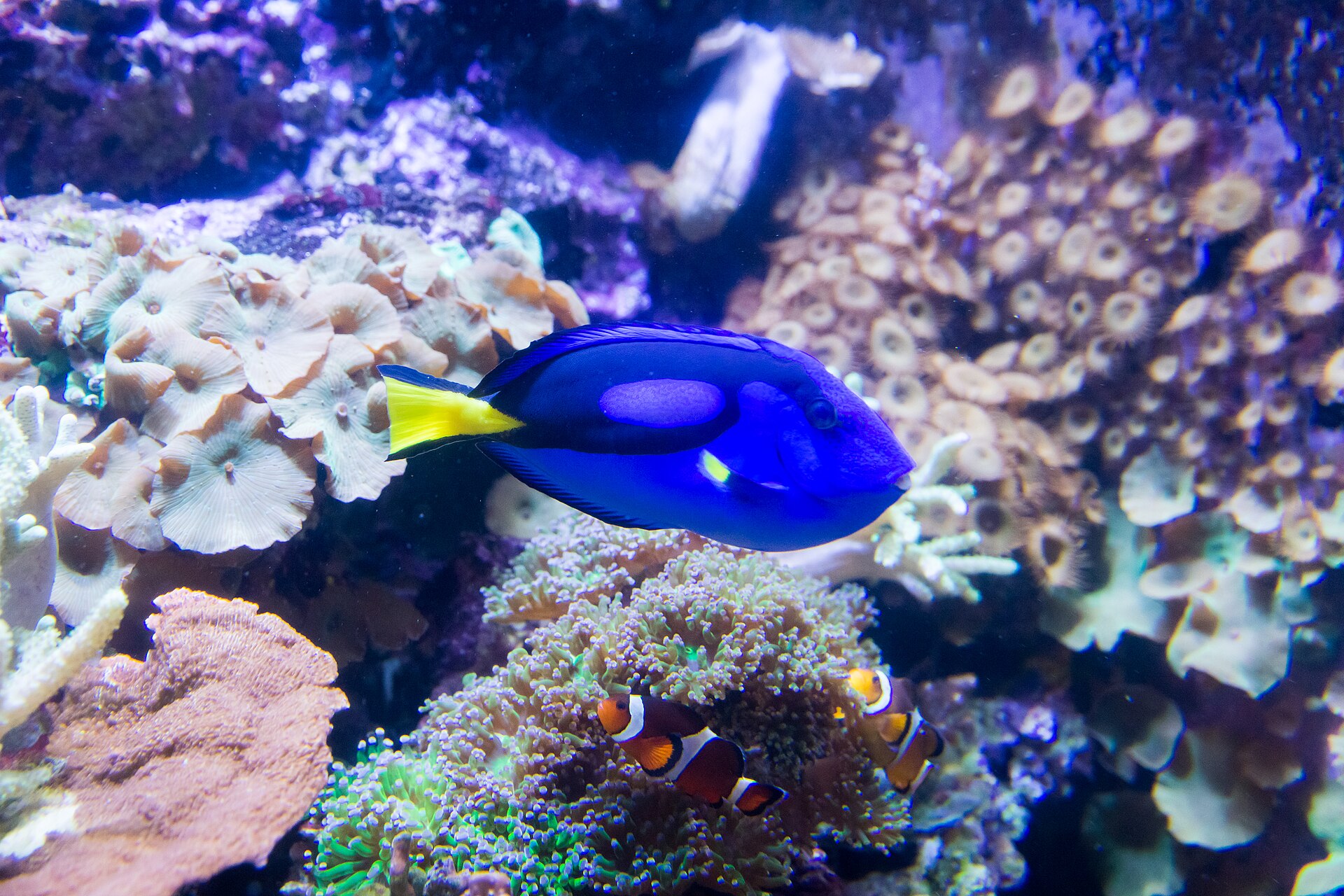
The Surgeonfish is a tropical marine fish recognizable by its laterally compressed oval shape and its often bright colors. Its name comes from the sharp spines located on either side of its caudal peduncle, similar to scalpel blades. It lives solitary, in pairs or in schools depending on the species, on coral reefs. This herbivorous fish plays an important ecological role by limiting the proliferation of algae on corals. The Acanthuridae family brings together several dozen species distributed in the warm seas of the globe.
The body is oval, laterally flattened, with variable coloring depending on the species, often blue, yellow or brown. One or two retractile sharp spines are present on each side of the caudal peduncle, used as defense. The dorsal fin and anal fin are long and continuous.
Characteristics
Indicative values: they vary by subspecies, sex and region.
Habitat and distribution
The species frequents coral reefs and shallow rocky areas of tropical and subtropical waters. It favors lagoons, the outer slopes of reefs and seagrass beds where algae is abundant.
CURRENT RANGE
Surgeonfish are widely distributed in tropical and subtropical areas of the Indian Ocean, the Pacific, and to a lesser extent the Atlantic and Red Seas. They are absent from cold temperate waters such as the western Mediterranean or the Tunisian coasts.
Behaviour
Depending on the species, it lives solitary, in small groups or in large schools that can number several hundred individuals. Schooling behavior dilutes the risk of predation and facilitates access to algal areas defended by other territorial fish. The tail spines are deployed when threatened and can inflict deep wounds.
Reproduction
Reproduction occurs by external fertilization, usually during seasonal gatherings near the surface. Females release thousands of pelagic eggs which drift with the plankton. The larvae go through a prolonged planktonic stage before reaching the reefs and metamorphosing into juveniles.
Peculiarities
The common name of this fish refers to its sharp tail spines compared to surgical scalpels. Certain species are popular in marine aquariums, notably the blue surgeonfish popularized by animated films.
Threats and conservation
The degradation of coral reefs, linked to global warming and pollution, constitutes the main threat to this family. Overfishing for the aquarium trade affects certain populations locally. Most species, however, remain widespread.
Numbers and trends vary across sources and regions. See the IUCN assessment for the latest reference data.
Gallery
1 documented photographs.
References
Profile updated 30 August 2026 · Reviewed by the TunisieVet editorial team.
Comments (0)
No comments yet.
CONSERVATION STATUS
Least concern (LC)
IUCN source, latest published assessment.
Species health
Documented diseases for this species.
Find a veterinarianThis information is provided for educational purposes only and is not a substitute for a veterinary consultation. If you have any concerns about your animal's health, consult a veterinarian.
Similar animals
Other species documented in Animalpedia.

TunisieVet in your pocket 📱🐾 Access your veterinary services wherever you are. [ Download the app ]
Learn more