
Presentation
The Atlantic Salmon is a migratory fish belonging to the Salmonidae family, known for its life cycle shared between fresh and salt water. It is born in rivers, reaches the ocean to grow, then returns to its native river to reproduce. Its spindle-shaped, silvery body is adapted to rapid swimming and long migrations. The species is of major economic importance, both for wild fishing and for intensive aquaculture. It is also a strong ecological symbol, an indicator of the quality of waterways. Its pink flesh, rich in omega-3, makes it a very popular fish in the human diet.
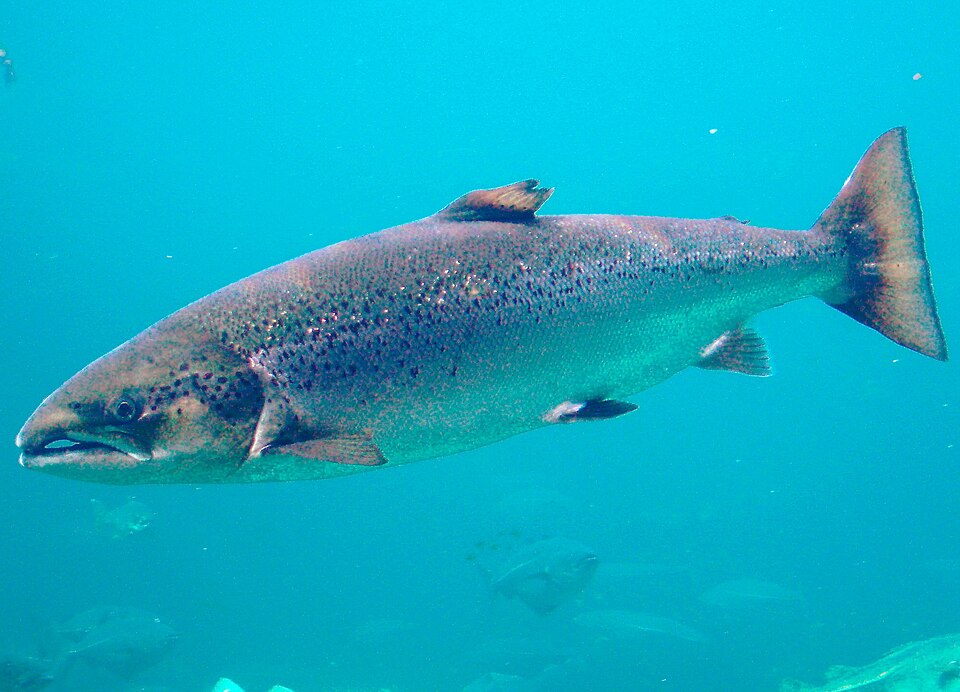
The Salmon has an elongated, hydrodynamic body covered in silvery scales, which turn red-brown when breeding. It has an adipose fin characteristic of salmonids, located between the dorsal fin and the caudal fin. Its jaws deform in breeding males, forming a hook called a “kype”. Coloring and morphology vary greatly depending on the life stage and the environment (sea or river).
Characteristics
Indicative values: they vary by subspecies, sex and region.
Habitat and distribution
The Salmon frequents two types of environments during its life: freshwater rivers and lakes with cool, oxygenated currents for reproduction and juvenile growth, and the cold marine waters of the North Atlantic for the adult growth phase. It likes clear, well-oxygenated waterways with gravelly bottoms suitable for spawning.
CURRENT RANGE
Atlantic Salmon occurs naturally in the rivers and coasts of the North Atlantic, in Europe (Norway, Scotland, Ireland, France) and in North America (Canada, northeastern United States). Farmed populations are distributed across many countries, including Norway, Chile and Scotland, the world's leading aquaculture producers. The species is absent in the natural state of Tunisian and Mediterranean waters.
Behaviour
Salmon is an anadromous fish, meaning it migrates from salt water to fresh water to reproduce. It is capable of covering long distances by going upstream and overcoming natural obstacles with powerful jumps. Outside of the breeding season, it generally lives in groups in the ocean. Its migratory behavior is guided by a highly developed olfactory sense allowing it to find its native river.
Reproduction
Reproduction takes place in fresh water, in fast-moving rivers with gravelly bottoms. The female digs a nest called a “spawning ground” where she lays her eggs, immediately fertilized by the male. After spawning, many individuals die of exhaustion, particularly in certain Pacific populations. The fry hatch after several weeks and spend one to two years in the river before migrating to the sea.
Peculiarities
The Salmon is able to find its native river thanks to a precise olfactory memory, after several years spent at sea. It can perform spectacular jumps to cross waterfalls or dams during its migration. Certain populations, particularly in the Pacific, systematically die after reproduction.
Threats and conservation
Wild populations of Atlantic Salmon are threatened by overfishing, degradation of river habitats, dams that block migrations, and climate change affecting river temperatures. Intensive aquaculture also poses health and genetic problems for neighboring wild populations. River conservation and restoration programs exist in several European countries.
Numbers and trends vary across sources and regions. See the IUCN assessment for the latest reference data.
Gallery
1 documented photographs.
References
Profile updated 28 August 2026 · Reviewed by the TunisieVet editorial team.
Comments (0)
No comments yet.
CONSERVATION STATUS
Least concern (LC)
IUCN source, latest published assessment.
Species health
Documented diseases for this species.
See the 8 diseases of this species Find a veterinarianThis information is provided for educational purposes only and is not a substitute for a veterinary consultation. If you have any concerns about your animal's health, consult a veterinarian.
To discover around: Salmon
Videos, facts, stories and records linked to this species.
Similar animals
Other species documented in Animalpedia.

TunisieVet in your pocket 📱🐾 Access your veterinary services wherever you are. [ Download the app ]
Learn more