
Presentation
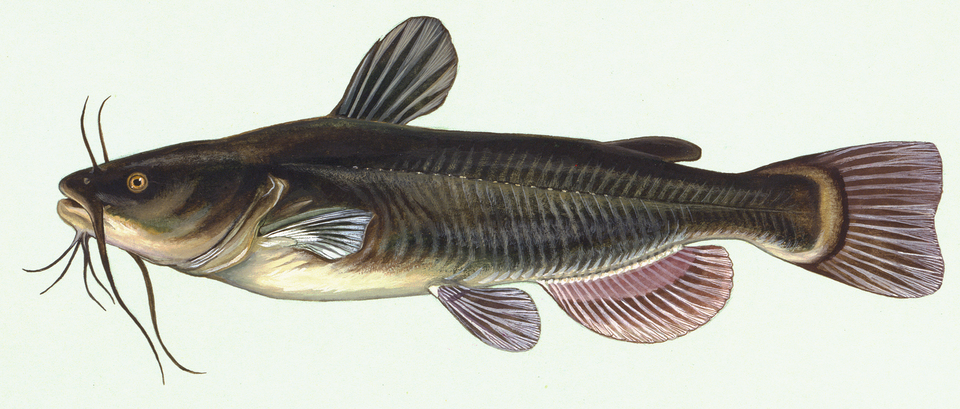
The Catfish is a freshwater fish belonging to the order Siluriformes, recognizable by its long sensory barbels arranged around the mouth. This group has many species throughout the world, including the European Catfish (Silurus glanis) and various introduced species in North Africa. Its body is generally scaleless, often elongated, with smooth, slimy skin. It lives mainly in rivers, lakes and calm areas rich in vegetation. In Tunisia, certain species have been introduced into reservoirs and waterways for recreational fishing.
The body is elongated, without scales, covered with protective mucous skin. The head is broad and flattened, equipped with several pairs of very sensitive tactile barbels. The dorsal and pectoral fins sometimes bear hard rays which can be slightly venomous in some species.
Characteristics
Indicative values: they vary by subspecies, sex and region.
Habitat and distribution
The Catfish frequents slow-moving rivers, lakes, canals and wetlands with muddy or sandy bottoms. It appreciates calm waters rich in aquatic vegetation offering hiding places and feeding areas. It tolerates a wide range of water qualities, including lightly polluted or oxygen-poor environments.
CURRENT RANGE
Catfish species are widely distributed across Europe, Asia, Africa and America, with great diversity in South America. Several species have been introduced outside their native range for fishing or aquaculture purposes. In Tunisia, certain populations come from introductions into dams and rivers.
Behaviour
It is an essentially nocturnal fish, hiding during the day in shelters, cavities or dense vegetation. It has a marked territorial behavior, particularly in large solitary individuals. Its highly developed chemical and tactile sensitivity allows it to locate its food even in very cloudy water.
Reproduction
Reproduction takes place in spring or summer, when water temperatures increase. The female lays her eggs on plant supports or in basic nests dug in the substrate. In some species, the male guards the eggs and fry until they hatch.
Peculiarities
Its barbels give it an exceptionally developed sense of taste and touch, distributed over the entire surface of its body. Some species can reach significant size and longevity, notably the weaned catfish in Europe. Its scaleless skin makes it particularly sensitive to certain chemical treatments used in aquaculture.
Threats and conservation
Water pollution and degradation of aquatic habitats pose threats to wild populations. Localized overfishing may affect some populations, although many species are also introduced and invasive in some ecosystems. The construction of dams modifies natural breeding habitats.
Numbers and trends vary across sources and regions. See the IUCN assessment for the latest reference data.
Gallery
1 documented photographs.
References
Profile updated 30 August 2026 · Reviewed by the TunisieVet editorial team.
Comments (0)
No comments yet.
CONSERVATION STATUS
Least concern (LC)
IUCN source, latest published assessment.
Species health
Documented diseases for this species.
See the 4 diseases of this species Find a veterinarianThis information is provided for educational purposes only and is not a substitute for a veterinary consultation. If you have any concerns about your animal's health, consult a veterinarian.
Similar animals
Other species documented in Animalpedia.

TunisieVet in your pocket 📱🐾 Access your veterinary services wherever you are. [ Download the app ]
Learn more