
Presentation
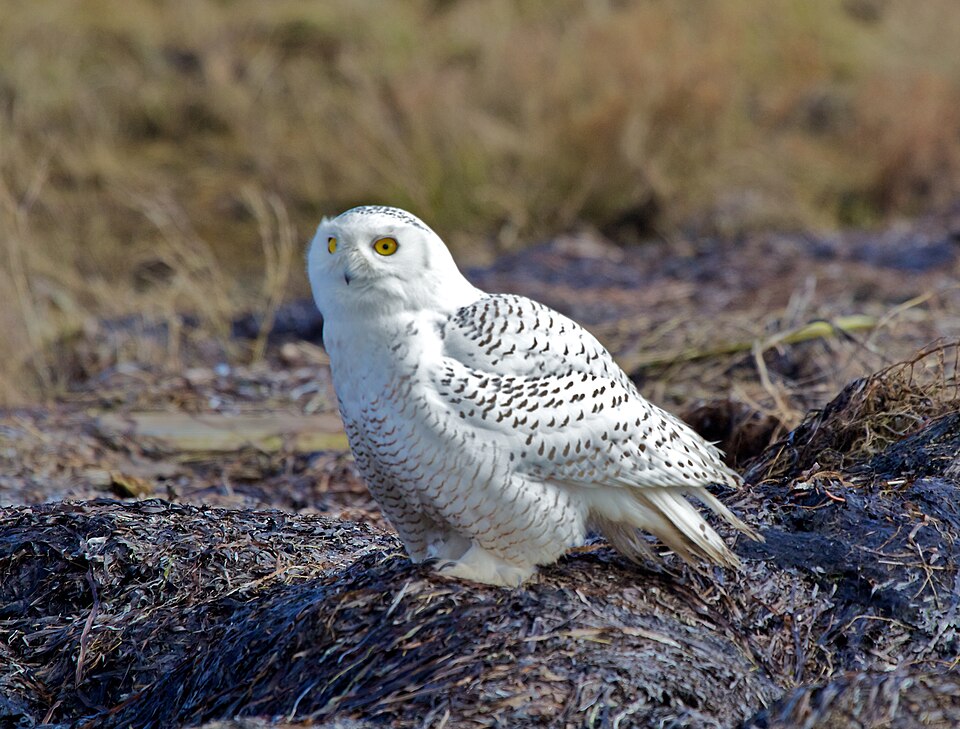
The Snowy owl is a large nocturnal and diurnal raptor native to Arctic regions. It is distinguished by its predominantly white plumage, more or less spotted with brown depending on age and sex, which offers it effective camouflage in the snowy tundra. Its bright yellow eyes and hooked black beak contrast with this light plumage. Unlike many other owls, it is active both day and night, an adaptation to the long Arctic summer days. It is one of the most emblematic raptor species in the polar zones of the northern hemisphere.
The Snowy owl has a massive body covered in thick insulating plumage, including on the legs and feet, which protects it from extreme cold. Males are almost entirely white as adults, while females retain more dark bars and spots. Its powerful claws and keen hearing make it a formidable hunter despite lacking the pronounced facial discs of other owls.
Characteristics
Indicative values: they vary by subspecies, sex and region.
Habitat and distribution
Snowy owl lives primarily in open, treeless arctic tundra. It also frequents meadows, coastal marshes and sometimes agricultural areas during its winter movements southwards. It generally avoids dense forest environments, preferring open spaces which allow it to spot its prey from a distance.
CURRENT RANGE
This species is present in the Arctic circumpolar regions of North America, northern Europe (Scandinavia, Russia) and northern Asia. In winter, some individuals migrate to more temperate latitudes in North America and Europe during years of food shortage. It does not occur naturally in Africa or the Mediterranean regions.
Behaviour
A generally solitary species outside the breeding season, the Snowy owl defends an extensive hunting territory. It is known for its irregular movements called invasions, when the scarcity of prey in the Arctic causes it to migrate further south than usual. Unlike most owls, it hunts actively in broad daylight, taking advantage of the continuous brightness of the Arctic summer.
Reproduction
The female lays between 3 and 11 eggs directly on the ground, in a shallow depression, the number varying depending on the abundance of available prey. Incubation lasts about a month and only the female incubates while the male hunts for the family. The young leave the nest on foot before they can even fly, a strategy that limits the risk of group predation.
Peculiarities
The Snowy owl is able to spot its prey under the snow thanks to its extremely developed hearing. It can remain motionless for long hours before swooping down on prey with remarkable precision. Its cultural popularity has been enhanced by its appearance in popular works of fiction, notably as a fictional animal companion.
Threats and conservation
Major threats include global warming, which is changing prey availability and tundra habitat. Collisions with human infrastructure and disruptions from industrial development in the Arctic are also growing risks. Natural fluctuations in lemming populations also greatly affect its reproductive success from year to year.
Numbers and trends vary across sources and regions. See the IUCN assessment for the latest reference data.
Gallery
1 documented photographs.
References
Profile updated 18 August 2026 · Reviewed by the TunisieVet editorial team.
Comments (0)
No comments yet.
CONSERVATION STATUS
Vulnerable (VU)
IUCN source, latest published assessment.
Species health
Documented diseases for this species.
See the 7 diseases of this species Find a veterinarianThis information is provided for educational purposes only and is not a substitute for a veterinary consultation. If you have any concerns about your animal's health, consult a veterinarian.
To discover around: Snowy owl
Videos, facts, stories and records linked to this species.
Similar animals
Other species documented in Animalpedia.

TunisieVet in your pocket 📱🐾 Access your veterinary services wherever you are. [ Download the app ]
Learn more