
Presentation
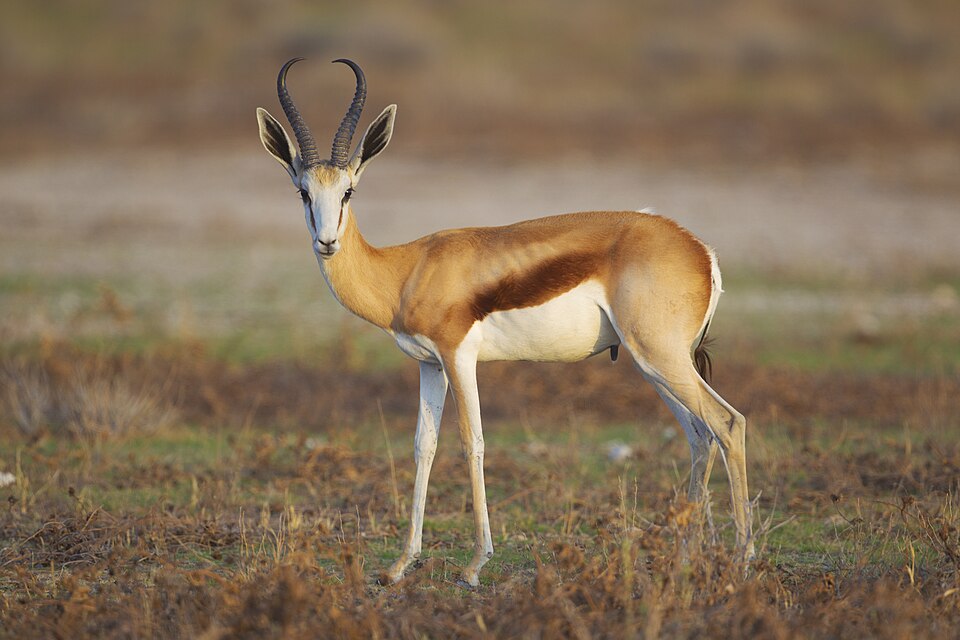
The Springbok (Antidorcas marsupialis) is a small antelope from southern Africa, famous for its spectacular leaps called “pronking”. It lives in herds in arid savannahs and semi-deserts, where it can reach high speeds to escape predators. This species is the national emblem of South Africa and appears on its coat of arms. Its reddish-brown coat contrasted with white and its dark lateral stripe make it an easily recognizable animal.
The Springbok has a slender body, slender legs and long, pointed ears. Both sexes have ringed horns curved backwards, shorter in females. A band of erectile white hairs fan out on the back during the characteristic jumps, exposing a skin gland. Its coat is fawn-brown on top, white under the belly, separated by a black stripe on the sides.
Characteristics
Indicative values: they vary by subspecies, sex and region.
Habitat and distribution
Springbok frequents open savannahs, arid steppes and semi-desert areas of southern Africa. It prefers flat terrain with good visibility to detect predators. It tolerates extreme climatic conditions with large thermal amplitudes.
CURRENT RANGE
The species occurs in southern and western Africa, including Namibia, Botswana and South Africa. It also occupies arid regions of the Kalahari and Karoo. Its natural distribution does not extend beyond the African continent.
Behaviour
The Springbok is a gregarious animal living in herds that can number from a few individuals to several hundred. It is renowned for “pronking”, a steep vertical jump used in particular to signal the presence of a predator. Active especially at dawn and dusk, it avoids the intense heat of the day. Males defend temporary territories during the breeding season.
Reproduction
The female gives birth to a single young after a gestation of approximately six months. Parturition generally occurs in the rainy season, when food resources are abundant. The young can get up and follow the herd shortly after birth. Sexual maturity is reached around one year in females.
Peculiarities
The Springbok owes its name to its ability to leap up to several meters in height, a behavior called “pronking” or “stotting”. It appears on the coat of arms and sports crest of South Africa, notably the national rugby team. Historically, it formed migratory herds of several hundred thousand individuals, which have now disappeared.
Threats and conservation
Populations of Springboks declined sharply in the 20th century due to intensive hunting and conversion of land to agricultural pastures. Land enclosure has fragmented habitats and prevented major historical migrations. However, the species remains abundant thanks to management programs on reserves and private farms.
Numbers and trends vary across sources and regions. See the IUCN assessment for the latest reference data.
Gallery
1 documented photographs.
References
Profile updated 21 August 2026 · Reviewed by the TunisieVet editorial team.
Comments (0)
No comments yet.
CONSERVATION STATUS
Least concern (LC)
IUCN source, latest published assessment.
Species health
Documented diseases for this species.
See the 8 diseases of this species Find a veterinarianThis information is provided for educational purposes only and is not a substitute for a veterinary consultation. If you have any concerns about your animal's health, consult a veterinarian.
Related species
To discover around: Springbok
Videos, facts, stories and records linked to this species.
RECORD
up to 3-4 m in height
The vertical jump champion among antelopes
Measured during pronking behavior used to escape predators.
Similar animals
Other species documented in Animalpedia.

TunisieVet in your pocket 📱🐾 Access your veterinary services wherever you are. [ Download the app ]
Learn more