
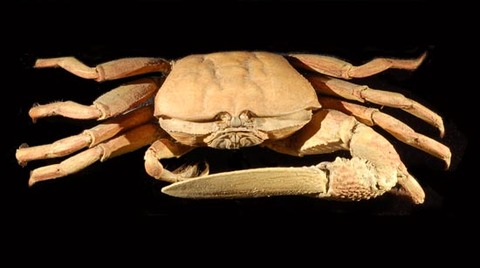
Presentation
The fiddler crab is a small decapod crustacean living on mudflats and sand-mud beaches in tropical and temperate intertidal zones. It owes its name to the oversized claw borne by the male, used for display and intimidation of rivals, which resembles a violinist holding an instrument. Females possess two small symmetrical claws adapted for feeding. This genus includes around one hundred species distributed along coastlines throughout the world, often gathered in dense colonies that dig burrows. It plays an important ecological role in the aeration and mixing of sediments in mangroves and estuaries.
The male is distinguished by one greatly enlarged claw that can represent half its body weight, while the other claw remains small. The carapace, trapezoid in shape, generally measures 2 to 3 cm wide and displays variable colours depending on the species, ranging from dull brown to bright blue. The eyes, borne on long mobile stalks, provide panoramic vision useful for detecting predators and other members of the species.
Characteristics
Indicative values: they vary by subspecies, sex and region.
Habitat and distribution
The fiddler crab inhabits mudflats, mangroves, and salt marshes in the intertidal zone, where it digs burrows in soft substrate. It tolerates large variations in salinity and temperature linked to tidal cycles. Some species also frequent estuary banks and sheltered sandy-muddy beaches.
CURRENT RANGE
The genus is found on tropical and subtropical coasts of the Americas, Africa, Asia, and Oceania, as well as on certain temperate coasts. It is particularly diverse along Atlantic and Indo-Pacific shorelines. In the Mediterranean, its presence remains marginal and restricted to a few coastal sites.
Behaviour
The species is diurnal and highly social, living in colonies sometimes composed of thousands of individuals on the same mudflat. Males wave their large claw in rhythmic movements to attract females and defend their burrow against rivals. Each individual digs and maintains a burrow that serves as refuge against predators, desiccation and rising tide.
Reproduction
After the male's courtship display, the female selects a mate and typically mates inside the burrow. She then carries her eggs under her abdomen for several weeks before releasing them into the water during high tide. The larvae, called zoea, undergo planktonic development before metamorphosing into benthic juveniles.
Peculiarities
The male's enlarged claw can regrow after accidental loss, but it then switches to the opposite side relative to the original. The movements of the large claw, resembling those of a bow, gave rise to the common name of the species. Colonies produce a faint soundscape related to claw scraping and synchronized movements during tidal cycles.
Threats and conservation
Degradation and loss of mangroves and coastal wetlands locally threaten some populations. Pollution of estuaries and coastal urbanization also reduce available habitats. Overall, the genus remains widely distributed and not threatened globally.
Numbers and trends vary across sources and regions. See the IUCN assessment for the latest reference data.
Gallery
1 documented photographs.
References
Profile updated 13 September 2026 · Reviewed by the TunisieVet editorial team.
Comments (0)
No comments yet.
CONSERVATION STATUS
Least concern (LC)
IUCN source, latest published assessment.
Species health
Documented diseases for this species.
Find a veterinarianThis information is provided for educational purposes only and is not a substitute for a veterinary consultation. If you have any concerns about your animal's health, consult a veterinarian.
To discover around: Fiddler Crab
Videos, facts, stories and records linked to this species.
Similar animals
Other species documented in Animalpedia.
