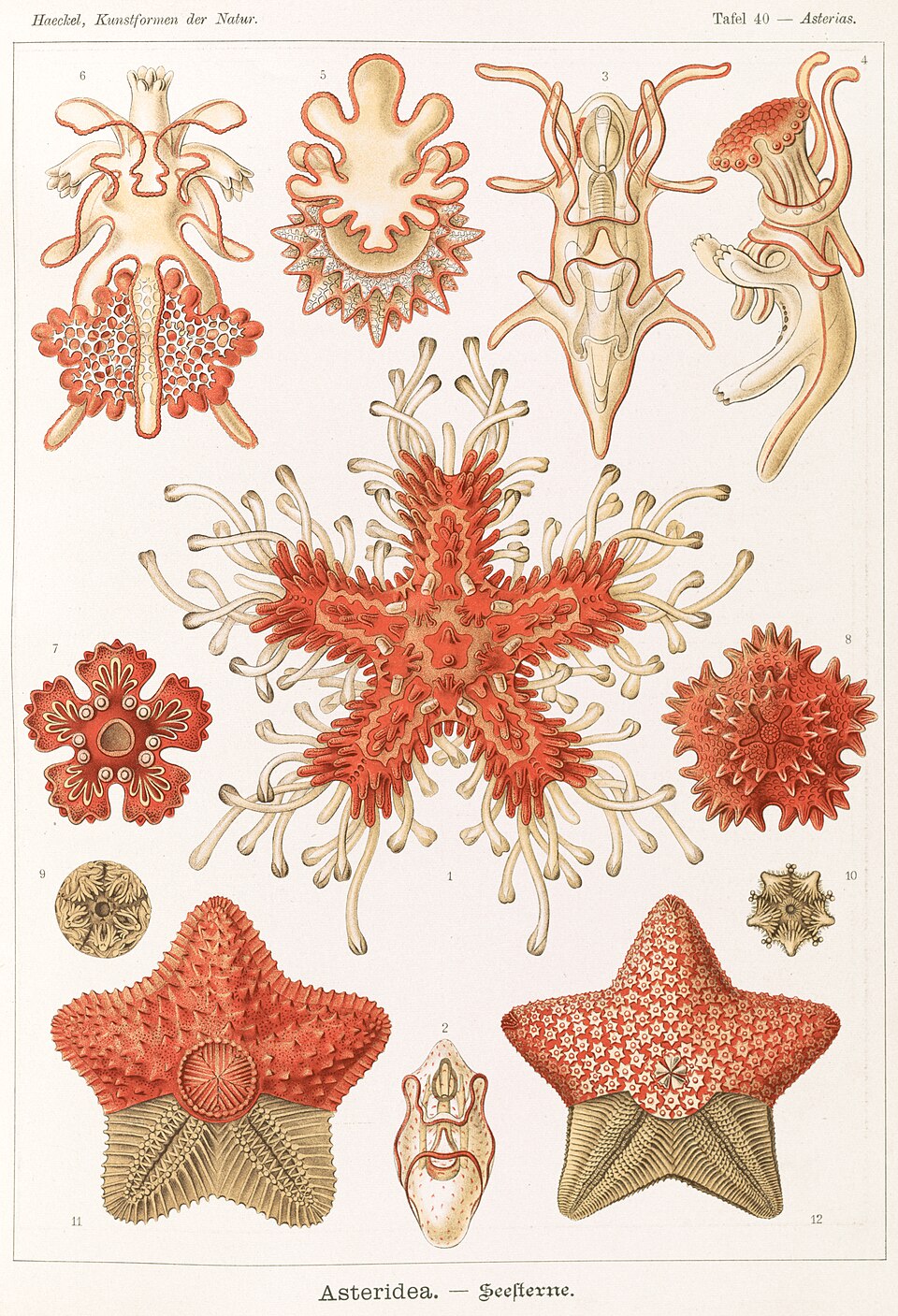
Presentation
The starfish is a marine invertebrate animal belonging to the class Asteroidea, characterized by a flattened, star-shaped body typically featuring five arms arranged around a central disc. It moves slowly across the seafloor using tiny tube feet located beneath each arm. Found in every ocean worldwide, from shallow coastal zones to great depths, it plays an important role in maintaining the balance of benthic ecosystems. Its skeleton consists of calcium plates linked together, providing a degree of rigidity while retaining flexibility. Some species possess remarkable regenerative abilities, capable of regrowing a lost arm or even reforming an entire individual from a single fragment. Thousands of starfish species exist, varying greatly in size and color.
The starfish body lacks a head and rigid internal skeleton, being formed of calcium plates called ossicles covered with spiny skin. It possesses a unique hydraulic system, the water-vascular system, which operates its tube feet used for movement and capturing prey. Its rudimentary eyes, located at the tip of each arm, perceive only light and darkness. The mouth is situated on the underside of the central disc and the anus on the upper surface in most species.
Characteristics
Indicative values: they vary by subspecies, sex and region.
Habitat and distribution
Starfish inhabit marine environments, from rocky and sandy coastal zones to the deepest ocean trenches. They are particularly fond of coral reefs, seagrass beds, and soft bottoms rich in prey. Their distribution spans a wide range of depths and temperatures depending on the species. They are often visible in intertidal zones at low tide.
CURRENT RANGE
Starfish are found in all the world's oceans, from the Arctic to the Antarctic, including the Mediterranean. Some species are endemic to specific regions while others have a very broad distribution. In Tunisia, several common species are found along the Mediterranean coast.
Behaviour
The starfish is a solitary and slow-moving animal, active mainly at night when hunting prey. It moves by using hydraulic pressure from its tube feet, allowing it to travel across various marine substrates. When threatened, some species can voluntarily detach an arm to escape a predator. It has no complex social behavior and interacts little with others of its kind except during reproduction.
Reproduction
Starfish typically reproduce sexually by releasing gametes into the water where fertilization occurs externally. The planktonic larvae that result develop while floating in the water before metamorphosing into benthic juveniles. Some species are also capable of asexual reproduction through regeneration or fission of the body. Sexual maturity is reached after several months to a few years depending on the species.
Peculiarities
Starfish have no blood in the classical sense: they use filtered seawater for their circulatory and locomotor systems. Their capacity for regeneration is among the most remarkable in the animal kingdom, with some species capable of reconstituting an entire individual from a single arm containing part of the central disc. They lack a centralized brain, their nervous system being organized as a diffuse network.
Threats and conservation
Starfish are affected by warming waters, marine pollution, and ocean acidification, which weaken their calcareous skeleton. Some populations have experienced episodes of mass mortality linked to diseases that are still poorly understood. Destruction of coastal habitats, particularly reefs and seagrass beds, also poses a threat to several species.
Numbers and trends vary across sources and regions. See the IUCN assessment for the latest reference data.
Gallery
1 documented photographs.
References
Profile updated 01 September 2026 · Reviewed by the TunisieVet editorial team.
Comments (0)
No comments yet.
CONSERVATION STATUS
Least concern (LC)
IUCN source, latest published assessment.
Species health
Documented diseases for this species.
This information is provided for educational purposes only and is not a substitute for a veterinary consultation. If you have any concerns about your animal's health, consult a veterinarian.
To discover around: Starfish
Videos, facts, stories and records linked to this species.
Similar animals
Other species documented in Animalpedia.

Be among the first to use our app. Sign up and get early Google Play access.
Discover