
Presentation
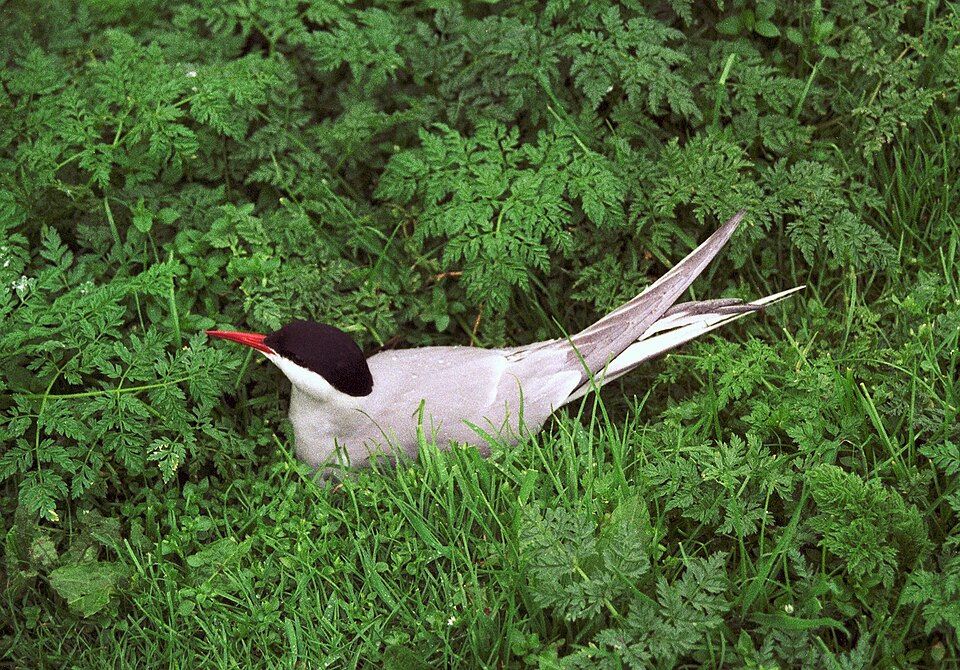
The Arctic Tern is a small migratory seabird renowned for undertaking the longest migration known in the animal kingdom, connecting the Arctic to the Antarctic each year. It has a slender body, thin pointed wings, a black cap, and an orange-red bill. Its pale grey and white plumage provides subtle camouflage above the water. It nests in colonies on northern coasts and islands during the boreal summer. Thanks to its seasonal movements, this species experiences two summers per year, a unique record in the animal world. It is not found in Tunisia, as its natural range remains limited to high latitudes and the oceans it crosses during migration.
The Arctic Tern measures approximately 13 to 15 inches long with a wingspan of 30 to 33 inches. It is distinguished by its forked tail, short red legs, and slender bill adapted for fishing. Its flight is agile and buoyant, allowing it to hover extensively above the water before diving on its prey.
Characteristics
Indicative values: they vary by subspecies, sex and region.
Habitat and distribution
This species frequents rocky coasts, islands, and Arctic tundra during the breeding season. For the rest of the year, it lives mainly at sea, far from land. It depends on waters rich in small fish for feeding during its travels.
CURRENT RANGE
The Arctic tern nests in the circumpolar regions of the Northern Hemisphere, notably in Greenland, Iceland, Scandinavia, Canada, and Siberia. It then migrates to Antarctic waters to spend the southern summer. This dual polar presence makes it one of the world's most travelled birds.
Behaviour
The Arctic Tern is a gregarious bird that nests in noisy colonies and aggressively defends its territory against predators, including humans. It is famous for its extremely long migratory flights, covering each year the equivalent of a round trip between Arctic and Antarctic. Outside the breeding season, it spends most of its life at sea or in flight.
Reproduction
The female typically lays one or two eggs in a simple shallow depression on bare ground, with minimal lining. Incubation lasts roughly three weeks and is shared by both parents. The young become able to fly after about a month, shortly before the start of their long migration southward.
Peculiarities
It holds the record for the longest known animal migration, sometimes covering more than 70,000 km per year between the two poles. Its longevity, combined with these journeys repeated each year, means an individual can travel the equivalent of several round trips to the Moon over the course of its lifetime.
Threats and conservation
The main threats include climate change, which alters the availability of marine prey, as well as predation of eggs and chicks by introduced mammals on certain islands. Marine pollution and human disturbance at nesting sites also pose risks.
Numbers and trends vary across sources and regions. See the IUCN assessment for the latest reference data.
Gallery
1 documented photographs.
References
Profile updated 08 September 2026 · Reviewed by the TunisieVet editorial team.
Comments (0)
No comments yet.
CONSERVATION STATUS
Least concern (LC)
IUCN source, latest published assessment.
Species health
Documented diseases for this species.
See the 4 diseases of this species Find a veterinarianThis information is provided for educational purposes only and is not a substitute for a veterinary consultation. If you have any concerns about your animal's health, consult a veterinarian.
To discover around: Arctic Tern
Videos, facts, stories and records linked to this species.
RECORD
up to 70,000 km per year
The longest animal migration
Distance covered during the annual round trip between the Arctic and Antarctic, measured b...
Similar animals
Other species documented in Animalpedia.

TunisieVet in your pocket 📱🐾 Access your veterinary services wherever you are. [ Download the app ]
Learn more