
Presentation
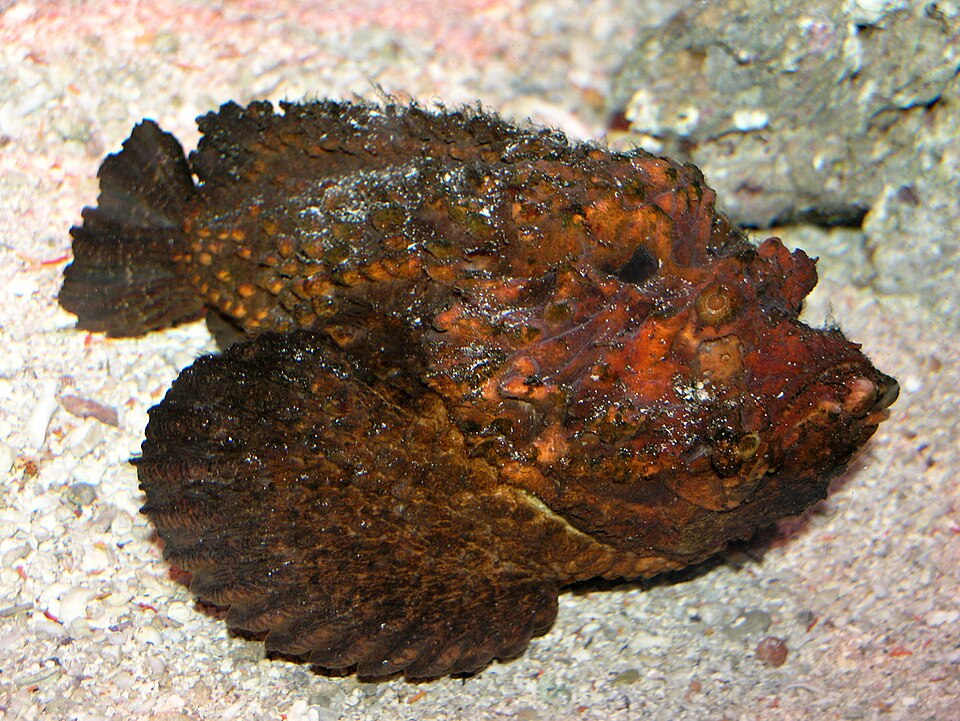
The Stonefish (Synanceia) is a venomous marine fish that lives hidden in sandy or rocky bottoms of tropical Indo-Pacific areas. Its massive, lumpy body perfectly imitates a stone covered in algae, making it almost invisible to predators and swimmers alike. It has thirteen erectile dorsal spines connected to venom glands, capable of inflicting an extremely painful sting. It is considered one of the most venomous fish known. Sedentary, it spends most of its time immobile, buried in the substrate, waiting for prey to pass by. It is not present in Tunisian waters, its distribution being limited to the Indo-Pacific.
Body stocky, warty and covered with protuberances imitating a rock or dead coral. Brown, gray or spotted coloring allowing almost perfect camouflage. Thirteen erect dorsal spines connected to venomous sacs, activated only in case of contact or threat.
Characteristics
Indicative values: they vary by subspecies, sex and region.
Habitat and distribution
It lives in shallow coastal waters, on sandy, muddy or rocky bottoms, often near coral reefs. It likes areas where it can hide among debris, algae or stones. It is also found occasionally in estuarine areas and mangroves.
CURRENT RANGE
Stonefish is found in tropical and subtropical waters of the Indo-Pacific, from the East African coast to the coasts of Australia and the Pacific Islands. It does not exist in the Mediterranean nor in Tunisian waters.
Behaviour
Solitary and extremely sedentary, it remains buried or immobile most of the day. Its camouflage is its main survival strategy, both for hunting and for escaping predators. It does not leak when in contact with an intruder, which explains the frequency of accidental bites among swimmers walking on it.
Reproduction
Reproduction takes place by spawning in open water, the eggs and larvae being pelagic before reaching the coastal bottom. Little detailed information exists on its reproductive behavior in the natural environment. Sexual maturity and reproductive frequency remain poorly documented.
Peculiarities
Its venom, injected through the dorsal spines, causes intense pain that can last several hours and require urgent medical attention. Its camouflage is such that it is often confused with a stone or dead coral, even by experienced divers. It can survive several hours out of water thanks to its high tolerance in the open air.
Threats and conservation
The species is not considered globally threatened. Coral reef degradation and coastal pollution can locally affect its habitats. It is not the subject of significant targeted fishing.
Numbers and trends vary across sources and regions. See the IUCN assessment for the latest reference data.
Gallery
1 documented photographs.
References
Profile updated 30 August 2026 · Reviewed by the TunisieVet editorial team.
Comments (0)
No comments yet.
CONSERVATION STATUS
Least concern (LC)
IUCN source, latest published assessment.
Species health
Documented diseases for this species.
See the 4 diseases of this species Find a veterinarianThis information is provided for educational purposes only and is not a substitute for a veterinary consultation. If you have any concerns about your animal's health, consult a veterinarian.
To discover around: Stonefish
Videos, facts, stories and records linked to this species.
RECORD
Neurotoxic and myotoxic venom among the most powerful in the fish kingdom
The most poisonous fish
Measured by the potency of venom injected through the dorsal spines during accidental cont...
Similar animals
Other species documented in Animalpedia.

TunisieVet in your pocket 📱🐾 Access your veterinary services wherever you are. [ Download the app ]
Learn more