
Presentation
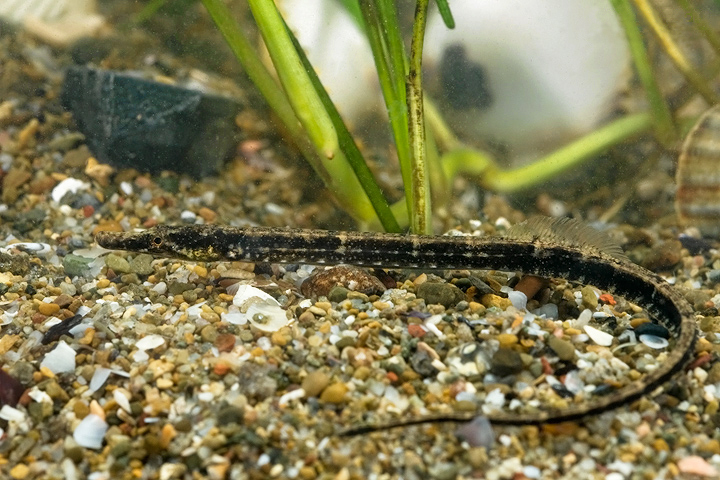
The Pipefish is an elongated marine fish, belonging to the same family as seahorses. Its body is protected by external bony rings rather than conventional scales. It moves slowly thanks to an undulating dorsal fin, often in a horizontal position in seagrass beds. Its filiform shape and variable color allow it to blend in with aquatic plants. It is frequently found in the Mediterranean, particularly on the Tunisian coasts.
The body of the Pipefish is very elongated and rigid, covered in ringed bony plates. Its head ends in a tubular snout adapted to sucking in prey. It does not have pelvic fins and its caudal fin is reduced or absent depending on the species.
Characteristics
Indicative values: they vary by subspecies, sex and region.
Habitat and distribution
The Pipefish lives in posidonia beds, shallow coastal areas and lagoons with abundant vegetation. It likes calm waters rich in algae and aquatic plants, which provide it with effective camouflage. It is found both in the Mediterranean and in estuarine areas.
CURRENT RANGE
The genus Syngnathus is widely distributed along the European, Mediterranean and North African coasts. It is present in the northeast Atlantic as well as in the Mediterranean Sea, including on the Tunisian coast. Its distribution mainly follows the presence of coastal seagrass beds.
Behaviour
It is a discreet and not very mobile animal, which spends most of its time clinging to seagrass beds thanks to its prehensile tail. It moves in a vertical or horizontal position depending on the species, by slow undulations of its dorsal fin. Its camouflage constitutes its main defense strategy against predators.
Reproduction
As in seahorses, Pipefish reproduction involves incubation of eggs by the male. The female lays the eggs in a pouch or on a specialized ventral area of the male, which ensures their protection until hatching. Juveniles are autonomous from birth.
Peculiarities
Its close relationship with the seahorse, sharing the family Syngnathidae, makes it a notable case of reproductive role reversal, with the male carrying the eggs. Its body armored with bony rings is an original defensive adaptation among fish.
Threats and conservation
The degradation of Posidonia meadows, particularly through coastal pollution and boat anchoring, threatens its natural habitat. Accidental fishing and the destruction of coastal areas can also affect certain local populations.
Numbers and trends vary across sources and regions. See the IUCN assessment for the latest reference data.
Gallery
1 documented photographs.
References
Profile updated 31 August 2026 · Reviewed by the TunisieVet editorial team.
Comments (0)
No comments yet.
CONSERVATION STATUS
Least concern (LC)
IUCN source, latest published assessment.
Species health
Documented diseases for this species.
Find a veterinarianThis information is provided for educational purposes only and is not a substitute for a veterinary consultation. If you have any concerns about your animal's health, consult a veterinarian.
Similar animals
Other species documented in Animalpedia.

TunisieVet in your pocket 📱🐾 Access your veterinary services wherever you are. [ Download the app ]
Learn more