
Presentation
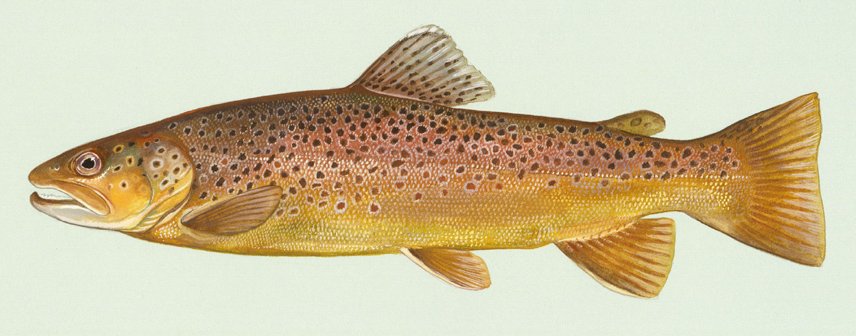
The Trout is a freshwater fish belonging to the Salmonidae family, appreciated for its meat and sport fishing. Its fusiform body is covered with small scales and has a variable coat, often spotted with black, red or orange dots ringed with pale. It lives preferentially in the fresh, clear and well-oxygenated waters of rivers, streams and mountain lakes. Several forms exist, including the sedentary Trout fario and the migratory sea Trout. The species is widely raised in fish farming for human consumption. It is also introduced in many countries for recreational fishing.
The body is elongated and slightly laterally compressed, adapted for swimming in running water. The coloring varies from brown-green to silvery gray depending on the environment and the subspecies, with characteristic spots on the sides. An adipose fin, typical of salmonids, is present between the dorsal and caudal fins.
Characteristics
Indicative values: they vary by subspecies, sex and region.
Habitat and distribution
Trout frequents rivers, torrents and lakes with cold, clear water rich in oxygen, often in mountain or foothill areas. It likes gravel or pebble bottoms conducive to reproduction. Certain migratory forms, such as the sea Trout, alternate between fresh water and coastal environments.
CURRENT RANGE
The species is native to Europe, West Asia and North Africa, where it inhabits cool waterways. It has been voluntarily introduced to many parts of the world, including North and South America, Oceania and southern Africa, for fishing purposes. These introductions have sometimes had a negative impact on local aquatic fauna.
Behaviour
The Trout is a territorial fish that defends a hunting area against its peers, particularly during the breeding season. It is rather solitary and often lies in wait near currents to capture its prey. Some populations migrate between fresh water and the sea, or between breeding areas and feeding areas.
Reproduction
Reproduction takes place in fall or winter, when the female digs a nest called a spawning ground in the gravel of a watercourse. She lays her eggs there which are then fertilized by the male. The fry hatch after several weeks and first feed on the reserves of their yolk sac before hunting on their own.
Peculiarities
The Trout is capable of detecting very small variations in current and water oxygenation, which guides its choice of habitat. Its spotted coat serves as effective camouflage among the gravel and reflections of the water. Some populations change color and behavior during migration to the sea.
Threats and conservation
The pollution of waterways, the degradation of habitats and the construction of dams seriously disrupt wild populations. Global warming, by increasing water temperature, also reduces areas favorable to the species. Localized overfishing can also affect certain natural populations.
Numbers and trends vary across sources and regions. See the IUCN assessment for the latest reference data.
Gallery
1 documented photographs.
References
Profile updated 28 August 2026 · Reviewed by the TunisieVet editorial team.
Comments (0)
No comments yet.
CONSERVATION STATUS
Least concern (LC)
IUCN source, latest published assessment.
Species health
Documented diseases for this species.
This information is provided for educational purposes only and is not a substitute for a veterinary consultation. If you have any concerns about your animal's health, consult a veterinarian.
Similar animals
Other species documented in Animalpedia.

TunisieVet in your pocket 📱🐾 Access your veterinary services wherever you are. [ Download the app ]
Learn more