
Presentation
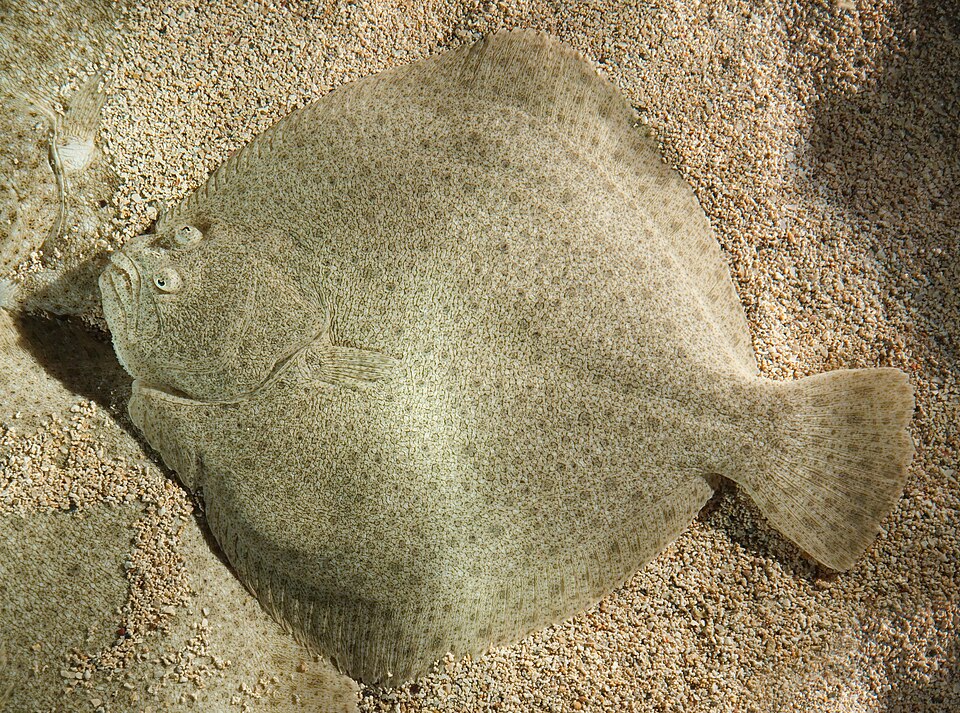
The Turbot (Scophthalmus maximus) is a marine flatfish belonging to the family Scophthalmidae. It lives on the sandy or gravelly bottoms of the continental shelf, where its flattened shape and mimic coloring make it difficult to spot. The two eyes are located on the left side of the body, the result of a larval metamorphosis characteristic of flatfish. A prized species in fishing and aquaculture, Turbot is appreciated for the quality of its flesh. It mainly frequents the northeast Atlantic, the English Channel and the Mediterranean Sea.
The body is laterally flattened, almost circular in shape, lacking visible scales but covered with bony tubercles. Dorsal coloring varies from greenish-brown to sandy, with dark spots providing effective camouflage; the underside is white. Both eyes are grouped together on the left side of the body in adults. The mouth is wide and lined with small teeth.
Characteristics
Indicative values: they vary by subspecies, sex and region.
Habitat and distribution
The Turbot lives on the sandy, gravelly or muddy bottoms of the coast and the continental shelf, generally between a few meters and a hundred meters deep. It favors coastal waters, estuaries and areas close to river mouths. Juveniles often frequent shallower waters than adults.
CURRENT RANGE
The species is distributed in the northeast Atlantic, from Norway to Morocco, as well as in the North Sea, the English Channel, the Baltic and the Mediterranean. It is absent from tropical waters and the Pacific and Indian oceans. Its presence is well documented along European coasts.
Behaviour
A solitary and sedentary fish, the Turbot spends much of its time semi-buried in soft substrate. It is active mainly at dusk and at night, during which it hunts. Its camouflage also allows it to escape its predators by remaining immobile.
Reproduction
Reproduction takes place in spring and summer, in shallow coastal waters. Females lay large numbers of pelagic eggs which drift with the current before hatching. The larvae undergo a progressive metamorphosis during which an eye migrates to the left side of the body, accompanying the transition to a benthic life.
Peculiarities
Eye migration during larval development is a striking feature of flatfish like Turbot. Its ability to camouflage, by slightly modifying its color depending on the substrate, is particularly developed. It is also a flagship species of European marine aquaculture.
Threats and conservation
Overfishing has put significant pressure on some wild populations, particularly in the North Sea and the Baltic. The degradation of coastal habitats, used as nurseries, constitutes an additional threat. The rise of aquaculture has, however, reduced pressure on wild stocks in several regions.
Numbers and trends vary across sources and regions. See the IUCN assessment for the latest reference data.
Gallery
1 documented photographs.
References
Profile updated 29 August 2026 · Reviewed by the TunisieVet editorial team.
Comments (0)
No comments yet.
CONSERVATION STATUS
Least concern (LC)
IUCN source, latest published assessment.
Species health
Documented diseases for this species.
See the 4 diseases of this species Find a veterinarianThis information is provided for educational purposes only and is not a substitute for a veterinary consultation. If you have any concerns about your animal's health, consult a veterinarian.
Similar animals
Other species documented in Animalpedia.

TunisieVet in your pocket 📱🐾 Access your veterinary services wherever you are. [ Download the app ]
Learn more