
Presentation
The Desert monitor is a large predatory lizard adapted to the arid environments of North Africa and Central Asia. With its grayish skin and robust morphology, it embodies one of the most impressive species of monitor lizards in the Palearctic.
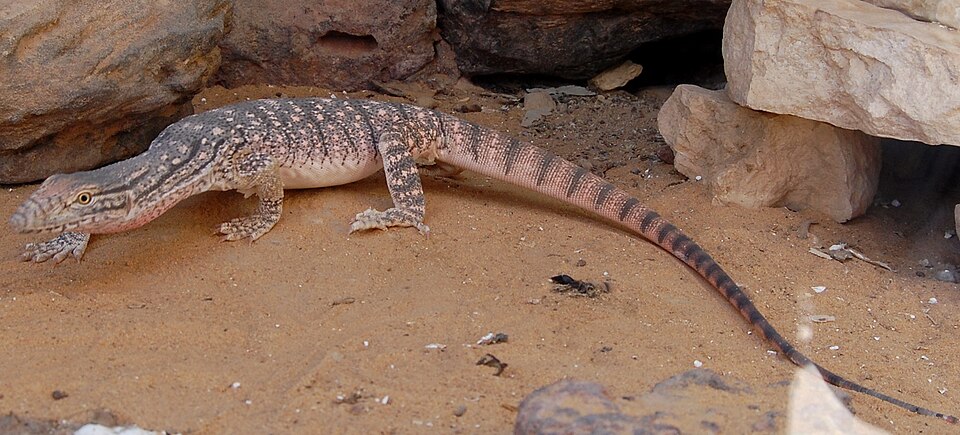
Powerful and elongated body, flattened head, long and muscular tail. Grayish or brownish skin with a vermiculated pattern of lighter shades. Eyes placed laterally, nostrils located near the tip of the snout. Short, vigorous limbs with sharp claws for digging.
Characteristics
Indicative values: they vary by subspecies, sex and region.
Habitat and distribution
Arid and semi-arid environments: deserts, steppes, rocky and sandy areas with sparse vegetation. Prefers areas offering digging possibilities and natural shelters.
CURRENT RANGE
Distributed in North Africa (Morocco, Algeria, Tunisia, Libya, Egypt) and South-West Asia (Middle East to Pakistan). Discontinuous distribution area following suitable desert environments.
Behaviour
Mainly diurnal and burrowing species, digging burrows in sand and earth. Territorial and solitary outside the breeding season. Excellent digestion capable of storing energy during periods of scarcity.
Reproduction
Oviparous: mating in spring, laying of 4 to 30 eggs in summer in burrows or protected cavities. Natural incubation of 4 to 5 months depending on environmental temperature.
Peculiarities
Exceptionally resistant to dehydration thanks to waterproof skin and highly efficient kidneys. Able to go several months without eating by drawing on its adipose reserves. Communicates by whistling and throat puffing.
Threats and conservation
Currently stable species. Although locally captured for the pet trade and hunted for meat, these pressures remain moderate and the species maintains viable populations.
Numbers and trends vary across sources and regions. See the IUCN assessment for the latest reference data.
Gallery
1 documented photographs.
References
UICN — Liste rouge des espèces menacées
Profile updated 01 September 2026 · Reviewed by the TunisieVet editorial team.
Comments (0)
No comments yet.
CONSERVATION STATUS
Least concern (LC)
IUCN source, latest published assessment.
Species health
Documented diseases for this species.
This information is provided for educational purposes only and is not a substitute for a veterinary consultation. If you have any concerns about your animal's health, consult a veterinarian.
To discover around: Desert monitor
Videos, facts, stories and records linked to this species.
Similar animals
Other species documented in Animalpedia.

TunisieVet in your pocket 📱🐾 Access your veterinary services wherever you are. [ Download the app ]
Learn more